

134
Benthic Microflora, Periphyton and Plant Associations
Table 4.5. Generalized data on levels of gross photosynthesis (P) and respiration rates
(M) of microphytobenthic and microbial communities of soft' reef sediments by measurements employing different methods
Sites
Method a P
M
PIM
Author
(average)
The Phantom bank,
rwr
0.055
0.26
0.2
Propp et at.
Timor Sea
(1983)
Heron I., GBR
rwr
0.26
0.32
0.8
Propp et at.
(1983)
Heron I., GBR
bod
0.57
0.64
0.9
Sorokin (1984b)
One Tree I., GBR
enc
0.90
1.40
0.6
Kinsey (1978)
Takapoto atoll, Tuamotu bod
1.0-3.2
Sournia (1976b)
Sinton atoll, South China enc
0.45-0.92 0.42-0.59 1.4
Original data
Sea
Scott reefs, Indian Ocean bod
1.58-2.16 1.28-3.12 0.8
Sorokin (1986)
Majuro atoll, Marshalls
C l4 +bod 0.40-2.22 0.28-3.96 0.6
Sorokin (1978b)
Nosy Be, Madagascar
C I4
0.23-0.39 -
Plante-Cuny
(1973)
Kaneohe Bay, Hawaii
C4+bod 0.08-0.21 0.68-1.90 0.1
Sorokin (1973c)
Central Vietnam
enc
0.06-0.36 0.46-0.68 0.4
Original data
Same site
bod
0.50-1.70 0.52-1.70 1.0
Original data
a C I4 _ radiocarbon method; for other methods see Table 4.3; P and M values are given as
gCm- 2 day-l.
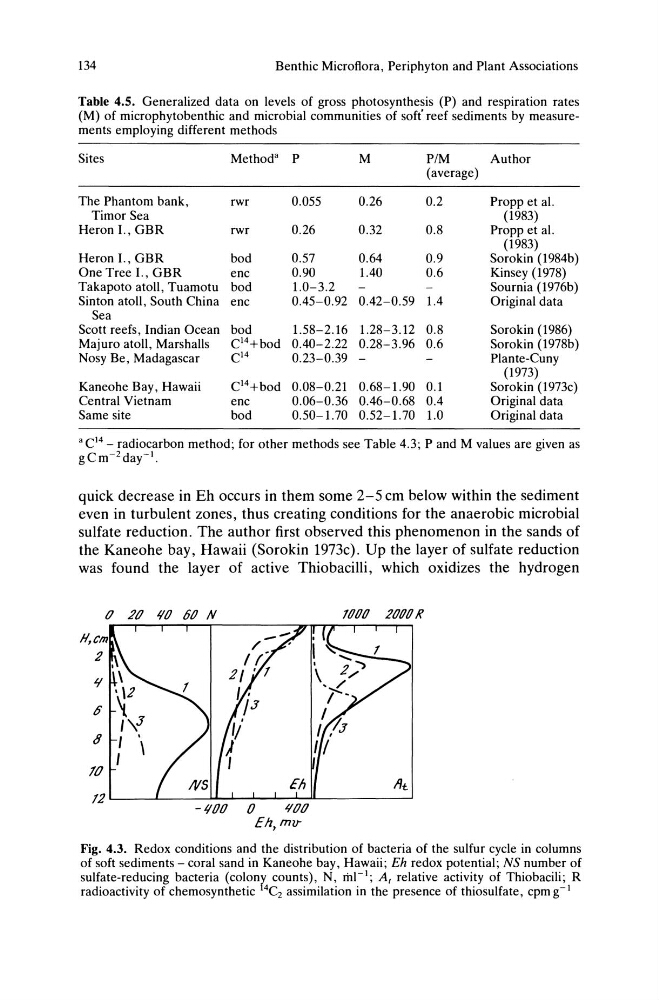
quick decrease in Eh occurs in them some 2-5 cm below within the sediment
even in turbulent zones, thus creating conditions for the anaerobic microbial
sulfate reduction. The author first observed this phenomenon in the sands of
the Kaneohe bay, Hawaii (Sorokin 1973c). Up the layer of sulfate reduction
was found the layer of active Thiobacilli, which oxidizes the hydrogen
o 20 '10 60 N
lDDD 2DDD R
8
117
- 'IDD
0
'100
Eh,mlr
Fig. 4.3. Redox conditions and the distribution of bacteria of the sulfur cycle in columns
of soft sediments - coral sand in Kaneohe bay, Hawaii; Eh redox potential; NS number of
sulfate-r~~ucing bacteria (col~m(, count~),. N,. mI.-I; AI relative activi.ty of Thiobacili; R
radIOactivity of chemosynthetic 4C2 assimilatIOn III the presence of thIOsulfate, cpm g-I
Benthic Microflora, Periphyton and Plant Associations
Table 4.5. Generalized data on levels of gross photosynthesis (P) and respiration rates
(M) of microphytobenthic and microbial communities of soft' reef sediments by measurements employing different methods
Sites
Method a P
M
PIM
Author
(average)
The Phantom bank,
rwr
0.055
0.26
0.2
Propp et at.
Timor Sea
(1983)
Heron I., GBR
rwr
0.26
0.32
0.8
Propp et at.
(1983)
Heron I., GBR
bod
0.57
0.64
0.9
Sorokin (1984b)
One Tree I., GBR
enc
0.90
1.40
0.6
Kinsey (1978)
Takapoto atoll, Tuamotu bod
1.0-3.2
Sournia (1976b)
Sinton atoll, South China enc
0.45-0.92 0.42-0.59 1.4
Original data
Sea
Scott reefs, Indian Ocean bod
1.58-2.16 1.28-3.12 0.8
Sorokin (1986)
Majuro atoll, Marshalls
C l4 +bod 0.40-2.22 0.28-3.96 0.6
Sorokin (1978b)
Nosy Be, Madagascar
C I4
0.23-0.39 -
Plante-Cuny
(1973)
Kaneohe Bay, Hawaii
C4+bod 0.08-0.21 0.68-1.90 0.1
Sorokin (1973c)
Central Vietnam
enc
0.06-0.36 0.46-0.68 0.4
Original data
Same site
bod
0.50-1.70 0.52-1.70 1.0
Original data
a C I4 _ radiocarbon method; for other methods see Table 4.3; P and M values are given as
gCm- 2 day-l.
quick decrease in Eh occurs in them some 2-5 cm below within the sediment
even in turbulent zones, thus creating conditions for the anaerobic microbial
sulfate reduction. The author first observed this phenomenon in the sands of
the Kaneohe bay, Hawaii (Sorokin 1973c). Up the layer of sulfate reduction
was found the layer of active Thiobacilli, which oxidizes the hydrogen
o 20 '10 60 N
lDDD 2DDD R
8
117
- 'IDD
0
'100
Eh,mlr
Fig. 4.3. Redox conditions and the distribution of bacteria of the sulfur cycle in columns
of soft sediments - coral sand in Kaneohe bay, Hawaii; Eh redox potential; NS number of
sulfate-r~~ucing bacteria (col~m(, count~),. N,. mI.-I; AI relative activi.ty of Thiobacili; R
radIOactivity of chemosynthetic 4C2 assimilatIOn III the presence of thIOsulfate, cpm g-I