

128
Benthic Microfiora, Periphyton and Plant Associations
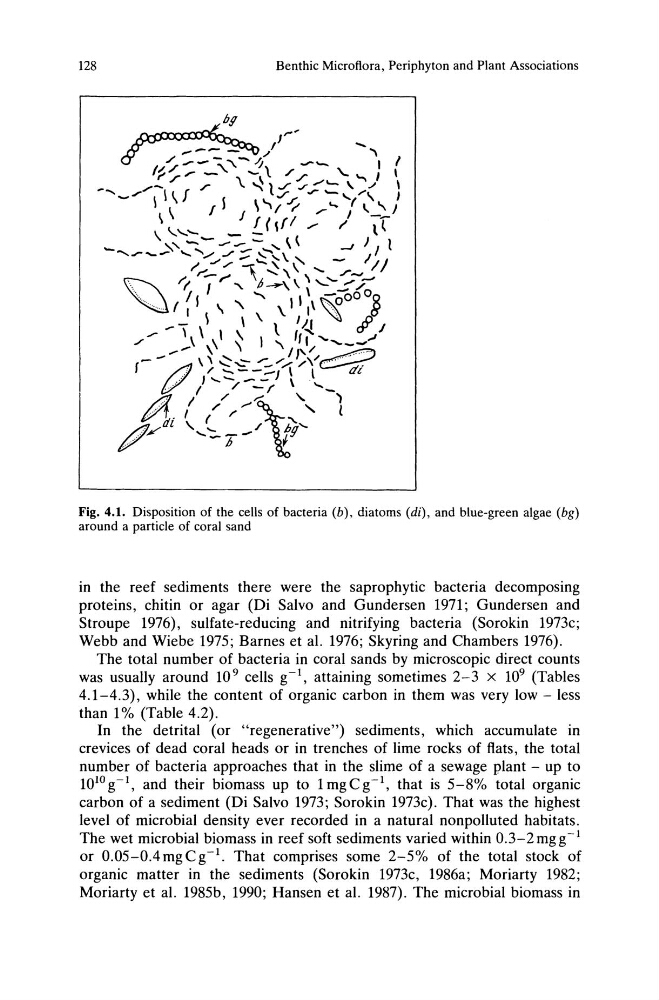
Fig. 4.1. Disposition of the cells of bacteria (b), diatoms (di), and blue-green algae (bg)
around a particle of coral sand
in the reef sediments there were the saprophytic bacteria decomposing
proteins, chitin or agar (Di Salvo and Gundersen 1971; Gundersen and
Stroupe 1976), sulfate-reducing and nitrifying bacteria (Sorokin 1973c;
Webb and Wiebe 1975; Barnes et al. 1976; Skyring and Chambers 1976).
The total number of bacteria in coral sands by microscopic direct counts
was usually around 10 9 cells g-r, attaining sometimes 2-3 x 10 9 (Tables
4.1-4.3), while the content of organic carbon in them was very low - less
than 1 % (Table 4.2).
In the detrital (or "regenerative") sediments, which accumulate in
crevices of dead coral heads or in trenches of lime rocks of flats, the total
number of bacteria approaches that in the slime of a sewage plant - up to
1O lO g- l , and their biomass up to 1mgCg- 1 , that is 5-8% total organic
carbon of a sediment (Di Salvo 1973; Sorokin 1973c). That was the highest
level of microbial density ever recorded in a natural nonpolluted habitats.
The wet microbial biomass in reef soft sediments varied within 0.3-2mgg- 1
or 0.05-0.4mgCg- 1 . That comprises some 2-5% of the total stock of
organic matter in the sediments (Sorokin 1973c, 1986a; Moriarty 1982;
Moriarty et al. 1985b, 1990; Hansen et al. 1987). The microbial biomass in
Benthic Microfiora, Periphyton and Plant Associations
Fig. 4.1. Disposition of the cells of bacteria (b), diatoms (di), and blue-green algae (bg)
around a particle of coral sand
in the reef sediments there were the saprophytic bacteria decomposing
proteins, chitin or agar (Di Salvo and Gundersen 1971; Gundersen and
Stroupe 1976), sulfate-reducing and nitrifying bacteria (Sorokin 1973c;
Webb and Wiebe 1975; Barnes et al. 1976; Skyring and Chambers 1976).
The total number of bacteria in coral sands by microscopic direct counts
was usually around 10 9 cells g-r, attaining sometimes 2-3 x 10 9 (Tables
4.1-4.3), while the content of organic carbon in them was very low - less
than 1 % (Table 4.2).
In the detrital (or "regenerative") sediments, which accumulate in
crevices of dead coral heads or in trenches of lime rocks of flats, the total
number of bacteria approaches that in the slime of a sewage plant - up to
1O lO g- l , and their biomass up to 1mgCg- 1 , that is 5-8% total organic
carbon of a sediment (Di Salvo 1973; Sorokin 1973c). That was the highest
level of microbial density ever recorded in a natural nonpolluted habitats.
The wet microbial biomass in reef soft sediments varied within 0.3-2mgg- 1
or 0.05-0.4mgCg- 1 . That comprises some 2-5% of the total stock of
organic matter in the sediments (Sorokin 1973c, 1986a; Moriarty 1982;
Moriarty et al. 1985b, 1990; Hansen et al. 1987). The microbial biomass in