

Zooplankton
121
The multicellular microzooplankton includes mostly the small larvae of
reef animals, like early nauplii of copepods, early veligers, rotifers, and
juvenile Oicopleura, which pass through the ordinary plankton nets and the
quantification of which needs special methodology.
The first attempt at quantification of the reef microzooplankton was made
in the net samples (Marshall 1933). Later, the same was done by Sammarco
and Cranshaw (1984). They counted large tintinnids and nauplii and found
their biomass negligible, which was far from reality. In fact, it could be
supposed to be high, when one took into account the abundance of bacteria,
detritus and microalgae as potential food for organisms in the microzooplankton. Counting them with the use of special methodology finally confirmed this statement (Sorokin and Tyapkin 1984; Landry et al. 1984;
Kopylov 1985; Moiseev 1985; Le Borgne et al. 1989; Blanchot et al. 1989).
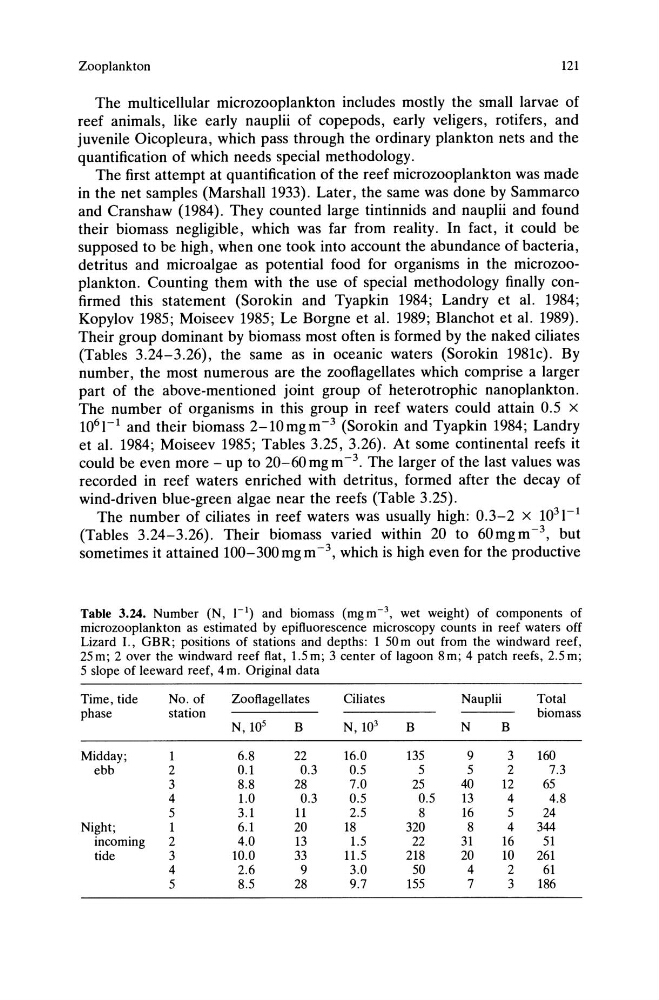
Their group dominant by biomass most often is formed by the naked ciliates
(Tables 3.24-3.26), the same as in oceanic waters (Sorokin 1981c). By
number, the most numerous are the zoo flagellates which comprise a larger
part of the above-mentioned joint group of heterotrophic nanoplankton.
The number of organisms in this group in reef waters could attain 0.5 x
10 6 1- 1 and their biomass 2-lOmgm- 3 (Sorokin and Tyapkin 1984; Landry
et al. 1984; Moiseev 1985; Tables 3.25, 3.26). At some continental reefs it
could be even more - up to 20-60mgm- 3 . The larger of the last values was
recorded in reef waters enriched with detritus, formed after the decay of
wind-driven blue-green algae near the reefs (Table 3.25).
The number of ciliates in reef waters was usually high: 0.3-2 x 10 3 1- 1
(Tables 3.24-3.26). Their biomass varied within 20 to 60mgm- 3 , but
sometimes it attained 100-300mgm- 3 , which is high even for the productive
Table 3.24. Number (N, 1-1) and biomass (mgm- 3 , wet weight) of components of
microzooplankton as estimated by epifluorescence microscopy counts in reef waters off
Lizard I., GBR; positions of stations and depths: 1 50 m out from the windward reef,
25 m; 2 over the windward reef flat, 1.5 m; 3 center of lagoon 8 m; 4 patch reefs, 2.5 m;
5 slope of leeward reef, 4 m. Original data
Time, tide
No. of
Zooflagellates
Ciliates
Nauplii
Total
phase
station
biomass
N,10 5
B
N,10 3
B
N
B
Midday;
1
6.8
22
16.0
135
9
3
160
ebb
2
0.1
0.3
0.5
5
5
2
7.3
3
8.8
28
7.0
25
40
12
65
4
1.0
0.3
0.5
0.5
13
4
4.8
5
3.1
11
2.5
8
16
5
24
Night;
1
6.1
20
18
320
8
4
344
incoming
2
4.0
13
1.5
22
31
16
51
tide
3
10.0
33
11.5
218
20
10
261
4
2.6
9
3.0
50
4
2
61
5
8.5
28
9.7
155
7
3
186
121
The multicellular microzooplankton includes mostly the small larvae of
reef animals, like early nauplii of copepods, early veligers, rotifers, and
juvenile Oicopleura, which pass through the ordinary plankton nets and the
quantification of which needs special methodology.
The first attempt at quantification of the reef microzooplankton was made
in the net samples (Marshall 1933). Later, the same was done by Sammarco
and Cranshaw (1984). They counted large tintinnids and nauplii and found
their biomass negligible, which was far from reality. In fact, it could be
supposed to be high, when one took into account the abundance of bacteria,
detritus and microalgae as potential food for organisms in the microzooplankton. Counting them with the use of special methodology finally confirmed this statement (Sorokin and Tyapkin 1984; Landry et al. 1984;
Kopylov 1985; Moiseev 1985; Le Borgne et al. 1989; Blanchot et al. 1989).
Their group dominant by biomass most often is formed by the naked ciliates
(Tables 3.24-3.26), the same as in oceanic waters (Sorokin 1981c). By
number, the most numerous are the zoo flagellates which comprise a larger
part of the above-mentioned joint group of heterotrophic nanoplankton.
The number of organisms in this group in reef waters could attain 0.5 x
10 6 1- 1 and their biomass 2-lOmgm- 3 (Sorokin and Tyapkin 1984; Landry
et al. 1984; Moiseev 1985; Tables 3.25, 3.26). At some continental reefs it
could be even more - up to 20-60mgm- 3 . The larger of the last values was
recorded in reef waters enriched with detritus, formed after the decay of
wind-driven blue-green algae near the reefs (Table 3.25).
The number of ciliates in reef waters was usually high: 0.3-2 x 10 3 1- 1
(Tables 3.24-3.26). Their biomass varied within 20 to 60mgm- 3 , but
sometimes it attained 100-300mgm- 3 , which is high even for the productive
Table 3.24. Number (N, 1-1) and biomass (mgm- 3 , wet weight) of components of
microzooplankton as estimated by epifluorescence microscopy counts in reef waters off
Lizard I., GBR; positions of stations and depths: 1 50 m out from the windward reef,
25 m; 2 over the windward reef flat, 1.5 m; 3 center of lagoon 8 m; 4 patch reefs, 2.5 m;
5 slope of leeward reef, 4 m. Original data
Time, tide
No. of
Zooflagellates
Ciliates
Nauplii
Total
phase
station
biomass
N,10 5
B
N,10 3
B
N
B
Midday;
1
6.8
22
16.0
135
9
3
160
ebb
2
0.1
0.3
0.5
5
5
2
7.3
3
8.8
28
7.0
25
40
12
65
4
1.0
0.3
0.5
0.5
13
4
4.8
5
3.1
11
2.5
8
16
5
24
Night;
1
6.1
20
18
320
8
4
344
incoming
2
4.0
13
1.5
22
31
16
51
tide
3
10.0
33
11.5
218
20
10
261
4
2.6
9
3.0
50
4
2
61
5
8.5
28
9.7
155
7
3
186