

Zooplankton
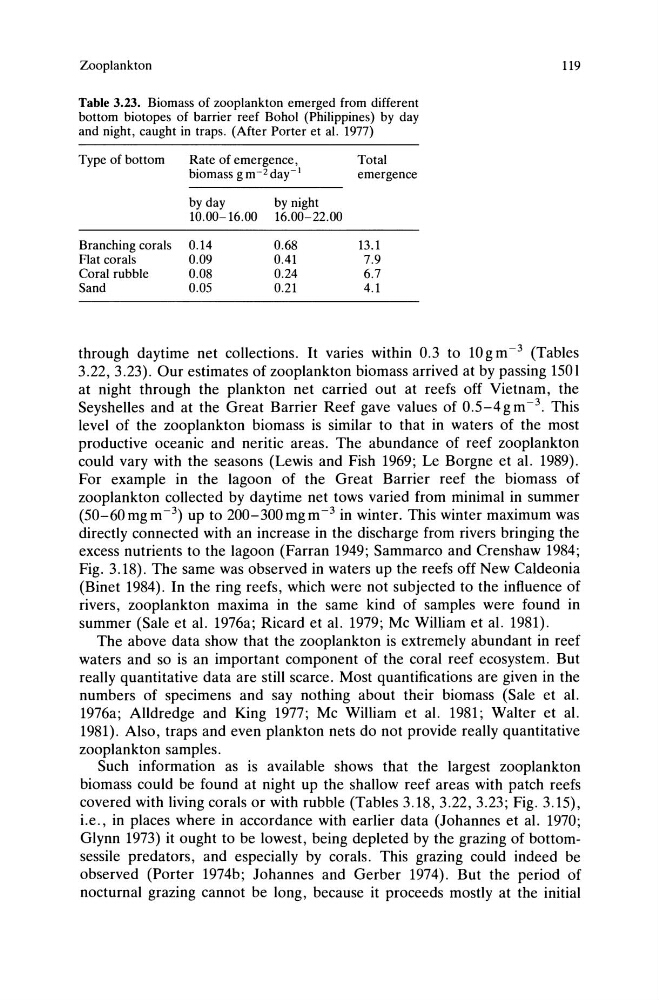
Table 3.23. Biomass of zooplankton emerged from different
bottom biotopes of barrier reef Bohol (Philippines) by day
and night, caught in traps. (After Porter et al. 1977)
Type of bottom
Rate of emergence,
biomass g m-2 day-l
by day
by night
10.00-16.00 16.00-22.00
Branching corals 0.14
Flat corals
0.09
Coral rubble
0.08
Sand
0.05
0.68
0.41
0.24
0.21
Total
emergence
13.1
7.9
6.7
4.1
119
through daytime net collections. It varies within 0.3 to 10 g m -3 (Tables
3.22, 3.23). Our estimates of zooplankton biomass arrived at by passing 150 I
at night through the plankton net carried out at reefs off Vietnam, the
Seyshelles and at the Great Barrier Reef gave values of 0.5-4 g m -3. This
level of the zooplankton biomass is similar to that in waters of the most
productive oceanic and neritic areas. The abundance of reef zooplankton
could vary with the seasons (Lewis and Fish 1969; Le Borgne et al. 1989).
For example in the lagoon of the Great Barrier reef the biomass of
zooplankton collected by daytime net tows varied from minimal in summer
(50-60 mg m -3) up to 200-300 mg m -3 in winter. This winter maximum was
directly connected with an increase in the discharge from rivers bringing the
excess nutrients to the lagoon (Farran 1949; Sammarco and Crenshaw 1984;
Fig. 3.18). The same was observed in waters up the reefs off New Caldeonia
(Binet 1984). In the ring reefs, which were not subjected to the influence of
rivers, zooplankton maxima in the same kind of samples were found in
summer (Sale et al. 1976a; Ricard et al. 1979; Mc William et al. 1981).
The above data show that the zooplankton is extremely abundant in reef
waters and so is an important component of the coral reef ecosystem. But
really quantitative data are still scarce. Most quantifications are given in the
numbers of specimens and say nothing about their biomass (Sale et al.
1976a; Alldredge and King 1977; Mc William et al. 1981; Walter et al.
1981). Also, traps and even plankton nets do not provide really quantitative
zooplankton samples.
Such information as is available shows that the largest zooplankton
biomass could be found at night up the shallow reef areas with patch reefs
covered with living corals or with rubble (Tables 3.18, 3.22, 3.23; Fig. 3.15),
i.e., in places where in accordance with earlier data (Johannes et al. 1970;
Glynn 1973) it ought to be lowest, being depleted by the grazing of bottomsessile predators, and especially by corals. This grazing could indeed be
observed (Porter 1974b; Johannes and Gerber 1974). But the period of
nocturnal grazing cannot be long, because it proceeds mostly at the initial
Table 3.23. Biomass of zooplankton emerged from different
bottom biotopes of barrier reef Bohol (Philippines) by day
and night, caught in traps. (After Porter et al. 1977)
Type of bottom
Rate of emergence,
biomass g m-2 day-l
by day
by night
10.00-16.00 16.00-22.00
Branching corals 0.14
Flat corals
0.09
Coral rubble
0.08
Sand
0.05
0.68
0.41
0.24
0.21
Total
emergence
13.1
7.9
6.7
4.1
119
through daytime net collections. It varies within 0.3 to 10 g m -3 (Tables
3.22, 3.23). Our estimates of zooplankton biomass arrived at by passing 150 I
at night through the plankton net carried out at reefs off Vietnam, the
Seyshelles and at the Great Barrier Reef gave values of 0.5-4 g m -3. This
level of the zooplankton biomass is similar to that in waters of the most
productive oceanic and neritic areas. The abundance of reef zooplankton
could vary with the seasons (Lewis and Fish 1969; Le Borgne et al. 1989).
For example in the lagoon of the Great Barrier reef the biomass of
zooplankton collected by daytime net tows varied from minimal in summer
(50-60 mg m -3) up to 200-300 mg m -3 in winter. This winter maximum was
directly connected with an increase in the discharge from rivers bringing the
excess nutrients to the lagoon (Farran 1949; Sammarco and Crenshaw 1984;
Fig. 3.18). The same was observed in waters up the reefs off New Caldeonia
(Binet 1984). In the ring reefs, which were not subjected to the influence of
rivers, zooplankton maxima in the same kind of samples were found in
summer (Sale et al. 1976a; Ricard et al. 1979; Mc William et al. 1981).
The above data show that the zooplankton is extremely abundant in reef
waters and so is an important component of the coral reef ecosystem. But
really quantitative data are still scarce. Most quantifications are given in the
numbers of specimens and say nothing about their biomass (Sale et al.
1976a; Alldredge and King 1977; Mc William et al. 1981; Walter et al.
1981). Also, traps and even plankton nets do not provide really quantitative
zooplankton samples.
Such information as is available shows that the largest zooplankton
biomass could be found at night up the shallow reef areas with patch reefs
covered with living corals or with rubble (Tables 3.18, 3.22, 3.23; Fig. 3.15),
i.e., in places where in accordance with earlier data (Johannes et al. 1970;
Glynn 1973) it ought to be lowest, being depleted by the grazing of bottomsessile predators, and especially by corals. This grazing could indeed be
observed (Porter 1974b; Johannes and Gerber 1974). But the period of
nocturnal grazing cannot be long, because it proceeds mostly at the initial