

Zooplankton
117
areas (Alldredge and King 1980). Some bottom-dwelling cyclopoids go to
the water column in the daytime to hunt in the schools of holoplankters,
crowding near their shelters. The time schedule of night migrations appears
to be different for different species of demersal zooplankters. After sunset
the first to ascend to the water column are the cumaceans and poly<;haetes.
They return at 2-3 a.m. Amphipods and isopods ascend in the water several
times during the night (Alldredge and King 1980; Ohlhorst 1982).
A significant influence is exerted on the distribution of reef zooplankton
by the tendency of many zooplankters to move to the center of eddies
(Alldredge and Hamner 1980). Thus, it concentrates in the centers of the
numerous rings forming during the interaction of currents with reef
constructions at their windward sides (d. Fig. 2.4). In the centers of such
rings the concentration of zooplankton might be by an order greater than
only a few tens of meters away from it (Hamner and Hauri 1981).
First attempts at quantification of reef zooplankton by means of daytime
net tows gave relatively low values (50-100mgm- 3 ), which nevertheless
were higher than those in the surrounding ocean (Johnson 1949). Later,
when the role of the night migration of demersal and meroplanktonic
zooplankters was recognized, the nocturnal tows and traps gave total
numbers and biomass values 10-50 times greater than the daytime tows
(Emery 1968; Tranter and George 1972; Alldredge and King 1977; Renon
1977; Porter et al. 1977; Porter 1977; Ohlehorst 1985). The number of
mesozooplankton collected by night tows was 1-4 x 10 3 sp. m -3 (Tables
3.16,3.17). Because the undivided weights of demersal species were 10-100
greater than those of copepods, and dominated in the daytime samples, the
total biomass thus established was by 2-3 orders more than that found
N
B
300
200 200
100 100
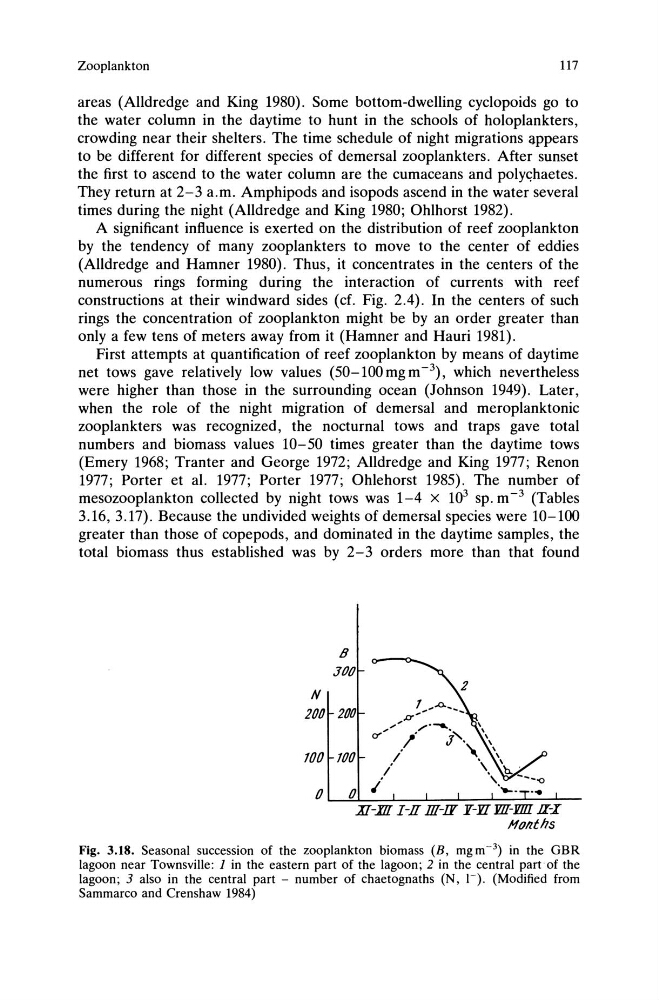
Fig. 3.18. Seasonal succession of the zooplankton biomass (B, mgm- 3 ) in the GBR
lagoon near Townsville: 1 in the eastern part of the lagoon; 2 in the central part of the
lagoon; 3 also in the central part - number of chaetognaths (N, 1-). (Modified from
Sammarco and Crenshaw 1984)
117
areas (Alldredge and King 1980). Some bottom-dwelling cyclopoids go to
the water column in the daytime to hunt in the schools of holoplankters,
crowding near their shelters. The time schedule of night migrations appears
to be different for different species of demersal zooplankters. After sunset
the first to ascend to the water column are the cumaceans and poly<;haetes.
They return at 2-3 a.m. Amphipods and isopods ascend in the water several
times during the night (Alldredge and King 1980; Ohlhorst 1982).
A significant influence is exerted on the distribution of reef zooplankton
by the tendency of many zooplankters to move to the center of eddies
(Alldredge and Hamner 1980). Thus, it concentrates in the centers of the
numerous rings forming during the interaction of currents with reef
constructions at their windward sides (d. Fig. 2.4). In the centers of such
rings the concentration of zooplankton might be by an order greater than
only a few tens of meters away from it (Hamner and Hauri 1981).
First attempts at quantification of reef zooplankton by means of daytime
net tows gave relatively low values (50-100mgm- 3 ), which nevertheless
were higher than those in the surrounding ocean (Johnson 1949). Later,
when the role of the night migration of demersal and meroplanktonic
zooplankters was recognized, the nocturnal tows and traps gave total
numbers and biomass values 10-50 times greater than the daytime tows
(Emery 1968; Tranter and George 1972; Alldredge and King 1977; Renon
1977; Porter et al. 1977; Porter 1977; Ohlehorst 1985). The number of
mesozooplankton collected by night tows was 1-4 x 10 3 sp. m -3 (Tables
3.16,3.17). Because the undivided weights of demersal species were 10-100
greater than those of copepods, and dominated in the daytime samples, the
total biomass thus established was by 2-3 orders more than that found
N
B
300
200 200
100 100
Fig. 3.18. Seasonal succession of the zooplankton biomass (B, mgm- 3 ) in the GBR
lagoon near Townsville: 1 in the eastern part of the lagoon; 2 in the central part of the
lagoon; 3 also in the central part - number of chaetognaths (N, 1-). (Modified from
Sammarco and Crenshaw 1984)