

Zooplankton
8
10
8
2
.I1afl
1\
I \
I \
I
\1
I
\
I
\ . , .
I
...... / \
113
/;oars
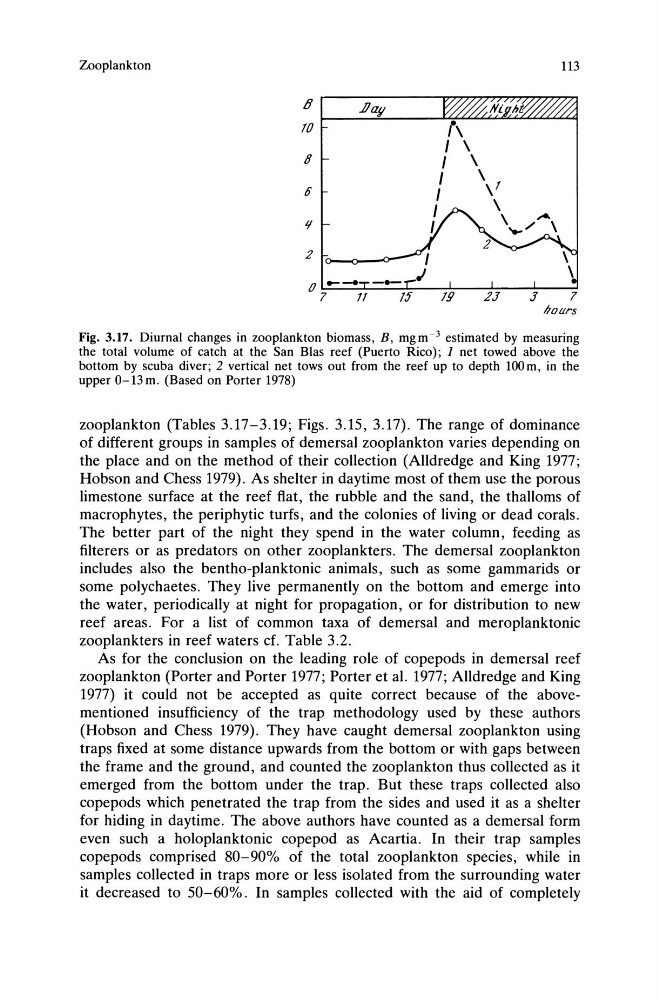
Fig. 3.17. Diurnal changes in zooplankton biomass, B, mgm- 3 estimated by measuring
the total volume of catch at the San BIas reef (Puerto Rico); 1 net towed above the
bottom by scuba diver; 2 vertical net tows out from the reef up to depth 100 m, in the
upper 0-13 m. (Based on Porter 1978)
zooplankton (Tables 3.17-3.19; Figs. 3.15, 3.17). The range of dominance
of different groups in samples of demersal zooplankton varies depending on
the place and on the method of their collection (Alldredge and King 1977;
Hobson and Chess 1979). As shelter in daytime most of them use the porous
limestone surface at the reef fiat, the rubble and the sand, the thalloms of
macrophytes, the periphytic turfs, and the colonies of living or dead corals.
The better part of the night they spend in the water column, feeding as
filterers or as predators on other zooplankters. The demersal zooplankton
includes also the bentho-planktonic animals, such as some gammarids or
some polychaetes. They live permanently on the bottom and emerge into
the water, periodically at night for propagation, or for distribution to new
reef areas. For a list of common taxa of demersal and meroplanktonic
zooplankters in reef waters d. Table 3.2.
As for the conclusion on the leading role of copepods in demersal reef
zooplankton (Porter and Porter 1977; Porter et al. 1977; Alldredge and King
1977) it could not be accepted as quite correct because of the abovementioned insufficiency of the trap methodology used by these authors
(Hobson and Chess 1979). They have caught demersal zooplankton using
traps fixed at some distance upwards from the bottom or with gaps between
the frame and the ground, and counted the zooplankton thus collected as it
emerged from the bottom under the trap. But these traps collected also
copepods which penetrated the trap from the sides and used it as a shelter
for hiding in daytime. The above authors have counted as a demersal form
even such a holoplanktonic copepod as Acartia. In their trap samples
copepods comprised 80-90% of the total zooplankton species, while in
samples collected in traps more or less isolated from the surrounding water
it decreased to 50-60%. In samples collected with the aid of completely
8
10
8
2
.I1afl
1\
I \
I \
I
\1
I
\
I
\ . , .
I
...... / \
113
/;oars
Fig. 3.17. Diurnal changes in zooplankton biomass, B, mgm- 3 estimated by measuring
the total volume of catch at the San BIas reef (Puerto Rico); 1 net towed above the
bottom by scuba diver; 2 vertical net tows out from the reef up to depth 100 m, in the
upper 0-13 m. (Based on Porter 1978)
zooplankton (Tables 3.17-3.19; Figs. 3.15, 3.17). The range of dominance
of different groups in samples of demersal zooplankton varies depending on
the place and on the method of their collection (Alldredge and King 1977;
Hobson and Chess 1979). As shelter in daytime most of them use the porous
limestone surface at the reef fiat, the rubble and the sand, the thalloms of
macrophytes, the periphytic turfs, and the colonies of living or dead corals.
The better part of the night they spend in the water column, feeding as
filterers or as predators on other zooplankters. The demersal zooplankton
includes also the bentho-planktonic animals, such as some gammarids or
some polychaetes. They live permanently on the bottom and emerge into
the water, periodically at night for propagation, or for distribution to new
reef areas. For a list of common taxa of demersal and meroplanktonic
zooplankters in reef waters d. Table 3.2.
As for the conclusion on the leading role of copepods in demersal reef
zooplankton (Porter and Porter 1977; Porter et al. 1977; Alldredge and King
1977) it could not be accepted as quite correct because of the abovementioned insufficiency of the trap methodology used by these authors
(Hobson and Chess 1979). They have caught demersal zooplankton using
traps fixed at some distance upwards from the bottom or with gaps between
the frame and the ground, and counted the zooplankton thus collected as it
emerged from the bottom under the trap. But these traps collected also
copepods which penetrated the trap from the sides and used it as a shelter
for hiding in daytime. The above authors have counted as a demersal form
even such a holoplanktonic copepod as Acartia. In their trap samples
copepods comprised 80-90% of the total zooplankton species, while in
samples collected in traps more or less isolated from the surrounding water
it decreased to 50-60%. In samples collected with the aid of completely