

92
Plankton in Coral-Reef Waters
second maximum in autumn besides the above mentioned also Thallasiotrix
frauenfeldii, Chaetoceros tetrastycon, Rhyzosolenia setigera and Dactylosolen
mediterranea were numerous, and together with nanoplanktonic algae
numbered up to 3 X 10 7 cells 1- 1 . The total numbers of diatoms and
dinoflagallates were 10 4 _10 5 cells 1- 1 . The spring blooms of the blue-green
alga Trichodesmium rub rum caused there sometimes real "red tides". In
December 1975 - and also in July and August - I have observed from the
plane the brownish stripes of masses of floating Trichodesmium stretching in
the lagoon of the GBR between Bundaberg and Townsville for several
tenths of kilometers.
Ollr observations accomplished in different reef regions, taking counts of
algae on the membrane filters, showed that especially this alga and some
other bentho-planktonic filamentous blue-greens are an important and
sometimes even dominating feature in phytoplankton. This alga often
attains mass blooms in oligotrophic tropical oceanic and coastal waters
(Bowman and Lancaster 1965; Quasim 1970; Sorokin and Tsvetkova 1972).
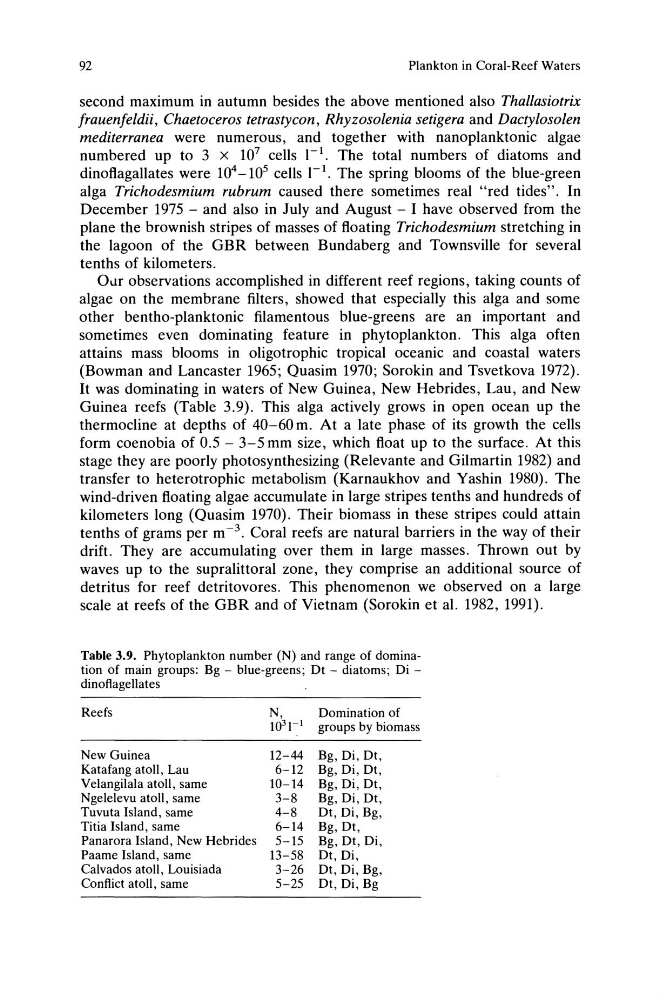
It was dominating in waters of New Guinea, New Hebrides, Lau, and New
Guinea reefs (Table 3.9). This alga actively grows in open ocean up the
thermocline at depths of 40-60 m. At a late phase of its growth the cells
form coenobia of 0.5 - 3-5 mm size, which float up to the surface. At this
stage they are poorly photosynthesizing (Relevante and Gilmartin 1982) and
transfer to heterotrophic metabolism (Karnaukhov and Yashin 1980). The
wind-driven floating algae accumulate in large stripes tenths and hundreds of
kilometers long (Quasim 1970). Their biomass in these stripes could attain
tenths of grams per m- 3 . Coral reefs are natural barriers in the way of their
drift. They are accumulating over them in large masses. Thrown out by
waves up to the supralittoral zone, they comprise an additional source of
detritus for reef detritovores. This phenomenon we observed on a large
scale at reefs of the GBR and of Vietnam (Sorokin et al. 1982, 1991).
Table 3.9. Phytoplankton number (N) and range of domination of main groups: Bg - blue-greens; Ot - diatoms; Oi -
dinoflagellates
Reefs
New Guinea
Katafang atoll, Lau
Velangilala atoll, same
Ngelelevu atoll, same
Tuvuta Island, same
Titia Island, same
Panarora Island, New Hebrides
Paame Island, same
Calvados atoll, Louisiada
Conflict atoll, same
12-44
6-12
10-14
3-8
4-8
6-14
5-15
13-58
3-26
5-25
Oomination of
groups by biomass
Bg, Oi, Ot,
Bg, Oi, Ot,
Bg, Oi, Ot,
Bg, Oi, Ot,
Ot, Oi, Bg,
Bg,Ot,
Bg, Ot, Oi,
Ot,Oi,
Ot, Oi, Bg,
Ot, Oi, Bg
Plankton in Coral-Reef Waters
second maximum in autumn besides the above mentioned also Thallasiotrix
frauenfeldii, Chaetoceros tetrastycon, Rhyzosolenia setigera and Dactylosolen
mediterranea were numerous, and together with nanoplanktonic algae
numbered up to 3 X 10 7 cells 1- 1 . The total numbers of diatoms and
dinoflagallates were 10 4 _10 5 cells 1- 1 . The spring blooms of the blue-green
alga Trichodesmium rub rum caused there sometimes real "red tides". In
December 1975 - and also in July and August - I have observed from the
plane the brownish stripes of masses of floating Trichodesmium stretching in
the lagoon of the GBR between Bundaberg and Townsville for several
tenths of kilometers.
Ollr observations accomplished in different reef regions, taking counts of
algae on the membrane filters, showed that especially this alga and some
other bentho-planktonic filamentous blue-greens are an important and
sometimes even dominating feature in phytoplankton. This alga often
attains mass blooms in oligotrophic tropical oceanic and coastal waters
(Bowman and Lancaster 1965; Quasim 1970; Sorokin and Tsvetkova 1972).
It was dominating in waters of New Guinea, New Hebrides, Lau, and New
Guinea reefs (Table 3.9). This alga actively grows in open ocean up the
thermocline at depths of 40-60 m. At a late phase of its growth the cells
form coenobia of 0.5 - 3-5 mm size, which float up to the surface. At this
stage they are poorly photosynthesizing (Relevante and Gilmartin 1982) and
transfer to heterotrophic metabolism (Karnaukhov and Yashin 1980). The
wind-driven floating algae accumulate in large stripes tenths and hundreds of
kilometers long (Quasim 1970). Their biomass in these stripes could attain
tenths of grams per m- 3 . Coral reefs are natural barriers in the way of their
drift. They are accumulating over them in large masses. Thrown out by
waves up to the supralittoral zone, they comprise an additional source of
detritus for reef detritovores. This phenomenon we observed on a large
scale at reefs of the GBR and of Vietnam (Sorokin et al. 1982, 1991).
Table 3.9. Phytoplankton number (N) and range of domination of main groups: Bg - blue-greens; Ot - diatoms; Oi -
dinoflagellates
Reefs
New Guinea
Katafang atoll, Lau
Velangilala atoll, same
Ngelelevu atoll, same
Tuvuta Island, same
Titia Island, same
Panarora Island, New Hebrides
Paame Island, same
Calvados atoll, Louisiada
Conflict atoll, same
12-44
6-12
10-14
3-8
4-8
6-14
5-15
13-58
3-26
5-25
Oomination of
groups by biomass
Bg, Oi, Ot,
Bg, Oi, Ot,
Bg, Oi, Ot,
Bg, Oi, Ot,
Ot, Oi, Bg,
Bg,Ot,
Bg, Ot, Oi,
Ot,Oi,
Ot, Oi, Bg,
Ot, Oi, Bg