

Beaches, of course, are commonly shaped and internally structured by physical processes, but macroscopic
biological processes can become important enough to
co-dominate in the development of the beach sediment
structure. Figure 7b illustrates structures produced in
beach sediment where physical processes and biological
processes are co-dominant.
Burrow structures and bioturbation affect sediment
macrobiologically, microbiologically, hydrologically,
and geochemically through aeration, providing conduits
for micro-hydrological through-flow, altering composition of meiofauna, nutrient recycling (such as nitrogen
fluxes), and diagenetic mineral overturning (e.g., pyrite
in deeper anoxic sediment oxidized at the sediment surface), among other processes (McCall and Tevesz, 1982;
Alongi, 1985; Aller, 1988; Dittmann, 1993; Sadao,
2002; Webb and Eyre, 2004).
The higher parts of a beach, storm levels of a beach,
and/or the low beach ridge immediately leeward of the
beach slope often are colonized by halophytes and other
strand vegetation. Such plants result in root structuring
of sediments.
Animal predation, bioturbation, and foraging result in
shell fragmentation and shell comminution. Crabs, fish,
stingrays, octopus, and shorebirds hunt and feed on various invertebrate fauna of sandy shores, resulting in the
invertebrate exoskeleton fragmentation. Animal bioturbation and sediment ingestion also results in shell
fragmentation.
After storms, or after some active wave action that
might disrupt the seagrass beds and algal beds in the
nearby subtidal environments, the plants living on nearby
rocky shores, or the saltmarsh and mangroves from hightidal environments, plant material is transported to the
sandy shore and the beach may be littered at the high-tide
mark by varying plant debris (flotsam and jetsam, or
wrack). A range of macrofauna, such as crabs, or gastropods, or avifauna, forages among this material digesting
it, or feeding on the organisms that inhabit it (Griffiths
et al., 1983; McLachlan, 1985; Dugan et al., 2003; Lewis
et al., 2007). This results in the breakdown of the plant
material on the beach. Smaller organisms specialized for
this wrack environment, such as amphipods, isopods,
and meiofauna, also consume the finer-grained plant
material, adding to the biological breakdown of plant
and other organic matter stranded on the beach slope
(Hayes, 1974; Poulin and Latham, 2002; Mews et al.,
2006; Pelletier et al., 2011). In addition, particularly on
wet beaches, there is microbial decomposition of organic
matter on the beach and of organic matter shallowly buried
at or below the water table of the beach (Jørgensen, 1982;
Lovley and Phillips, 1986; Henriksen and Kemp, 1988).
Organic matter on and under beaches can also be broken down microbially (decayed). Some of this microbial
decay is related to, fixed on, or mediated by structures
and larger organisms in the environment (e.g., where
microbes, meiofauna, and bacterial productivity are associated with tubes constructed by a polychaete; Alongi,
1985). Microbial decay involves the conversion of
organic molecules to inorganic molecules and ions.
This biotransformation is often subsumed under the term
“mineralization.” It is the process by which organic matter
is “mineralized” (transformed to inorganic compounds,
radicals, or elements) by fermenting, denitrifying,
sulfate-reducing, and methane-producing bacteria
(Jørgensen, 1982), some under anaerobic conditions and
some under aerobic conditions. In estuarine beach environments, this takes place below an anaerobic water table
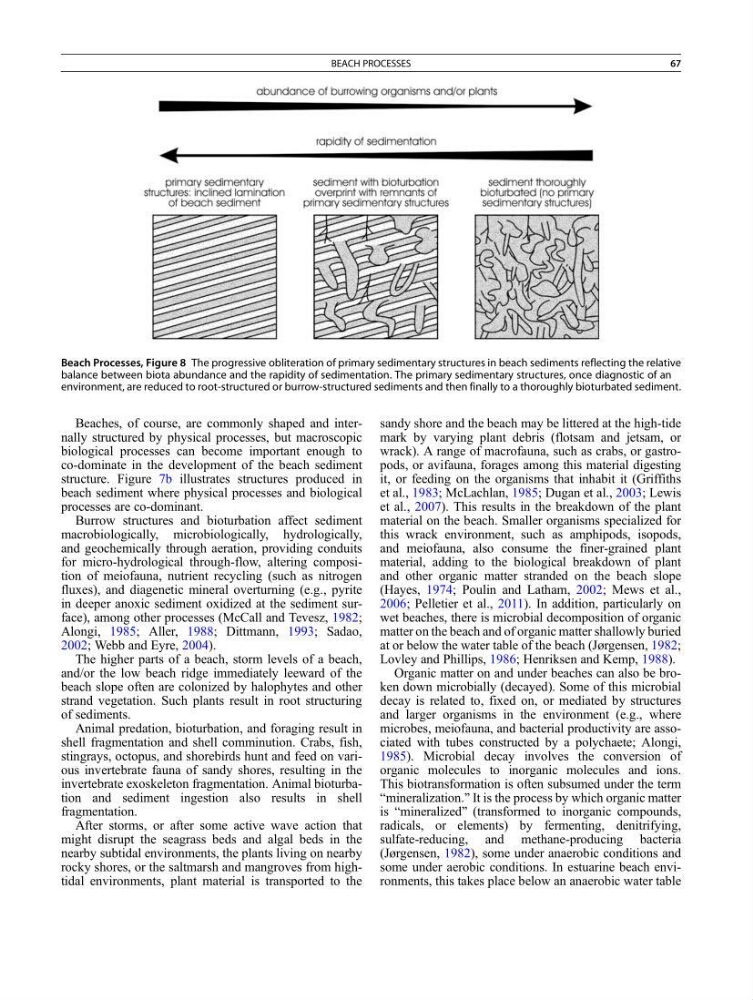
Beach Processes, Figure 8 The progressive obliteration of primary sedimentary structures in beach sediments reflecting the relative
balance between biota abundance and the rapidity of sedimentation. The primary sedimentary structures, once diagnostic of an
environment, are reduced to root-structured or burrow-structured sediments and then finally to a thoroughly bioturbated sediment.
BEACH PROCESSES
67
biological processes can become important enough to
co-dominate in the development of the beach sediment
structure. Figure 7b illustrates structures produced in
beach sediment where physical processes and biological
processes are co-dominant.
Burrow structures and bioturbation affect sediment
macrobiologically, microbiologically, hydrologically,
and geochemically through aeration, providing conduits
for micro-hydrological through-flow, altering composition of meiofauna, nutrient recycling (such as nitrogen
fluxes), and diagenetic mineral overturning (e.g., pyrite
in deeper anoxic sediment oxidized at the sediment surface), among other processes (McCall and Tevesz, 1982;
Alongi, 1985; Aller, 1988; Dittmann, 1993; Sadao,
2002; Webb and Eyre, 2004).
The higher parts of a beach, storm levels of a beach,
and/or the low beach ridge immediately leeward of the
beach slope often are colonized by halophytes and other
strand vegetation. Such plants result in root structuring
of sediments.
Animal predation, bioturbation, and foraging result in
shell fragmentation and shell comminution. Crabs, fish,
stingrays, octopus, and shorebirds hunt and feed on various invertebrate fauna of sandy shores, resulting in the
invertebrate exoskeleton fragmentation. Animal bioturbation and sediment ingestion also results in shell
fragmentation.
After storms, or after some active wave action that
might disrupt the seagrass beds and algal beds in the
nearby subtidal environments, the plants living on nearby
rocky shores, or the saltmarsh and mangroves from hightidal environments, plant material is transported to the
sandy shore and the beach may be littered at the high-tide
mark by varying plant debris (flotsam and jetsam, or
wrack). A range of macrofauna, such as crabs, or gastropods, or avifauna, forages among this material digesting
it, or feeding on the organisms that inhabit it (Griffiths
et al., 1983; McLachlan, 1985; Dugan et al., 2003; Lewis
et al., 2007). This results in the breakdown of the plant
material on the beach. Smaller organisms specialized for
this wrack environment, such as amphipods, isopods,
and meiofauna, also consume the finer-grained plant
material, adding to the biological breakdown of plant
and other organic matter stranded on the beach slope
(Hayes, 1974; Poulin and Latham, 2002; Mews et al.,
2006; Pelletier et al., 2011). In addition, particularly on
wet beaches, there is microbial decomposition of organic
matter on the beach and of organic matter shallowly buried
at or below the water table of the beach (Jørgensen, 1982;
Lovley and Phillips, 1986; Henriksen and Kemp, 1988).
Organic matter on and under beaches can also be broken down microbially (decayed). Some of this microbial
decay is related to, fixed on, or mediated by structures
and larger organisms in the environment (e.g., where
microbes, meiofauna, and bacterial productivity are associated with tubes constructed by a polychaete; Alongi,
1985). Microbial decay involves the conversion of
organic molecules to inorganic molecules and ions.
This biotransformation is often subsumed under the term
“mineralization.” It is the process by which organic matter
is “mineralized” (transformed to inorganic compounds,
radicals, or elements) by fermenting, denitrifying,
sulfate-reducing, and methane-producing bacteria
(Jørgensen, 1982), some under anaerobic conditions and
some under aerobic conditions. In estuarine beach environments, this takes place below an anaerobic water table
Beach Processes, Figure 8 The progressive obliteration of primary sedimentary structures in beach sediments reflecting the relative
balance between biota abundance and the rapidity of sedimentation. The primary sedimentary structures, once diagnostic of an
environment, are reduced to root-structured or burrow-structured sediments and then finally to a thoroughly bioturbated sediment.
BEACH PROCESSES
67