

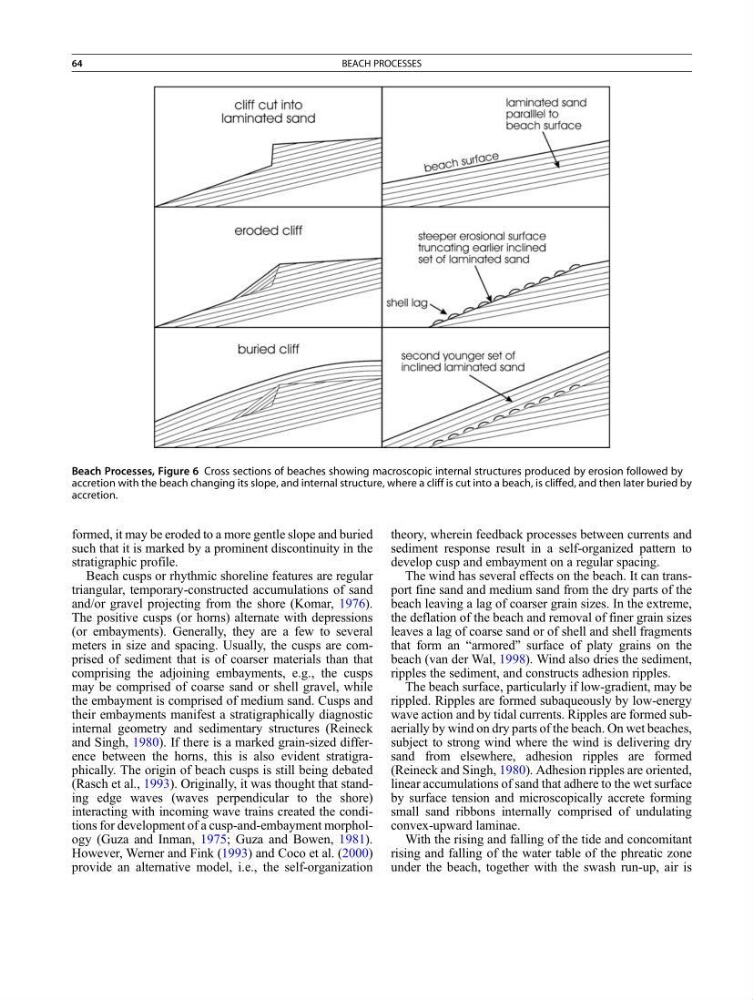
formed, it may be eroded to a more gentle slope and buried
such that it is marked by a prominent discontinuity in the
stratigraphic profile.
Beach cusps or rhythmic shoreline features are regular
triangular, temporary-constructed accumulations of sand
and/or gravel projecting from the shore (Komar, 1976).
The positive cusps (or horns) alternate with depressions
(or embayments). Generally, they are a few to several
meters in size and spacing. Usually, the cusps are comprised of sediment that is of coarser materials than that
comprising the adjoining embayments, e.g., the cusps
may be comprised of coarse sand or shell gravel, while
the embayment is comprised of medium sand. Cusps and
their embayments manifest a stratigraphically diagnostic
internal geometry and sedimentary structures (Reineck
and Singh, 1980). If there is a marked grain-sized difference between the horns, this is also evident stratigraphically. The origin of beach cusps is still being debated
(Rasch et al., 1993). Originally, it was thought that standing edge waves (waves perpendicular to the shore)
interacting with incoming wave trains created the conditions for development of a cusp-and-embayment morphology (Guza and Inman, 1975; Guza and Bowen, 1981).
However, Werner and Fink (1993) and Coco et al. (2000)
provide an alternative model, i.e., the self-organization
theory, wherein feedback processes between currents and
sediment response result in a self-organized pattern to
develop cusp and embayment on a regular spacing.
The wind has several effects on the beach. It can transport fine sand and medium sand from the dry parts of the
beach leaving a lag of coarser grain sizes. In the extreme,
the deflation of the beach and removal of finer grain sizes
leaves a lag of coarse sand or of shell and shell fragments
that form an “armored” surface of platy grains on the
beach (van der Wal, 1998). Wind also dries the sediment,
ripples the sediment, and constructs adhesion ripples.
The beach surface, particularly if low-gradient, may be
rippled. Ripples are formed subaqueously by low-energy
wave action and by tidal currents. Ripples are formed subaerially by wind on dry parts of the beach. On wet beaches,
subject to strong wind where the wind is delivering dry
sand from elsewhere, adhesion ripples are formed
(Reineck and Singh, 1980). Adhesion ripples are oriented,
linear accumulations of sand that adhere to the wet surface
by surface tension and microscopically accrete forming
small sand ribbons internally comprised of undulating
convex-upward laminae.
With the rising and falling of the tide and concomitant
rising and falling of the water table of the phreatic zone
under the beach, together with the swash run-up, air is
Beach Processes, Figure 6 Cross sections of beaches showing macroscopic internal structures produced by erosion followed by
accretion with the beach changing its slope, and internal structure, where a cliff is cut into a beach, is cliffed, and then later buried by
accretion.
64
BEACH PROCESSES
such that it is marked by a prominent discontinuity in the
stratigraphic profile.
Beach cusps or rhythmic shoreline features are regular
triangular, temporary-constructed accumulations of sand
and/or gravel projecting from the shore (Komar, 1976).
The positive cusps (or horns) alternate with depressions
(or embayments). Generally, they are a few to several
meters in size and spacing. Usually, the cusps are comprised of sediment that is of coarser materials than that
comprising the adjoining embayments, e.g., the cusps
may be comprised of coarse sand or shell gravel, while
the embayment is comprised of medium sand. Cusps and
their embayments manifest a stratigraphically diagnostic
internal geometry and sedimentary structures (Reineck
and Singh, 1980). If there is a marked grain-sized difference between the horns, this is also evident stratigraphically. The origin of beach cusps is still being debated
(Rasch et al., 1993). Originally, it was thought that standing edge waves (waves perpendicular to the shore)
interacting with incoming wave trains created the conditions for development of a cusp-and-embayment morphology (Guza and Inman, 1975; Guza and Bowen, 1981).
However, Werner and Fink (1993) and Coco et al. (2000)
provide an alternative model, i.e., the self-organization
theory, wherein feedback processes between currents and
sediment response result in a self-organized pattern to
develop cusp and embayment on a regular spacing.
The wind has several effects on the beach. It can transport fine sand and medium sand from the dry parts of the
beach leaving a lag of coarser grain sizes. In the extreme,
the deflation of the beach and removal of finer grain sizes
leaves a lag of coarse sand or of shell and shell fragments
that form an “armored” surface of platy grains on the
beach (van der Wal, 1998). Wind also dries the sediment,
ripples the sediment, and constructs adhesion ripples.
The beach surface, particularly if low-gradient, may be
rippled. Ripples are formed subaqueously by low-energy
wave action and by tidal currents. Ripples are formed subaerially by wind on dry parts of the beach. On wet beaches,
subject to strong wind where the wind is delivering dry
sand from elsewhere, adhesion ripples are formed
(Reineck and Singh, 1980). Adhesion ripples are oriented,
linear accumulations of sand that adhere to the wet surface
by surface tension and microscopically accrete forming
small sand ribbons internally comprised of undulating
convex-upward laminae.
With the rising and falling of the tide and concomitant
rising and falling of the water table of the phreatic zone
under the beach, together with the swash run-up, air is
Beach Processes, Figure 6 Cross sections of beaches showing macroscopic internal structures produced by erosion followed by
accretion with the beach changing its slope, and internal structure, where a cliff is cut into a beach, is cliffed, and then later buried by
accretion.
64
BEACH PROCESSES