

Bioturbation is common, along with burrows. The
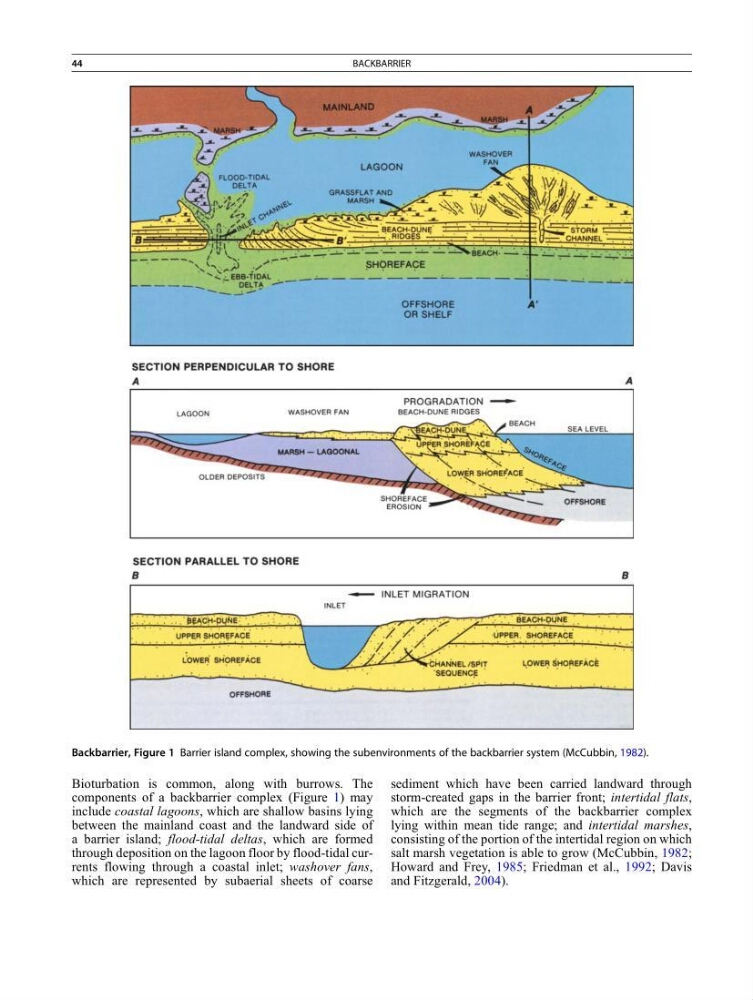
components of a backbarrier complex (Figure 1) may
include coastal lagoons, which are shallow basins lying
between the mainland coast and the landward side of
a barrier island; flood-tidal deltas, which are formed
through deposition on the lagoon floor by flood-tidal currents flowing through a coastal inlet; washover fans,
which are represented by subaerial sheets of coarse
sediment which have been carried landward through
storm-created gaps in the barrier front; intertidal flats,
which are the segments of the backbarrier complex
lying within mean tide range; and intertidal marshes,
consisting of the portion of the intertidal region on which
salt marsh vegetation is able to grow (McCubbin, 1982;
Howard and Frey, 1985; Friedman et al., 1992; Davis
and Fitzgerald, 2004).
Backbarrier, Figure 1 Barrier island complex, showing the subenvironments of the backbarrier system (McCubbin, 1982).
44
BACKBARRIER
components of a backbarrier complex (Figure 1) may
include coastal lagoons, which are shallow basins lying
between the mainland coast and the landward side of
a barrier island; flood-tidal deltas, which are formed
through deposition on the lagoon floor by flood-tidal currents flowing through a coastal inlet; washover fans,
which are represented by subaerial sheets of coarse
sediment which have been carried landward through
storm-created gaps in the barrier front; intertidal flats,
which are the segments of the backbarrier complex
lying within mean tide range; and intertidal marshes,
consisting of the portion of the intertidal region on which
salt marsh vegetation is able to grow (McCubbin, 1982;
Howard and Frey, 1985; Friedman et al., 1992; Davis
and Fitzgerald, 2004).
Backbarrier, Figure 1 Barrier island complex, showing the subenvironments of the backbarrier system (McCubbin, 1982).
44
BACKBARRIER