

analytical and observational methods. Tidal phases easily
obtained from harmonic analysis also provide useful information because they tend to flatten out near the reflector
(different positions reach high water or low water at the
same time) when reflection dominates over friction. The
wave number obtained directly from the observed tidal
phases is thus typically much smaller than the wave numbers of the incident and reflected waves. Frictional effects
can significantly change the resonance condition and the
maximum amplification. Nevertheless, due to complex
bathymetry, and the variety of forcings involved, a precise
estimate often requires computational techniques.
In many natural situations, reflection may also introduce a phase shift between the incoming and reflected
waves that affects the position of the antinodes and nodes.
Moreover, only a fraction of the incoming wave is
reflected. Energy reflection is characterized by
a (complex) reflection coefficient R, which is simply the
ratio between reflected and incident wave amplitudes.
Due to the imperfect reflection (R < 1), there are no true
nodes or antinodes in the wave profile, but quasiantinodes (maxima of the tidal elevation) and quasi-nodes
(minima of the tidal elevation). In simple terms, the
resulting wave is a partially (instead of fully) standing
wave, made up of a combination of a standing wave plus
an incoming progressive wave. In general, the reflection
coefficient is frequency dependent and varies spatially
with the absolute distance to the head due to the increase
in the dissipation and inverse shoaling of the reflected
wave. Nonlinear interactions between the two waves and
with other constituents may also be significant.
Tidal reflection also occurs due to topographic changes,
gradually as the wave propagates (e.g., variations in depth,
channel width, presence of meanders with small radius of
curvature, etc.). If the length scale of the spatial changes in
section is much larger than the tidal wavelength, energy
losses due to reflection are negligible and Green’s law,
which simply relates changes in channel width and depth
to changes in tidal range, is applicable. However, this
occurs rarely. In most cases tidal reflection is important
(e.g., at the sill of a fjord), and Green’s law is for practical
purposes inapplicable. Wave reflection from the margins
is also expected due to the geometry variations. For
instance, channel convergence causes partial reflection
of the incoming wave, thereby losing energy (apart from
bottom friction) as it propagates upstream. The seaward
radiation of (reflected) tidal energy due to channel convergence and, if any, reflection at the upper limit may modify
the ocean tide near the basin entrance, especially when the
basin is close to resonance.
The basic tidal movement in the open ocean is also
a system of standing wave oscillations. Oceanic boundaries (mainly continents) reflect part of the tidal wave
energy, setting up nodal points, and also resonant motions,
if conditions exist for them. This reflection is responsible
for the differences of timing and tidal range along the
coasts, which in turn influence to a greater extent the estuary mouth morphology (e.g., wave- or river-dominated
embayments occur where tidal action is weak). The
constraining effects of the emerged lands and the influence
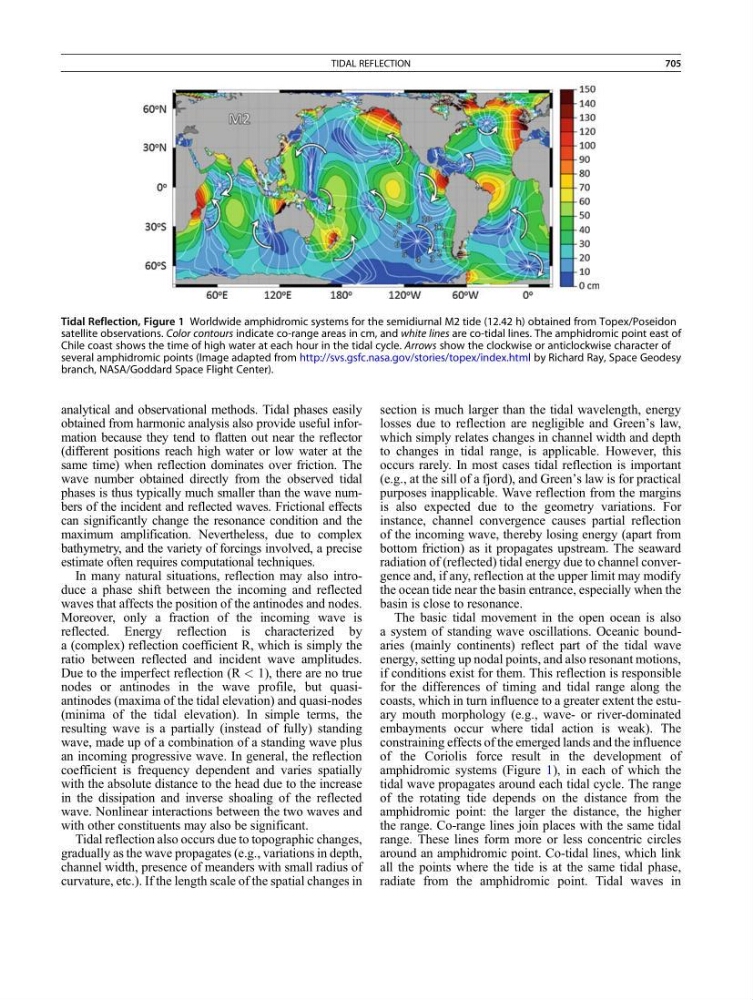
of the Coriolis force result in the development of
amphidromic systems (Figure 1), in each of which the
tidal wave propagates around each tidal cycle. The range
of the rotating tide depends on the distance from the
amphidromic point: the larger the distance, the higher
the range. Co-range lines join places with the same tidal
range. These lines form more or less concentric circles
around an amphidromic point. Co-tidal lines, which link
all the points where the tide is at the same tidal phase,
radiate from the amphidromic point. Tidal waves in
Tidal Reflection, Figure 1 Worldwide amphidromic systems for the semidiurnal M2 tide (12.42 h) obtained from Topex/Poseidon
satellite observations. Color contours indicate co-range areas in cm, and white lines are co-tidal lines. The amphidromic point east of
Chile coast shows the time of high water at each hour in the tidal cycle. Arrows show the clockwise or anticlockwise character of
several amphidromic points (Image adapted from http://svs.gsfc.nasa.gov/stories/topex/index.html by Richard Ray, Space Geodesy
branch, NASA/Goddard Space Flight Center).
TIDAL REFLECTION
705