

Bibliography
Parker, B., 1998. The perfect storm surge. Mariners Weather Log,
44(2), 4–12.
Parker, B., 2007. Tidal Analysis and Prediction. NOAA Special
Publication NOS CO-OPS 3, National Ocean Service, NOAA,
Department of Commerce, Silver Spring, MD.
Parker, B., 2012. The Power of the Sea. New York: PalgraveMacMillan.
Cross-references
Mean Sea Level
Seiche
Storm Surges
Tidal Hydrodynamics
Tides
TIDAL RANGES
Ivan D. Haigh
Ocean and Earth Science, National Oceanography Centre,
University of Southampton, European Way,
Southampton, UK
Definition
Tidal range is the vertical difference in height between
consecutive high and low waters over a tidal cycle. The
range of the tide varies between locations and also varies
over a range of time scales (Stembridge, 1982).
Differences in tidal range are important, as they are often
related to variations in coastal processes and morphology
(Davies, 1980).
Description
Temporally, tidal range varies due to changes in the position and alignment of the moon and sun relative to the
earth. Every fortnight, the largest tidal ranges in semidiurnal regions occur during spring tides, when the moon
and sun are in phase around times of new or full moon;
while the smallest tidal ranges occur during neap tides,
when the moon and sun are out of phase. In diurnal
regions, the largest tidal ranges occur every fortnight
during equatorial tides, when the moon is over the tropics; while the smallest tidal ranges occur during tropic
tides, when the moon is over the equator. Over a month,
tidal range changes as the moon moves from its closest
(perigee) approach to the earth to its furthest approach
(apogee) and back. Over annual time scales, changes in
tidal range occur as the sun’s position varies north or
south of the equator and as it moves from its closest
(perihelion) to furthest approach (aphelion) to the earth
and back. The largest semidiurnal tidal range occurs in
March and September during the equinoxes, while the
largest diurnal tidal range occurs in June and December
during the solstices. Over longer time scales, variations
in tidal range arise as a result of the 8.85-year cycle of
lunar perigee and the 18.61-year lunar nodal cycle
(Haigh et al., 2011).
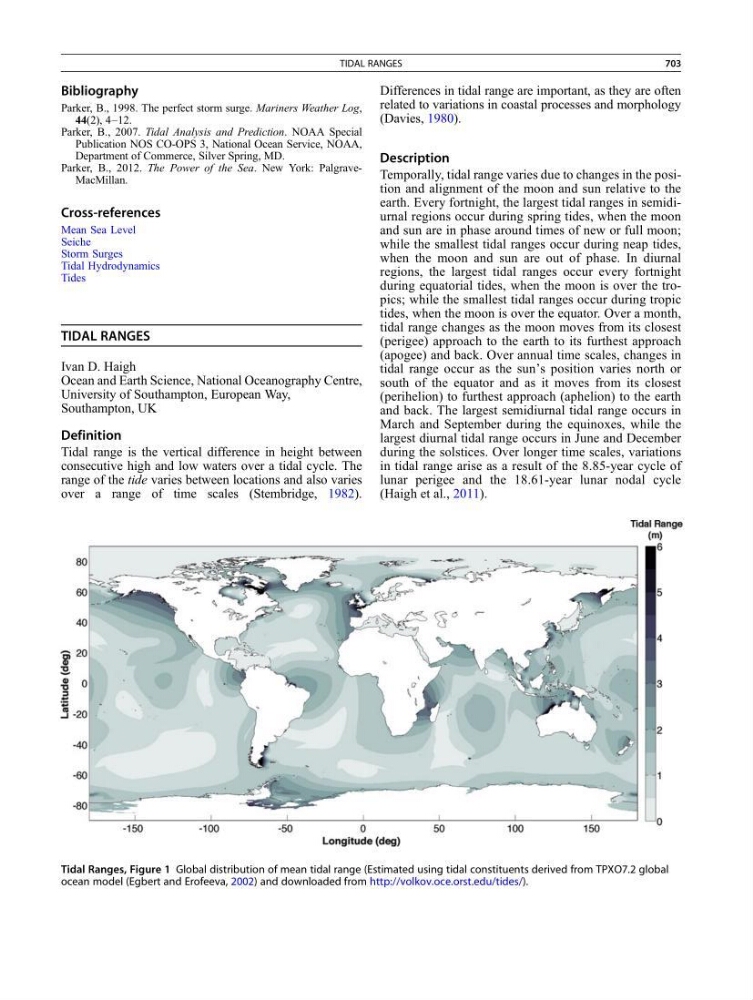
Tidal Ranges, Figure 1 Global distribution of mean tidal range (Estimated using tidal constituents derived from TPXO7.2 global
ocean model (Egbert and Erofeeva, 2002) and downloaded from http://volkov.oce.orst.edu/tides/).
TIDAL RANGES
703