

constricting morphology that results in amplification of
the tides (Mitsch and Gosselink, 2000). In some places,
such as the Gulf Coast of the United States, wind-derived
tides with irregular patterns of flooding and drying are
much more important than lunar tides (Mitsch and
Gosselink, 2000). Mature tidal freshwater habitat may
contain thick, highly organic peat (See Peat) soils, which
have accreted over hundreds or thousands of years
(Drexler et al., 2009a, b).
A variety of animals, including fish, amphibians,
reptiles, and waterfowl, live in tidal freshwater habitat permanently or for at least part of the year. With regard to fish,
many spawn and spend their entire lives in channels
within tidal freshwater habitat. Ictalurids (catfish), cyprinids (minnows, shiners, and carp), and centrarchids
(sunfish, crappies, and bass) are three important families
of such fishes. Many centrarchids, such as the largemouth
bass (Micropterus salmoides) and sunfishes (Lepomis
spp.), are important sport fish (Odum et al., 1984). Other
estuarine fishes such as killifishes (Fundulus spp.) and
juvenile naked gobies (Gobiosoma bosci) are part-time
residents, using tidal freshwater habitat for a source of
food or nursery grounds. A number of anadromous (See
Anadromous) and semianadromous fishes (which live as
adults in the ocean or lower estuary, respectively) travel
through tidal freshwater habitat on their way to streams
to spawn. The juveniles use tidal freshwater habitat as
nursery grounds. In the Pacific Northwest, several threatened and endangered salmonid species, including the
Upper Columbia River Spring Chinook salmon
(Oncorhynchus tshawytscha), have been shown to rely
on tidal freshwater habitat for this purpose (Johnson
et al., 2011).
In addition to fish, a variety of amphibians and reptiles
depend on tidal freshwater habitat. River turtles and water
snakes are common inhabitants, but perhaps the most conspicuous residents are American alligators (Alligator
mississippiensis), which are distributed throughout the
southeastern United States (Mitsch and Gosselink,
2000). American crocodiles (Crocodylus acutus) may also
be found in tidal freshwater habitat but are more likely to
inhabit brackish and saline environments in their range,
which extends from southern Florida to South America
(Cherkiss et al., 2011). The much larger and broad-ranging
saltwater crocodile (Crocodylus porosus) is distributed
mainly throughout Southeast Asia and Australia and can
be found in tidal freshwater habitat, particularly during
the wet season (Campbell et al., 2013).
A number of mammals make their home in tidal freshwater habitat. Some of these inhabitants are particularly
well adapted to wet environments such as beaver (Castor
canadensis), marsh rabbit (Sylvilagus palustris), marsh
rice rat (Oryzomys palustris), river otter (Lontra
canadensis), muskrat (Ondatra zibethicus), mink
(Neovison vison), and nutria (Myocastor coypus; an invasive species (See Invasive Species) originally from South
America) (Odum et al., 1984). Other mammals, including
white-tailed deer (Odocoileus virginianus), opossum
(Didelphis virginiana), and raccoon (Procyon lotor) may
use tidal freshwater habitat to fulfill at least part of their
food or habitat requirements (Odum et al., 1984).
The diversity of plants in tidal freshwater habitat provides a range of ecological niches (See Ecological Niche)
highly suitable for a large number of resident and migratory bird species. In fact, because of the broad range of
plant assemblages, tidal freshwater habitat supports some
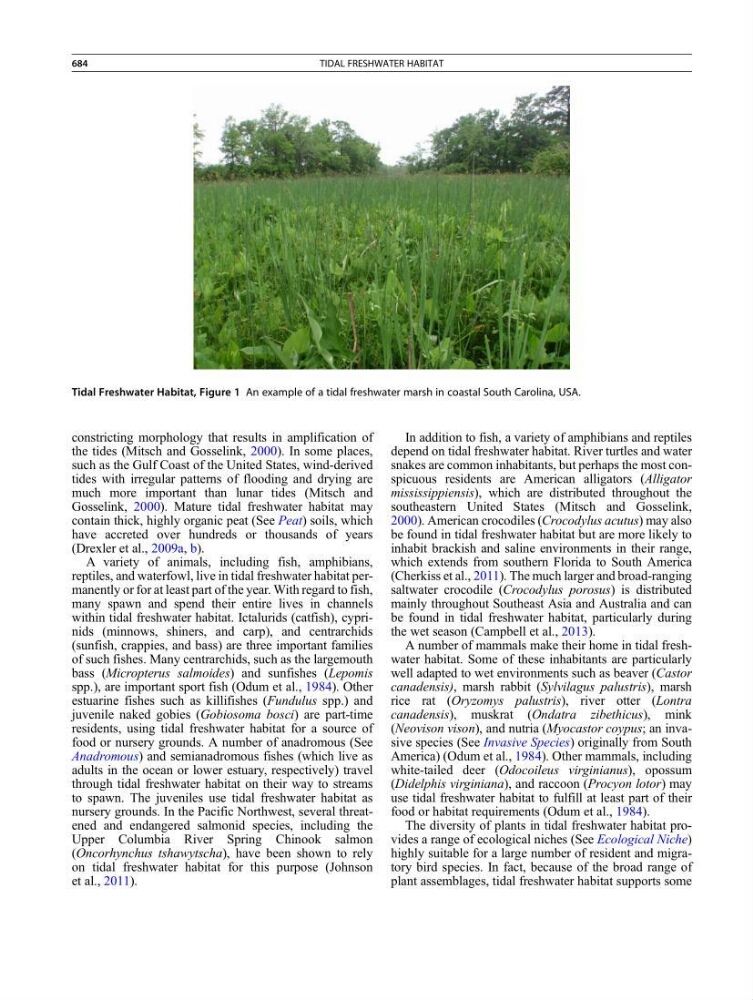
Tidal Freshwater Habitat, Figure 1 An example of a tidal freshwater marsh in coastal South Carolina, USA.
684
TIDAL FRESHWATER HABITAT