

brackish or to freshwater at the contact of the tidal flat with
the supratidal zone. Examples of the effect of freshwater
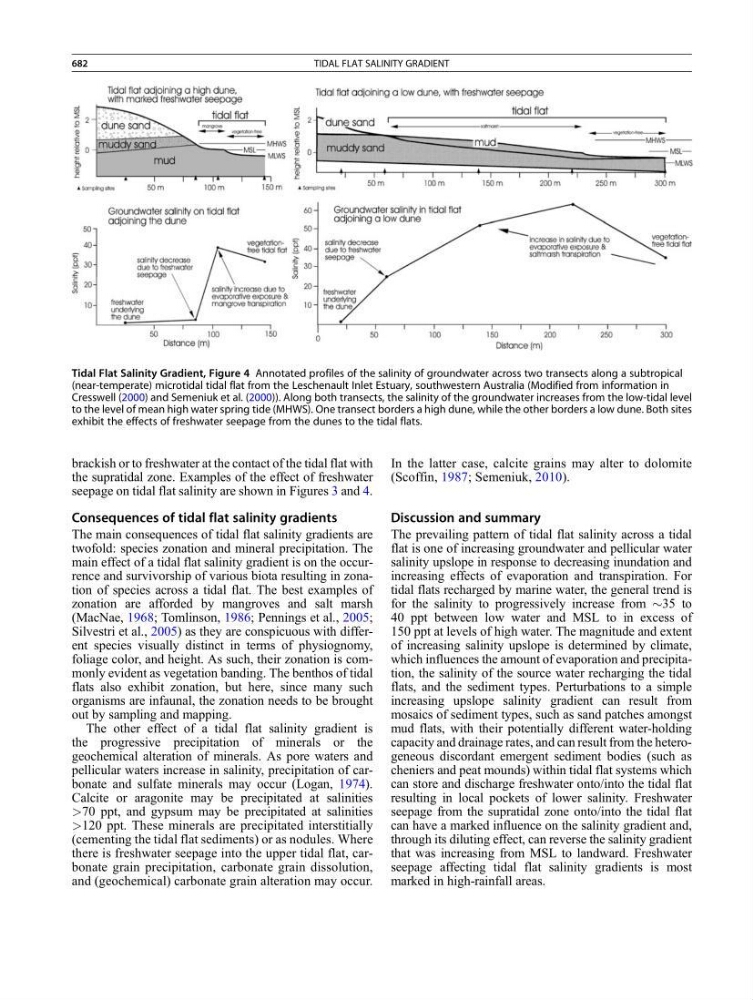
seepage on tidal flat salinity are shown in Figures 3 and 4.
Consequences of tidal flat salinity gradients
The main consequences of tidal flat salinity gradients are
twofold: species zonation and mineral precipitation. The
main effect of a tidal flat salinity gradient is on the occurrence and survivorship of various biota resulting in zonation of species across a tidal flat. The best examples of
zonation are afforded by mangroves and salt marsh
(MacNae, 1968; Tomlinson, 1986; Pennings et al., 2005;
Silvestri et al., 2005) as they are conspicuous with different species visually distinct in terms of physiognomy,
foliage color, and height. As such, their zonation is commonly evident as vegetation banding. The benthos of tidal
flats also exhibit zonation, but here, since many such
organisms are infaunal, the zonation needs to be brought
out by sampling and mapping.
The other effect of a tidal flat salinity gradient is
the progressive precipitation of minerals or the
geochemical alteration of minerals. As pore waters and
pellicular waters increase in salinity, precipitation of carbonate and sulfate minerals may occur (Logan, 1974).
Calcite or aragonite may be precipitated at salinities
>70 ppt, and gypsum may be precipitated at salinities
>120 ppt. These minerals are precipitated interstitially
(cementing the tidal flat sediments) or as nodules. Where
there is freshwater seepage into the upper tidal flat, carbonate grain precipitation, carbonate grain dissolution,
and (geochemical) carbonate grain alteration may occur.
In the latter case, calcite grains may alter to dolomite
(Scoffin, 1987; Semeniuk, 2010).
Discussion and summary
The prevailing pattern of tidal flat salinity across a tidal
flat is one of increasing groundwater and pellicular water
salinity upslope in response to decreasing inundation and
increasing effects of evaporation and transpiration. For
tidal flats recharged by marine water, the general trend is
for the salinity to progressively increase from $35 to
40 ppt between low water and MSL to in excess of
150 ppt at levels of high water. The magnitude and extent
of increasing salinity upslope is determined by climate,
which influences the amount of evaporation and precipitation, the salinity of the source water recharging the tidal
flats, and the sediment types. Perturbations to a simple
increasing upslope salinity gradient can result from
mosaics of sediment types, such as sand patches amongst
mud flats, with their potentially different water-holding
capacity and drainage rates, and can result from the heterogeneous discordant emergent sediment bodies (such as
cheniers and peat mounds) within tidal flat systems which
can store and discharge freshwater onto/into the tidal flat
resulting in local pockets of lower salinity. Freshwater
seepage from the supratidal zone onto/into the tidal flat
can have a marked influence on the salinity gradient and,
through its diluting effect, can reverse the salinity gradient
that was increasing from MSL to landward. Freshwater
seepage affecting tidal flat salinity gradients is most
marked in high-rainfall areas.
Tidal Flat Salinity Gradient, Figure 4 Annotated profiles of the salinity of groundwater across two transects along a subtropical
(near-temperate) microtidal tidal flat from the Leschenault Inlet Estuary, southwestern Australia (Modified from information in
Cresswell (2000) and Semeniuk et al. (2000)). Along both transects, the salinity of the groundwater increases from the low-tidal level
to the level of mean high water spring tide (MHWS). One transect borders a high dune, while the other borders a low dune. Both sites
exhibit the effects of freshwater seepage from the dunes to the tidal flats.
682
TIDAL FLAT SALINITY GRADIENT