

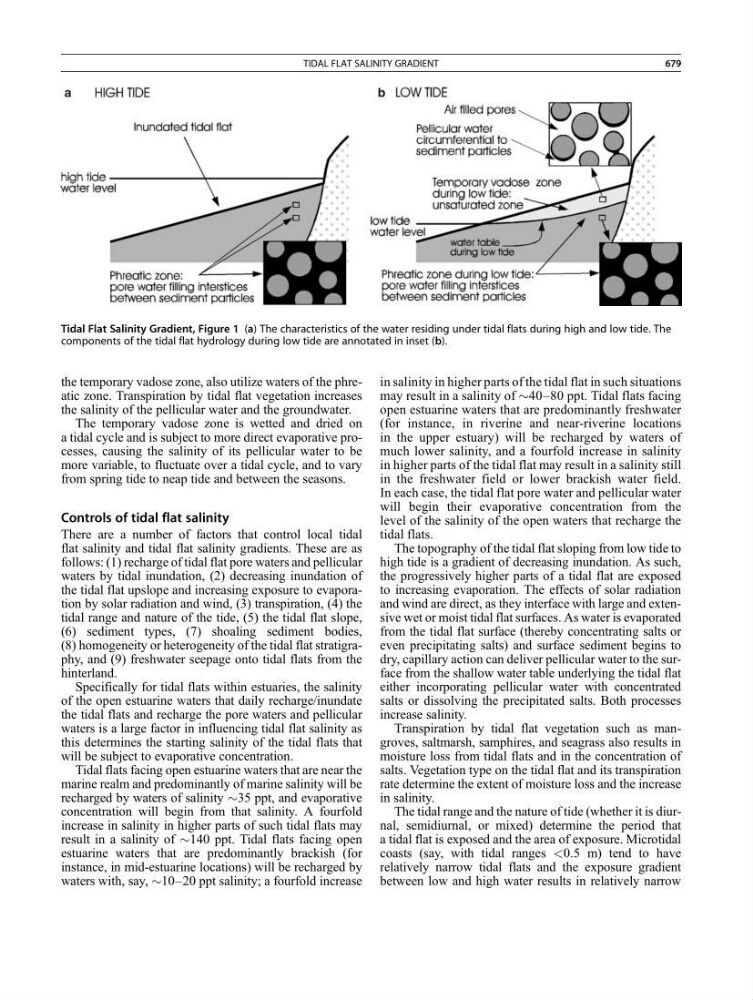
the temporary vadose zone, also utilize waters of the phreatic zone. Transpiration by tidal flat vegetation increases
the salinity of the pellicular water and the groundwater.
The temporary vadose zone is wetted and dried on
a tidal cycle and is subject to more direct evaporative processes, causing the salinity of its pellicular water to be
more variable, to fluctuate over a tidal cycle, and to vary
from spring tide to neap tide and between the seasons.
Controls of tidal flat salinity
There are a number of factors that control local tidal
flat salinity and tidal flat salinity gradients. These are as
follows: (1) recharge of tidal flat pore waters and pellicular
waters by tidal inundation, (2) decreasing inundation of
the tidal flat upslope and increasing exposure to evaporation by solar radiation and wind, (3) transpiration, (4) the
tidal range and nature of the tide, (5) the tidal flat slope,
(6) sediment types, (7) shoaling sediment bodies,
(8) homogeneity or heterogeneity of the tidal flat stratigraphy, and (9) freshwater seepage onto tidal flats from the
hinterland.
Specifically for tidal flats within estuaries, the salinity
of the open estuarine waters that daily recharge/inundate
the tidal flats and recharge the pore waters and pellicular
waters is a large factor in influencing tidal flat salinity as
this determines the starting salinity of the tidal flats that
will be subject to evaporative concentration.
Tidal flats facing open estuarine waters that are near the
marine realm and predominantly of marine salinity will be
recharged by waters of salinity $35 ppt, and evaporative
concentration will begin from that salinity. A fourfold
increase in salinity in higher parts of such tidal flats may
result in a salinity of $140 ppt. Tidal flats facing open
estuarine waters that are predominantly brackish (for
instance, in mid-estuarine locations) will be recharged by
waters with, say, $10–20 ppt salinity; a fourfold increase
in salinity in higher parts of the tidal flat in such situations
may result in a salinity of $40–80 ppt. Tidal flats facing
open estuarine waters that are predominantly freshwater
(for instance, in riverine and near-riverine locations
in the upper estuary) will be recharged by waters of
much lower salinity, and a fourfold increase in salinity
in higher parts of the tidal flat may result in a salinity still
in the freshwater field or lower brackish water field.
In each case, the tidal flat pore water and pellicular water
will begin their evaporative concentration from the
level of the salinity of the open waters that recharge the
tidal flats.
The topography of the tidal flat sloping from low tide to
high tide is a gradient of decreasing inundation. As such,
the progressively higher parts of a tidal flat are exposed
to increasing evaporation. The effects of solar radiation
and wind are direct, as they interface with large and extensive wet or moist tidal flat surfaces. As water is evaporated
from the tidal flat surface (thereby concentrating salts or
even precipitating salts) and surface sediment begins to
dry, capillary action can deliver pellicular water to the surface from the shallow water table underlying the tidal flat
either incorporating pellicular water with concentrated
salts or dissolving the precipitated salts. Both processes
increase salinity.
Transpiration by tidal flat vegetation such as mangroves, saltmarsh, samphires, and seagrass also results in
moisture loss from tidal flats and in the concentration of
salts. Vegetation type on the tidal flat and its transpiration
rate determine the extent of moisture loss and the increase
in salinity.
The tidal range and the nature of tide (whether it is diurnal, semidiurnal, or mixed) determine the period that
a tidal flat is exposed and the area of exposure. Microtidal
coasts (say, with tidal ranges <0.5 m) tend to have
relatively narrow tidal flats and the exposure gradient
between low and high water results in relatively narrow
Tidal Flat Salinity Gradient, Figure 1 (a) The characteristics of the water residing under tidal flats during high and low tide. The
components of the tidal flat hydrology during low tide are annotated in inset (b).
TIDAL FLAT SALINITY GRADIENT
679