

ELWS and EHWS is the tidal zone, and any low-gradient
surface between these levels is a tidal flat. Tidal flats are
not always simple uniformly sloping surfaces; they often
have variation as determined by hydrodynamic setting,
e.g., low hummocks of sand on mud flats, low relief
cheniers, or tidal creeks, as well as variable substrates.
These smaller-scale variations influence the development
of small-scale habitats and the distribution of biota across
the tidal flat. In providing variable habitats for organisms
related to sediment types, tidal levels, and hydrochemistry,
for a given biogeography and climate setting, tidal flats
form the foundation for coastal biodiversity.
Tidal flats occur in varied geomorphic and sedimentologic settings within an estuary; these include platforms
bordering estuary margins, tidal parts of flood-tidal deltas,
tidal parts of intra-estuarine riverine deltas, the crests and
flanks of middle-of-estuary shoals, and the protected
lagoons leeward of spits. Where sand and mud are available, the sediments commonly are partitioned across the
tidal flat because of hydrodynamic processes, resulting
in depth-related mud flat grading to sand flats.
When exposed at low tide, tidal flats are subject to
evaporation and transpiration, and a salinity gradient from
seaward to landward is developed due to the interacting
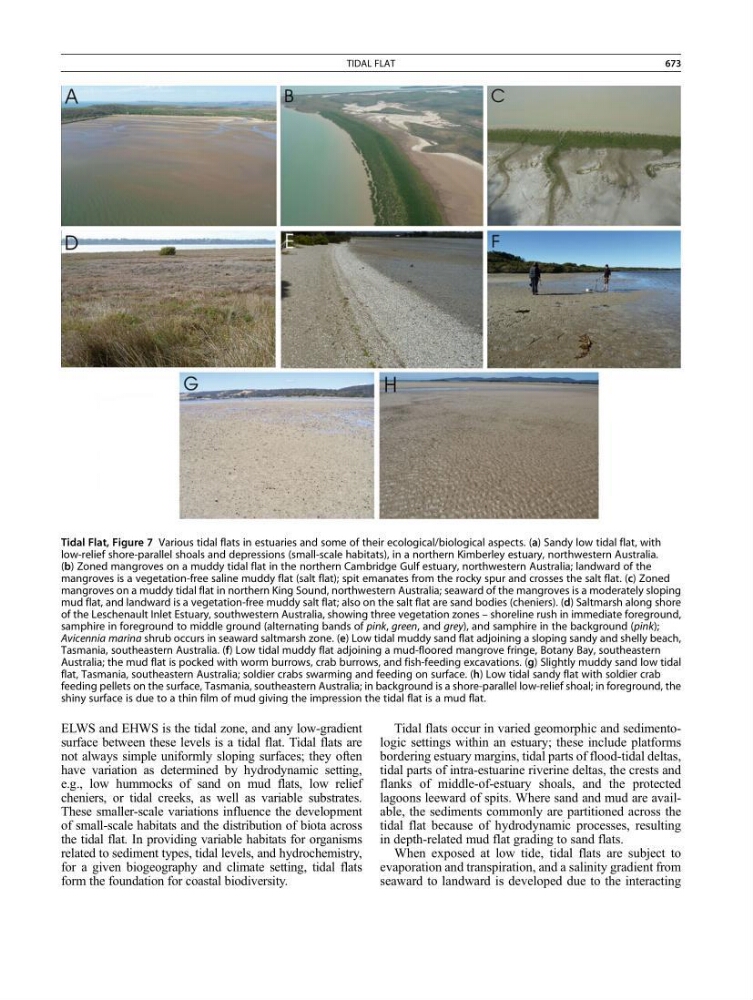
Tidal Flat, Figure 7 Various tidal flats in estuaries and some of their ecological/biological aspects. (a) Sandy low tidal flat, with
low-relief shore-parallel shoals and depressions (small-scale habitats), in a northern Kimberley estuary, northwestern Australia.
(b) Zoned mangroves on a muddy tidal flat in the northern Cambridge Gulf estuary, northwestern Australia; landward of the
mangroves is a vegetation-free saline muddy flat (salt flat); spit emanates from the rocky spur and crosses the salt flat. (c) Zoned
mangroves on a muddy tidal flat in northern King Sound, northwestern Australia; seaward of the mangroves is a moderately sloping
mud flat, and landward is a vegetation-free muddy salt flat; also on the salt flat are sand bodies (cheniers). (d) Saltmarsh along shore
of the Leschenault Inlet Estuary, southwestern Australia, showing three vegetation zones – shoreline rush in immediate foreground,
samphire in foreground to middle ground (alternating bands of pink, green, and grey), and samphire in the background (pink);
Avicennia marina shrub occurs in seaward saltmarsh zone. (e) Low tidal muddy sand flat adjoining a sloping sandy and shelly beach,
Tasmania, southeastern Australia. (f) Low tidal muddy flat adjoining a mud-floored mangrove fringe, Botany Bay, southeastern
Australia; the mud flat is pocked with worm burrows, crab burrows, and fish-feeding excavations. (g) Slightly muddy sand low tidal
flat, Tasmania, southeastern Australia; soldier crabs swarming and feeding on surface. (h) Low tidal sandy flat with soldier crab
feeding pellets on the surface, Tasmania, southeastern Australia; in background is a shore-parallel low-relief shoal; in foreground, the
shiny surface is due to a thin film of mud giving the impression the tidal flat is a mud flat.
TIDAL FLAT
673