

(inhabiting the tidal flat surface; this includes grazing gastropods, scavenging echinoderms, sessile mussels,
encrusting oysters), infauna (inhabiting the tidal flat subsurface in structured burrows, or cavities, or simply buried; this includes bivalves, polychaetes, echinoderms,
and crustacea; endobenthic is a term also applied to
infauna), or alternating infauna/epifauna (inhabiting the
subsurface but emerging periodically onto the surface for
feeding or breeding; this includes crabs, goby fish, some
polychaetes, and some gastropods, e.g., Unno and
Semeniuk, 2011). Again, these assemblages are biogeography specific and climate specific in composition and
structure but also substrate specific in that low tidal sand
flat fauna can be markedly different from low tidal mud
flat fauna for a given biogeographic and climate setting.
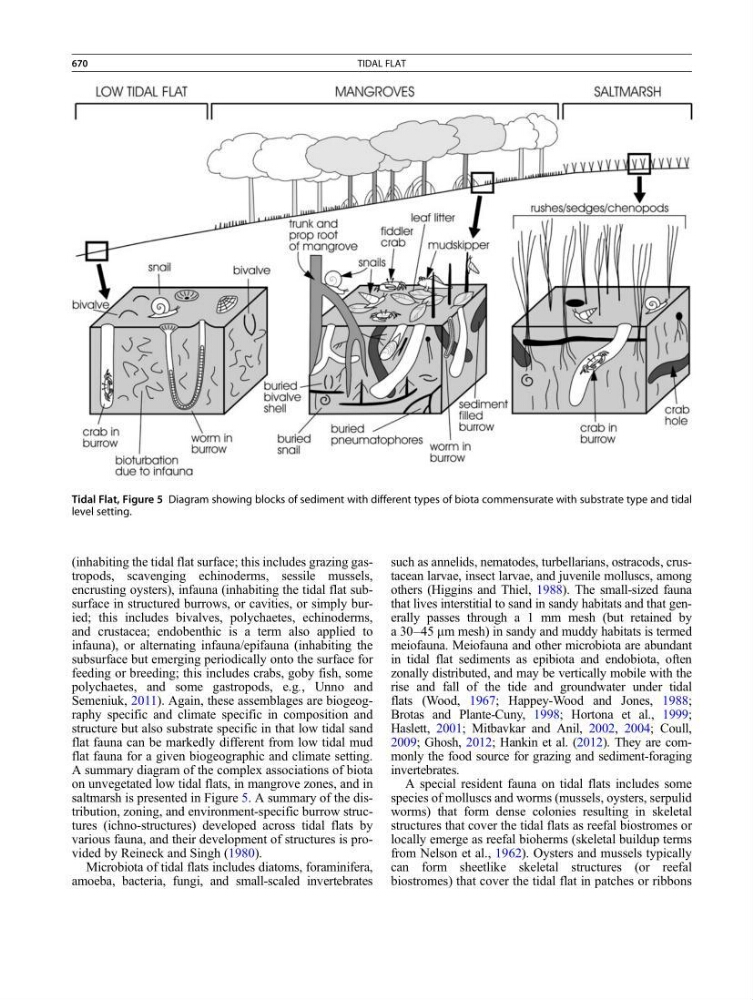
A summary diagram of the complex associations of biota
on unvegetated low tidal flats, in mangrove zones, and in
saltmarsh is presented in Figure 5. A summary of the distribution, zoning, and environment-specific burrow structures (ichno-structures) developed across tidal flats by
various fauna, and their development of structures is provided by Reineck and Singh (1980).
Microbiota of tidal flats includes diatoms, foraminifera,
amoeba, bacteria, fungi, and small-scaled invertebrates
such as annelids, nematodes, turbellarians, ostracods, crustacean larvae, insect larvae, and juvenile molluscs, among
others (Higgins and Thiel, 1988). The small-sized fauna
that lives interstitial to sand in sandy habitats and that generally passes through a 1 mm mesh (but retained by
a 30–45 mm mesh) in sandy and muddy habitats is termed
meiofauna. Meiofauna and other microbiota are abundant
in tidal flat sediments as epibiota and endobiota, often
zonally distributed, and may be vertically mobile with the
rise and fall of the tide and groundwater under tidal
flats (Wood, 1967; Happey-Wood and Jones, 1988;
Brotas and Plante-Cuny, 1998; Hortona et al., 1999;
Haslett, 2001; Mitbavkar and Anil, 2002, 2004; Coull,
2009; Ghosh, 2012; Hankin et al. (2012). They are commonly the food source for grazing and sediment-foraging
invertebrates.
A special resident fauna on tidal flats includes some
species of molluscs and worms (mussels, oysters, serpulid
worms) that form dense colonies resulting in skeletal
structures that cover the tidal flats as reefal biostromes or
locally emerge as reefal bioherms (skeletal buildup terms
from Nelson et al., 1962). Oysters and mussels typically
can form sheetlike skeletal structures (or reefal
biostromes) that cover the tidal flat in patches or ribbons
Tidal Flat, Figure 5 Diagram showing blocks of sediment with different types of biota commensurate with substrate type and tidal
level setting.
670
TIDAL FLAT