

Biological systems, which are dependent on cycling of
finite resources, have limitations with respect to the
goods they can provide and services they can render.
Although certain limits can be extended to some degree
through technological breakthroughs, there are still
limits and constraints imposed by the availability and
accessibility of endogenous and exogenous resources.
6. To ameliorate any potential negative long-term effects
of resource uses, it is incumbent on all resource users
to apply the precautionary principle in their management decisions and to opt for sustainable-use management strategies and policies favoring uses that provide
increased sustainable benefits.
Monitoring sustainability
Monitoring is the continuous or periodic process of
collecting and analyzing data to measure the performance
of a program, project, or activity. As an integral and continuing part of project/program management, monitoring
provides managers and stakeholders with regular feedback on implementation and progress toward the attainment of environmental objectives (UNESCO, 2006).
Monitoring enables management to take appropriate corrective action to achieve desired results. Effective monitoring requires baseline data, as well as indicators of
performance and related measurements, regular reporting,
and a feedback mechanism for management decisionmaking (UNESCO, 2006).
Effective monitoring and evaluation are widely recognized as an indispensable tool in assuring that the management objectives established are being achieved. If done
well, a monitoring and evaluation plan and associated
indicators serve both as a corrective function during the
project cycle, enabling timely adjustments, and as
a guide to structuring future projects more effectively.
Sustainable-use monitoring must involve the consideration of governance, ecological (including environmental)
and socioeconomic dimensions, as well as the interaction
between them (UNESCO, 2006). The indicators oriented
to measure sustainable development are designated as sustainable development indicators. The recent report titled
Framework and Suggested Indicators to Measure Sustainable Development (UNECE et al., 2013) presents an
approach which aims to facilitate users’ choices through
large numbers of sustainable development indicators
available in literature (e.g., EC, 2007; UN, 2007).
Although this publication is primarily aimed at statisticians, it may also be relevant for policymakers, as policy
targets for sustainable development are increasingly being
formulated at national and international levels.
Estuaries
An ecosystem with unequaled value
Estuaries are highly productive ecosystems which provide
a suite of resources and services (e.g., Nixon et al., 1986;
Wilson and Farber, 2009; Barbier et al., 2011). Thus, estuaries are an irreplaceable natural ecosystem that must be
managed carefully for the mutual benefit of all who enjoy
and depend on them. Thousands of species of birds, mammals, and other wildlife depend on estuarine habitats as
places to live, feed, and reproduce. And many marine
organisms, including most commercially important species of fish, depend on estuaries at some point during their
development. Estuaries are the year-round home for many
species (e.g., oysters), while other species move in and out
of estuaries on a seasonal basis for reproduction and
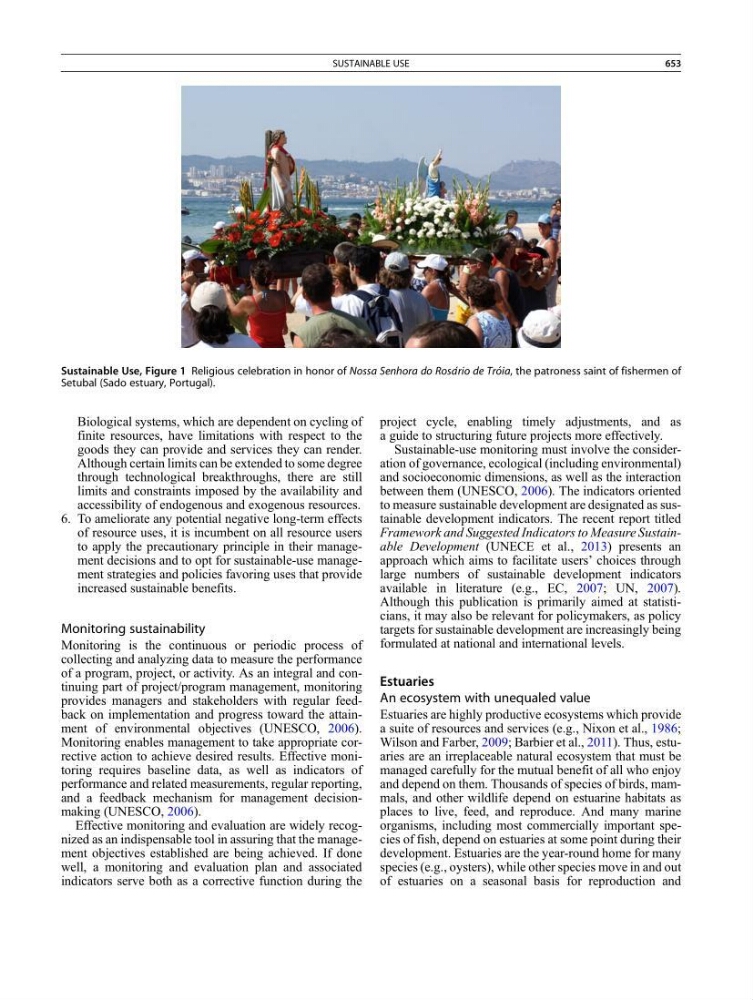
Sustainable Use, Figure 1 Religious celebration in honor of Nossa Senhora do Rosa ´rio de Tro ´ia, the patroness saint of fishermen of
Setubal (Sado estuary, Portugal).
SUSTAINABLE USE
653