

to form beach ridges and cuspate forelands, that can prograde into the estuarine basin. Similarly, a shore-parallel
elongate estuary with a barrier dune migrating inland
may transgress into the estuary or partition the estuary or
at the least contribute to estuarine shore facies. Also, elongate estuaries with mobile sand along their shore (derived
from an eroding shore mentioned earlier) can develop
accretionary spits and cuspate forelands that segment the
estuary (Zenkovitch, 1959; Bird, 1969), with the accretionary sedimentary bodies, manifesting as sand bodies
“invading” from the estuary margins into the interior of
the estuary, locally encroaching over basinal muddy
deposits. In contrast, an estuary founded on a bifurcating
tributary system, but now largely barred by a barrier,
may be digitate/palmate in geometry, with complicated
hydrodynamics resulting in complicated sedimentary
dynamics and facies (of sandy spits, bars, cuspate forelands, and mud-filled lagoons leeward of these spits, bars,
and cuspate forelands), as the wind-wave fields interact
with complex estuarine form and shore orientations.
Complexity in stratigraphy of estuarine valley fills can
also reflect the various depositional regimes in relation
to sea-level lowstands, transgressive phases, and
sea-level highstands. Allen and Posamentier (1993), for
instance, document the stratigraphic sequence of an
incised valley fill in the Gironde Estuary, France, recording a diverse assemblage of lithofacies (that are grouped
into lowstand, transgressive, and highstand system tracts)
and sedimentation within the current estuary (in terms of
estuary mouth, estuary funnel, a zone of varying types of
estuarine channels, and the alluvial plain). The valley-fill
stratigraphic sequence begins during the Würm global
sea-level lowstand, with accumulation of a continuous
unit of relatively thin fluvial gravel and coarse sand in
the thalweg of the incised valley. The transgressive system
tract, accumulated during the Holocene sea-level rise, comprises the bulk of the incised valley fill and forms a
landward-thinning wedge of tidal-estuarine sands and
muds. In the estuary mouth, these are overlain by a thick
unit of coarse-grained tidal-inlet and tidal-delta sands. The
highstand system tract forms a seaward-prograding, tidedominated estuarine bayhead delta that has been gradually
filling the estuary since the post-Holocene stillstand.
In addition, complexity and variability can result from
climate effects and climate setting, which can determine
factors such as the formation of peat, the extent of
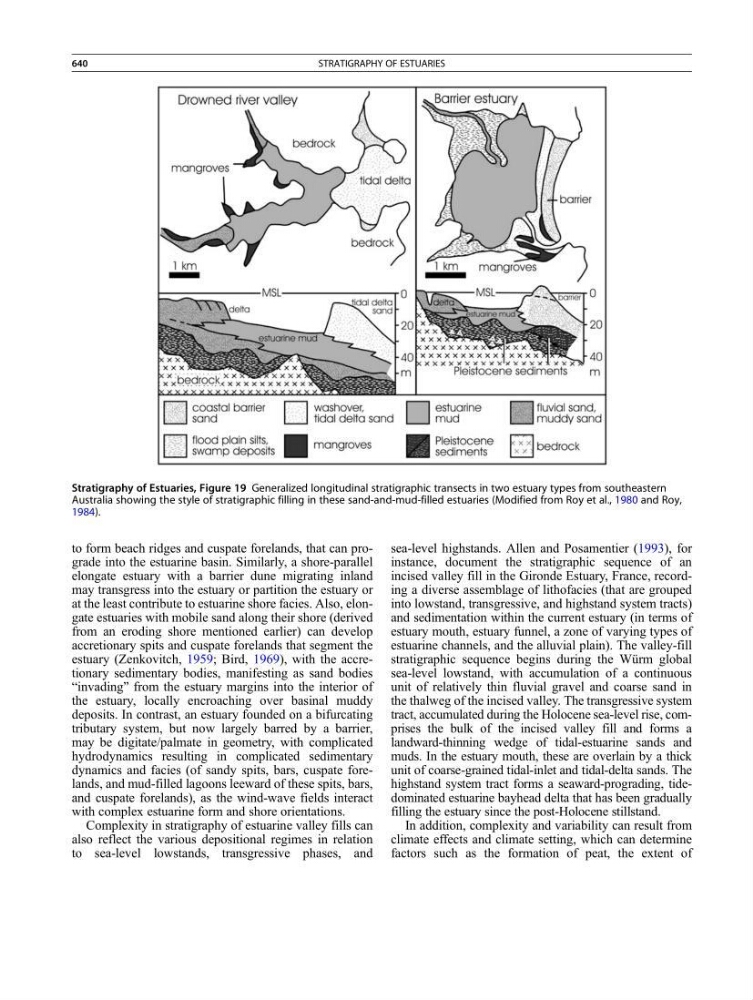
Stratigraphy of Estuaries, Figure 19 Generalized longitudinal stratigraphic transects in two estuary types from southeastern
Australia showing the style of stratigraphic filling in these sand-and-mud-filled estuaries (Modified from Roy et al., 1980 and Roy,
1984).
640
STRATIGRAPHY OF ESTUARIES