

a linear single valley tract, and this has provided valuable
models of the evolution and architecture of whole-ofestuary stratigraphy as summarized in Figures 10, 11, 12,
and 13. Figures 10 and 11 show generalized stratigraphy
in a wave-dominated and a tide-dominated estuary, in
a context of transgression, followed by sedimentary
progradation, with simplified lithologic suites. Figures 12
and 13 show generalized stratigraphy in a wavedominated and a tide-dominated estuary, in a context
of the simplified lithofacies located according to the
sub-environments within the estuary, but not as a
progradational sequence.
The stratigraphic models for estuaries, focused on
wave-dominated types and tide-dominated types within
linear, single valley tracts (Dalrymple et al., 1992;
Figures 10, 11, 12, and 13), have provided an overarching view of their facies and stratigraphic architecture
and have presented the stratigraphic evolution of an estuary in a conceptualized and uniform manner. However,
while this overarching approach for incised valley systems provides a useful model to characterize many estuarine sedimentary fills and their longitudinal
stratigraphy, it does not provide a framework for, or
explanation of, the full range of relatively homogeneous
stratigraphy or for the longitudinally and transversely
heterogeneous stratigraphy found in many other types
of estuaries in the variety of climatic settings and other
coastal settings in which they occur. The South Alligator
River Estuary of northern Australia, the Lawley River
Estuary of northwestern Australia, and the Leschenault
Inlet Estuary of southwestern Australia, among others,
stand as examples of contrasting stratigraphic fills in
estuaries. While the longitudinal facies variation in an
incised valley estuary provides some degree of heterogeneity in such estuaries, the full range of heterogeneity, or
even homogeneity, has not been addressed in these
models. For instance, heterogeneity can be determined
by deltas, i.e., on the number of deltas, their positions
in the estuary and hence their stratigraphic contribution
to the head and to the central parts of the estuarine
embayment, their position relative to basin fetch, and
hence whether they are wave-, tide-, or fluvially dominated, and the volume and type of sediment delivered
by contributing river(s), and thus whether the deltas
are mud-dominated, sand-and-mud-dominated, or sanddominated. In the complex Peel-Harvey Estuary
of southwestern Australia, for example, the deltas facing
the prevailing summer southwesterly wind waves
across a large estuary fetch are wave-dominated, while
one in the south of the estuary is fluvially dominated
(Semeniuk and Semeniuk, 1990a; Semeniuk and
Semeniuk, 1990b). Similarly for the complex WalpoleNornalup Inlet Estuary of southwestern Australia, each
of the deltas faces estuarine waters of differing fetch
and wind-wave trains such that they develop different
delta types and delta stratigraphy.
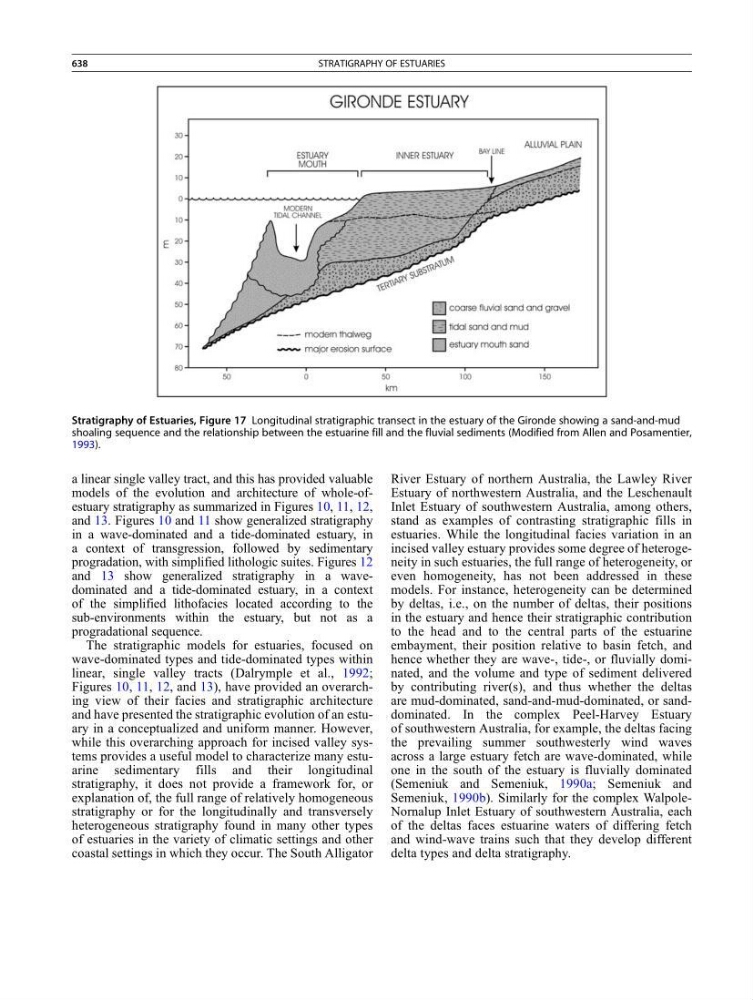
Stratigraphy of Estuaries, Figure 17 Longitudinal stratigraphic transect in the estuary of the Gironde showing a sand-and-mud
shoaling sequence and the relationship between the estuarine fill and the fluvial sediments (Modified from Allen and Posamentier,
1993).
638
STRATIGRAPHY OF ESTUARIES