

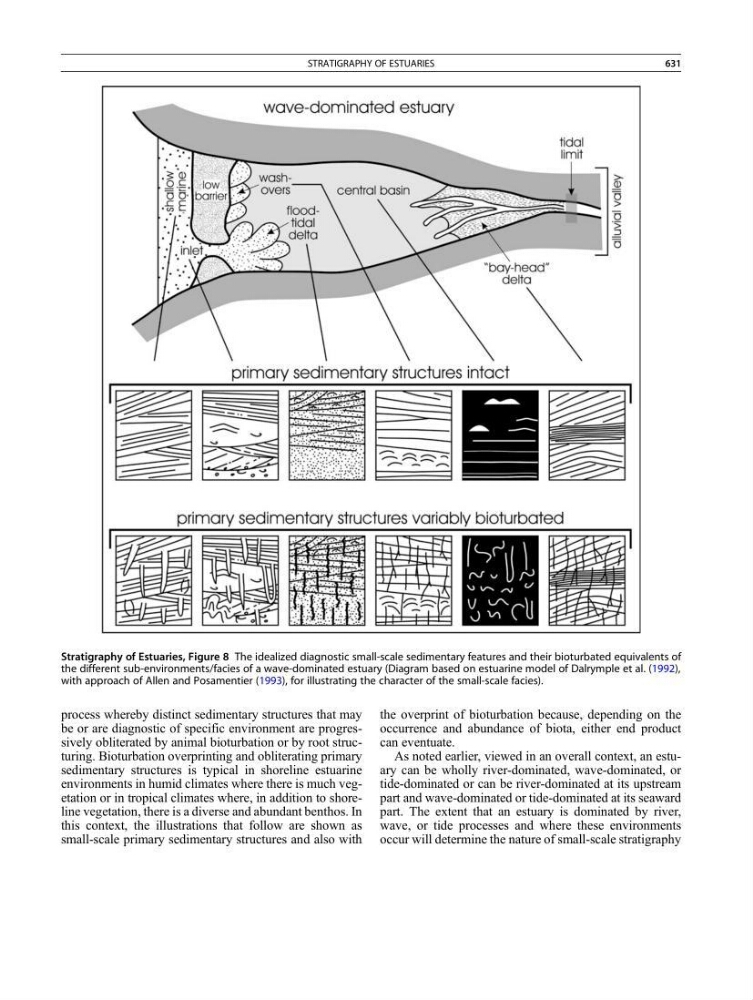
process whereby distinct sedimentary structures that may
be or are diagnostic of specific environment are progressively obliterated by animal bioturbation or by root structuring. Bioturbation overprinting and obliterating primary
sedimentary structures is typical in shoreline estuarine
environments in humid climates where there is much vegetation or in tropical climates where, in addition to shoreline vegetation, there is a diverse and abundant benthos. In
this context, the illustrations that follow are shown as
small-scale primary sedimentary structures and also with
the overprint of bioturbation because, depending on the
occurrence and abundance of biota, either end product
can eventuate.
As noted earlier, viewed in an overall context, an estuary can be wholly river-dominated, wave-dominated, or
tide-dominated or can be river-dominated at its upstream
part and wave-dominated or tide-dominated at its seaward
part. The extent that an estuary is dominated by river,
wave, or tide processes and where these environments
occur will determine the nature of small-scale stratigraphy
Stratigraphy of Estuaries, Figure 8 The idealized diagnostic small-scale sedimentary features and their bioturbated equivalents of
the different sub-environments/facies of a wave-dominated estuary (Diagram based on estuarine model of Dalrymple et al. (1992),
with approach of Allen and Posamentier (1993), for illustrating the character of the small-scale facies).
STRATIGRAPHY OF ESTUARIES
631