

fluvial and marine sources and containing facies
influenced by tide, wave, and fluvial processes. In this
context, the essence of an estuary is that it is a river-tomarine transitional environment, which is reflected in the
change from riverine conditions (with its assemblage of
lithofacies) to marine conditions (with its assemblage of
marine lithofacies), with the estuarine basin being
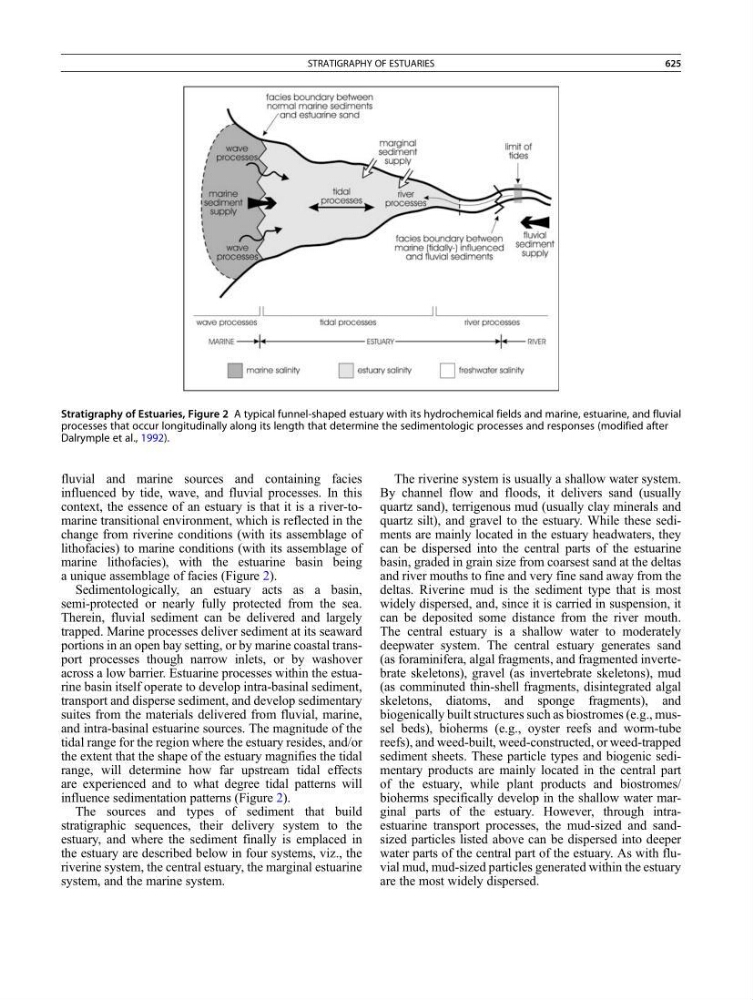
a unique assemblage of facies (Figure 2).
Sedimentologically, an estuary acts as a basin,
semi-protected or nearly fully protected from the sea.
Therein, fluvial sediment can be delivered and largely
trapped. Marine processes deliver sediment at its seaward
portions in an open bay setting, or by marine coastal transport processes though narrow inlets, or by washover
across a low barrier. Estuarine processes within the estuarine basin itself operate to develop intra-basinal sediment,
transport and disperse sediment, and develop sedimentary
suites from the materials delivered from fluvial, marine,
and intra-basinal estuarine sources. The magnitude of the
tidal range for the region where the estuary resides, and/or
the extent that the shape of the estuary magnifies the tidal
range, will determine how far upstream tidal effects
are experienced and to what degree tidal patterns will
influence sedimentation patterns (Figure 2).
The sources and types of sediment that build
stratigraphic sequences, their delivery system to the
estuary, and where the sediment finally is emplaced in
the estuary are described below in four systems, viz., the
riverine system, the central estuary, the marginal estuarine
system, and the marine system.
The riverine system is usually a shallow water system.
By channel flow and floods, it delivers sand (usually
quartz sand), terrigenous mud (usually clay minerals and
quartz silt), and gravel to the estuary. While these sediments are mainly located in the estuary headwaters, they
can be dispersed into the central parts of the estuarine
basin, graded in grain size from coarsest sand at the deltas
and river mouths to fine and very fine sand away from the
deltas. Riverine mud is the sediment type that is most
widely dispersed, and, since it is carried in suspension, it
can be deposited some distance from the river mouth.
The central estuary is a shallow water to moderately
deepwater system. The central estuary generates sand
(as foraminifera, algal fragments, and fragmented invertebrate skeletons), gravel (as invertebrate skeletons), mud
(as comminuted thin-shell fragments, disintegrated algal
skeletons, diatoms, and sponge fragments), and
biogenically built structures such as biostromes (e.g., mussel beds), bioherms (e.g., oyster reefs and worm-tube
reefs), and weed-built, weed-constructed, or weed-trapped
sediment sheets. These particle types and biogenic sedimentary products are mainly located in the central part
of the estuary, while plant products and biostromes/
bioherms specifically develop in the shallow water marginal parts of the estuary. However, through intraestuarine transport processes, the mud-sized and sandsized particles listed above can be dispersed into deeper
water parts of the central part of the estuary. As with fluvial mud, mud-sized particles generated within the estuary
are the most widely dispersed.
Stratigraphy of Estuaries, Figure 2 A typical funnel-shaped estuary with its hydrochemical fields and marine, estuarine, and fluvial
processes that occur longitudinally along its length that determine the sedimentologic processes and responses (modified after
Dalrymple et al., 1992).
STRATIGRAPHY OF ESTUARIES
625