

and a zonation of species across the tidal flat. For example,
experimental results have shown that for salt-marsh vegetation, periodicity of inundation can be a major determinant of survival, as it determines oxygen availability, and
only plants adapted to these conditions are able to tolerate
such environments (Pennings and Callaway, 1992; Mitsch
and Gosselink, 1993).
Broad-scale zonation
An estuary may be comprised of a sequence of habitats
that intergrade from river to sea, forming a gradient of
environments. In this context, biota responding to the gradient of changing environments will form gradational
zones. For example, the gradient from river to estuarine
basin involves tidal sand, subtidal muddy sand, and deeper
water mud, with a gradient of open-water salinity of freshwater to brackish water. Here, species zonation reflects the
gradient or sequence of habitat types, as well as the alongestuarine environmental gradient of salinity and substrate
grain size. This is species zonation across multiple habitats
(Figures 2 and 3).
Finer-scale zonation
Zonation within a habitat occurs when there are strong and
steep environmental gradients. For instance, on tidal flats
where daily tidal exposure introduces inundation, evaporation, salinity, and moisture content, the local species
respond to these environmental conditions and occur in
distinct and discrete bands. Where there is an aggregate
of species in the habitat, these will form a distinct zone,
i.e., species zonation across a habitat. Species zonation
also can occur in subtidal habitats in response to environmental gradients of water depth, light availability, and sediment types.
Examples of species zonation
One of the best examples of species zonation in response
to tidal flat environmental gradients is afforded by mangroves and saltmarshes (Figures 4, 5, 6, and 7; and
Chapman, 1938; Bridgewater, 1975; Tomlinson, 1986;
Bridgewater and Cresswell, 1993; Cresswell and Bridgewater, 1998; Emery et al., 2001; Pennings et al., 2005).
From mean sea level (MSL) to the high tidal mark, mangroves form zones in response to frequency of inundation,
salinity of pore water, pore-water content, and sediment
grain size. For instance, in a region comprised of six mangrove species (Avicennia marina, Aegialitis annulata,
Aegiceras corniculatum, Bruguiera exaristata, Ceriops
tagal, and Rhizophora stylosa), with strong environmental
gradients of salinity and inundation, there is zonation of
the species in terms of composition, vegetation structure,
and plant physiognomy. The species are zoned from
MSL to the high tidal mark with Avicennia marina found
where the pore-water salinity is 40 ppt, followed by a zone
of Rhizophora stylosa where the pore-water salinity is
45 ppt, then by a zone of Rhizophora stylosa and
Bruguiera exaristata where the pore-water salinity is
55 ppt, a zone of Ceriops tagal where the pore-water salinity is up to 85 ppt, and finally a landward zone of
Avicennia marina where the pore-water salinity is up to
90 ppt (Semeniuk, 1983). Likewise, various species of
saltmarsh form ecological zones in response to inundation
frequency and pore-water salinity on the tidal flats of
estuaries.
There are similar patterns of zonation on tidal flats and
in shallow-water habitats in estuaries for invertebrates
such as fiddler crabs, other Brachyura, and mollusks, with
the biota exhibiting zonation in response to environmental
gradients (Crane, 1975; Chakraborty and Choudhury,
1985; Dittmann, 2000; Dürr and Semeniuk, 2000;
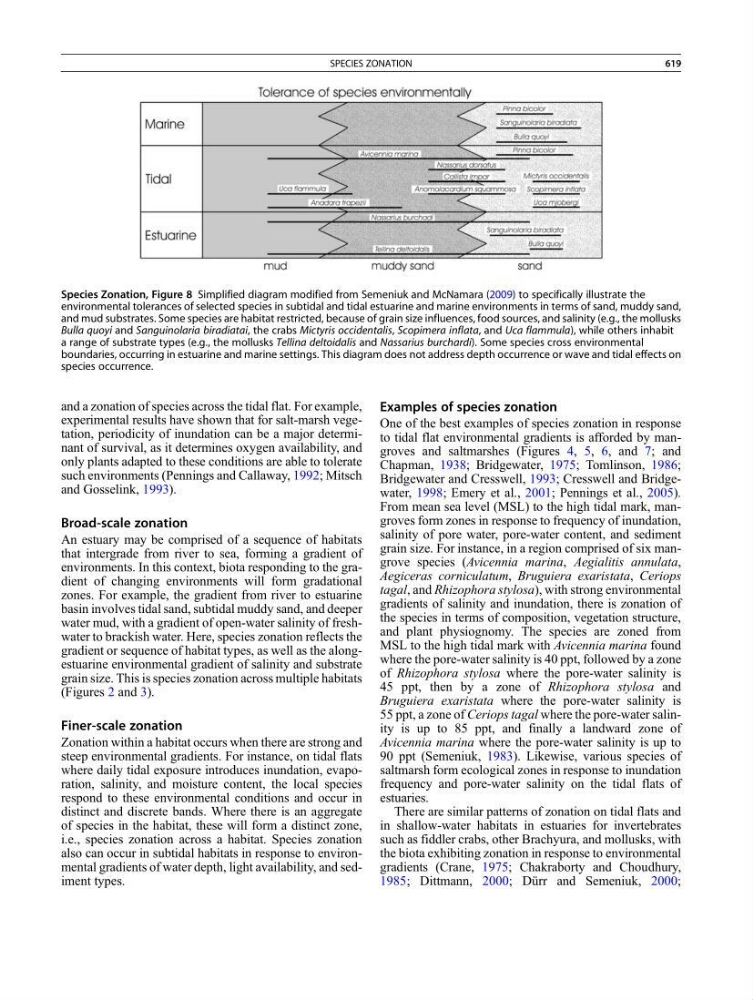
Species Zonation, Figure 8 Simplified diagram modified from Semeniuk and McNamara (2009) to specifically illustrate the
environmental tolerances of selected species in subtidal and tidal estuarine and marine environments in terms of sand, muddy sand,
and mud substrates. Some species are habitat restricted, because of grain size influences, food sources, and salinity (e.g., the mollusks
Bulla quoyi and Sanguinolaria biradiatai, the crabs Mictyris occidentalis, Scopimera inflata, and Uca flammula), while others inhabit
a range of substrate types (e.g., the mollusks Tellina deltoidalis and Nassarius burchardi). Some species cross environmental
boundaries, occurring in estuarine and marine settings. This diagram does not address depth occurrence or wave and tidal effects on
species occurrence.
SPECIES ZONATION
619