

SECCHI DISK
Melanie D. Harrison
Water Quality Specialist, National Oceanic and
Atmospheric Administration, Santa Rosa, CA, USA
Definition
Secchi disk is defined as a simple, standard instrument
used to measure water clarity in ponds, lakes, reservoirs,
estuaries, and oceans (Hutchinson, 1957).
Description
It is an 8-in. (20 cm) diameter circular plate, evenly
divided by black and white quadrants attached to a PVC
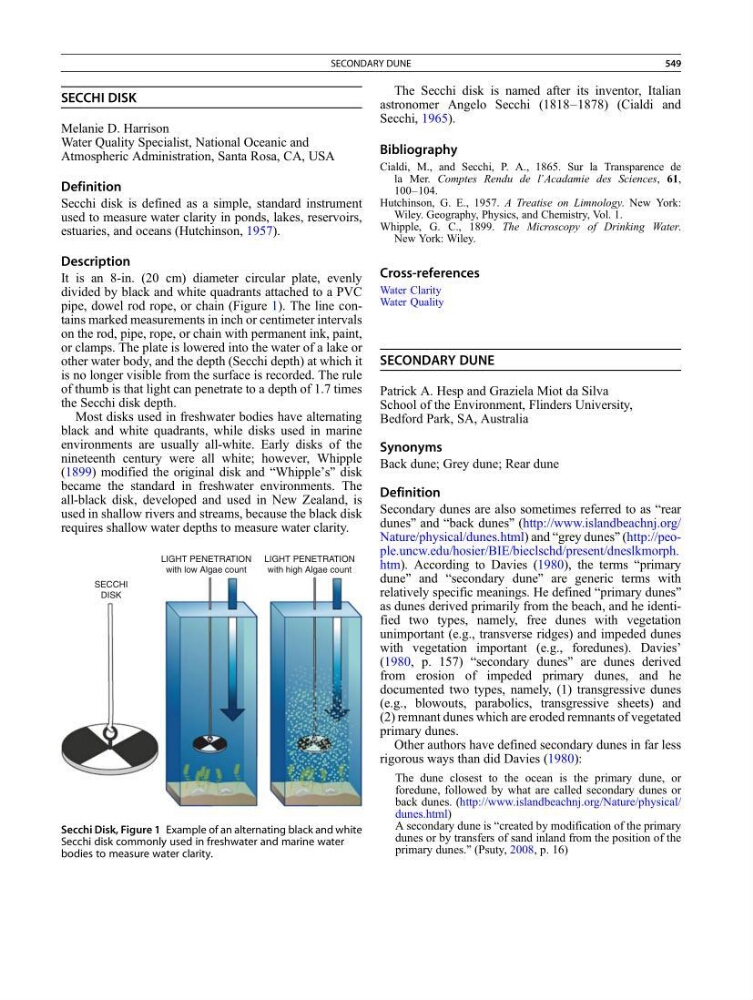
pipe, dowel rod rope, or chain (Figure 1). The line contains marked measurements in inch or centimeter intervals
on the rod, pipe, rope, or chain with permanent ink, paint,
or clamps. The plate is lowered into the water of a lake or
other water body, and the depth (Secchi depth) at which it
is no longer visible from the surface is recorded. The rule
of thumb is that light can penetrate to a depth of 1.7 times
the Secchi disk depth.
Most disks used in freshwater bodies have alternating
black and white quadrants, while disks used in marine
environments are usually all-white. Early disks of the
nineteenth century were all white; however, Whipple
(1899) modified the original disk and “Whipple’s” disk
became the standard in freshwater environments. The
all-black disk, developed and used in New Zealand, is
used in shallow rivers and streams, because the black disk
requires shallow water depths to measure water clarity.
The Secchi disk is named after its inventor, Italian
astronomer Angelo Secchi (1818–1878) (Cialdi and
Secchi, 1965).
Bibliography
Cialdi, M., and Secchi, P. A., 1865. Sur la Transparence de
la Mer. Comptes Rendu de l’Acadamie des Sciences, 61,
100–104.
Hutchinson, G. E., 1957. A Treatise on Limnology. New York:
Wiley. Geography, Physics, and Chemistry, Vol. 1.
Whipple, G. C., 1899. The Microscopy of Drinking Water.
New York: Wiley.
Cross-references
Water Clarity
Water Quality
SECONDARY DUNE
Patrick A. Hesp and Graziela Miot da Silva
School of the Environment, Flinders University,
Bedford Park, SA, Australia
Synonyms
Back dune; Grey dune; Rear dune
Definition
Secondary dunes are also sometimes referred to as “rear
dunes” and “back dunes” (http://www.islandbeachnj.org/
Nature/physical/dunes.html) and “grey dunes” (http://people.uncw.edu/hosier/BIE/bieclschd/present/dneslkmorph.
htm). According to Davies (1980), the terms “primary
dune” and “secondary dune” are generic terms with
relatively specific meanings. He defined “primary dunes”
as dunes derived primarily from the beach, and he identified two types, namely, free dunes with vegetation
unimportant (e.g., transverse ridges) and impeded dunes
with vegetation important (e.g., foredunes). Davies’
(1980, p. 157) “secondary dunes” are dunes derived
from erosion of impeded primary dunes, and he
documented two types, namely, (1) transgressive dunes
(e.g., blowouts, parabolics, transgressive sheets) and
(2) remnant dunes which are eroded remnants of vegetated
primary dunes.
Other authors have defined secondary dunes in far less
rigorous ways than did Davies (1980):
The dune closest to the ocean is the primary dune, or
foredune, followed by what are called secondary dunes or
back dunes. (http://www.islandbeachnj.org/Nature/physical/
dunes.html)
A secondary dune is “created by modification of the primary
dunes or by transfers of sand inland from the position of the
primary dunes.” (Psuty, 2008, p. 16)
SECCHI
DISK
LIGHT PENETRATION
with low Algae count
LIGHT PENETRATION
with high Algae count
Secchi Disk, Figure 1 Example of an alternating black and white
Secchi disk commonly used in freshwater and marine water
bodies to measure water clarity.
SECONDARY DUNE
549
Melanie D. Harrison
Water Quality Specialist, National Oceanic and
Atmospheric Administration, Santa Rosa, CA, USA
Definition
Secchi disk is defined as a simple, standard instrument
used to measure water clarity in ponds, lakes, reservoirs,
estuaries, and oceans (Hutchinson, 1957).
Description
It is an 8-in. (20 cm) diameter circular plate, evenly
divided by black and white quadrants attached to a PVC
pipe, dowel rod rope, or chain (Figure 1). The line contains marked measurements in inch or centimeter intervals
on the rod, pipe, rope, or chain with permanent ink, paint,
or clamps. The plate is lowered into the water of a lake or
other water body, and the depth (Secchi depth) at which it
is no longer visible from the surface is recorded. The rule
of thumb is that light can penetrate to a depth of 1.7 times
the Secchi disk depth.
Most disks used in freshwater bodies have alternating
black and white quadrants, while disks used in marine
environments are usually all-white. Early disks of the
nineteenth century were all white; however, Whipple
(1899) modified the original disk and “Whipple’s” disk
became the standard in freshwater environments. The
all-black disk, developed and used in New Zealand, is
used in shallow rivers and streams, because the black disk
requires shallow water depths to measure water clarity.
The Secchi disk is named after its inventor, Italian
astronomer Angelo Secchi (1818–1878) (Cialdi and
Secchi, 1965).
Bibliography
Cialdi, M., and Secchi, P. A., 1865. Sur la Transparence de
la Mer. Comptes Rendu de l’Acadamie des Sciences, 61,
100–104.
Hutchinson, G. E., 1957. A Treatise on Limnology. New York:
Wiley. Geography, Physics, and Chemistry, Vol. 1.
Whipple, G. C., 1899. The Microscopy of Drinking Water.
New York: Wiley.
Cross-references
Water Clarity
Water Quality
SECONDARY DUNE
Patrick A. Hesp and Graziela Miot da Silva
School of the Environment, Flinders University,
Bedford Park, SA, Australia
Synonyms
Back dune; Grey dune; Rear dune
Definition
Secondary dunes are also sometimes referred to as “rear
dunes” and “back dunes” (http://www.islandbeachnj.org/
Nature/physical/dunes.html) and “grey dunes” (http://people.uncw.edu/hosier/BIE/bieclschd/present/dneslkmorph.
htm). According to Davies (1980), the terms “primary
dune” and “secondary dune” are generic terms with
relatively specific meanings. He defined “primary dunes”
as dunes derived primarily from the beach, and he identified two types, namely, free dunes with vegetation
unimportant (e.g., transverse ridges) and impeded dunes
with vegetation important (e.g., foredunes). Davies’
(1980, p. 157) “secondary dunes” are dunes derived
from erosion of impeded primary dunes, and he
documented two types, namely, (1) transgressive dunes
(e.g., blowouts, parabolics, transgressive sheets) and
(2) remnant dunes which are eroded remnants of vegetated
primary dunes.
Other authors have defined secondary dunes in far less
rigorous ways than did Davies (1980):
The dune closest to the ocean is the primary dune, or
foredune, followed by what are called secondary dunes or
back dunes. (http://www.islandbeachnj.org/Nature/physical/
dunes.html)
A secondary dune is “created by modification of the primary
dunes or by transfers of sand inland from the position of the
primary dunes.” (Psuty, 2008, p. 16)
SECCHI
DISK
LIGHT PENETRATION
with low Algae count
LIGHT PENETRATION
with high Algae count
Secchi Disk, Figure 1 Example of an alternating black and white
Secchi disk commonly used in freshwater and marine water
bodies to measure water clarity.
SECONDARY DUNE
549