

Upper saltmarshes are visited by nekton when flooded
by spring tides; these flooding events are brief and may
not occur on every spring tide cycle during the year. As
such, the utilization of the upper marsh by nekton has been
considered to be accidental and probably of little value to
the visitors. Studies in eastern Australia challenge this
assumption (Hollingsworth and Connolly, 2006;
Mazumder et al., 2006; Mazumder, 2009; Platell and
Freewater, 2009; Mazumder et al., 2011). Breeding of
saltmarsh crabs is linked to the tidal cycle, with release
of zoea larvae coincident with high spring tides.
Individual larvae are very small, but they are extremely
abundant. They represent a high-quality food resource
for fish, which consume them in large numbers. Thus,
although high marshes are limited in extent and only
accessible for short periods of time, they may play
a disproportionately large role in estuarine fish ecology,
both directly for species which access the marshes and
indirectly higher up the food chain in estuaries and adjacent coastal waters.
The marine benthic fauna is diverse and occupies
a range of habitats. The regularly inundated unvegetated
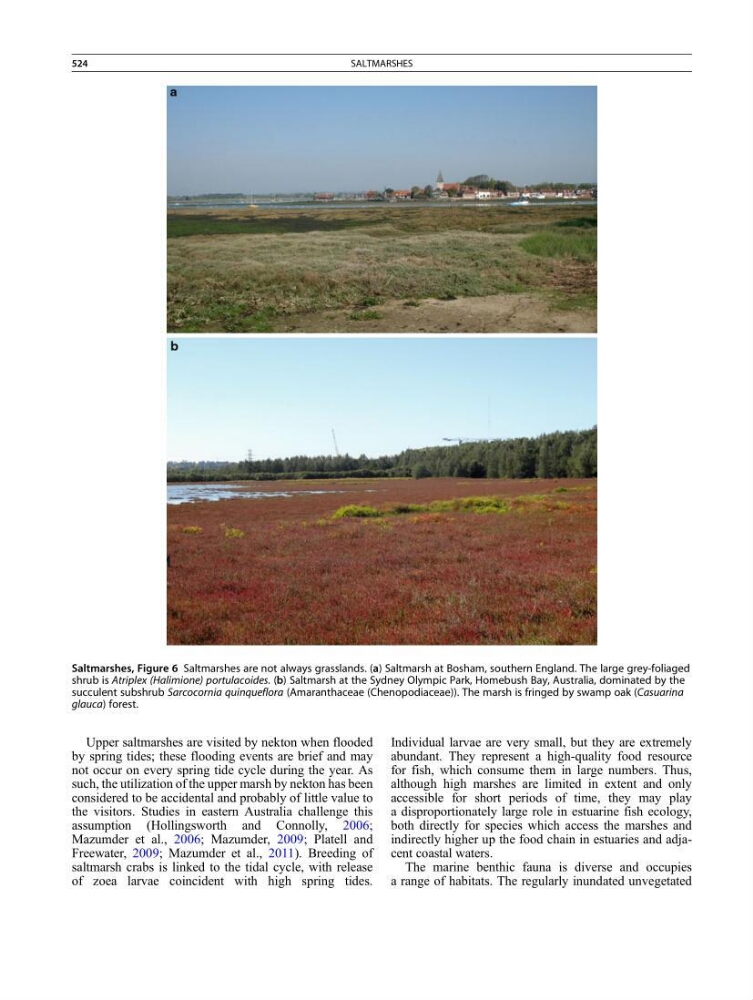
Saltmarshes, Figure 6 Saltmarshes are not always grasslands. (a) Saltmarsh at Bosham, southern England. The large grey-foliaged
shrub is Atriplex (Halimione) portulacoides. (b) Saltmarsh at the Sydney Olympic Park, Homebush Bay, Australia, dominated by the
succulent subshrub Sarcocornia quinqueflora (Amaranthaceae (Chenopodiaceae)). The marsh is fringed by swamp oak (Casuarina
glauca) forest.
524
SALTMARSHES
by spring tides; these flooding events are brief and may
not occur on every spring tide cycle during the year. As
such, the utilization of the upper marsh by nekton has been
considered to be accidental and probably of little value to
the visitors. Studies in eastern Australia challenge this
assumption (Hollingsworth and Connolly, 2006;
Mazumder et al., 2006; Mazumder, 2009; Platell and
Freewater, 2009; Mazumder et al., 2011). Breeding of
saltmarsh crabs is linked to the tidal cycle, with release
of zoea larvae coincident with high spring tides.
Individual larvae are very small, but they are extremely
abundant. They represent a high-quality food resource
for fish, which consume them in large numbers. Thus,
although high marshes are limited in extent and only
accessible for short periods of time, they may play
a disproportionately large role in estuarine fish ecology,
both directly for species which access the marshes and
indirectly higher up the food chain in estuaries and adjacent coastal waters.
The marine benthic fauna is diverse and occupies
a range of habitats. The regularly inundated unvegetated
Saltmarshes, Figure 6 Saltmarshes are not always grasslands. (a) Saltmarsh at Bosham, southern England. The large grey-foliaged
shrub is Atriplex (Halimione) portulacoides. (b) Saltmarsh at the Sydney Olympic Park, Homebush Bay, Australia, dominated by the
succulent subshrub Sarcocornia quinqueflora (Amaranthaceae (Chenopodiaceae)). The marsh is fringed by swamp oak (Casuarina
glauca) forest.
524
SALTMARSHES