

in the Yangtze River Delta. They found that 5–10 times as
much weight of sediment settled into joints of leaves and
stems than adhered directly to the leaves and stems; the
total amount of biomass correlated directly with the
amount of adherent sediment; the amount of adherent sediment decreased with elevation from the marsh surface
and with the distance from the marsh edge toward the high
marsh (both of these obviously reflect the amount of time
of water contact during tidal ebb and flow); and the invasive (in that region) species Spartina alterniflora trapped
significantly more sediment than the native Phragmites
alterniflora and Scirpus mariqueter. All of these plant
species die back in the fall, adding their sediment-laden
detritus to the marsh surface.
CO 2 increase
As atmospheric CO 2 increases, its effect on stimulating
plant growth has been studied in many areas. With salt
marsh vegetation in particular, a mesocosm experiment
in which CO 2 was nearly doubled (simulating expectations for the year 2100) enhanced growth, thickening the
soil by 4.9 mm yr
À1 vs. the control plot increase of
0.7 mm yr
À1
, in part due to stimulation of fine root growth
(Langley et al., 2009). This effect is greater in C 3 plants
such as the sedge Schoenoplectus americanus than in C 4
plants such as the grasses Spartina spp. and Distichlis
spicata (Cherry et al., 2009; Langley et al., 2009). In the
latter, it was not just the CO 2 fertilization effect that was
observed but also an interaction between CO 2 and salinity
(amelioration of salt stress).
Flooding/Sea-level rise
In a greenhouse experiment designed to replicate another
result of climate change, flooding stimulated root growth
(Nyman et al. 2006), thus adding to the organic portion
of the marsh soil.
Ice
When wind-driven ice flows are marooned on a marsh, the
debris in the ice can add to the marsh surface. On a marsh
in Maine, this process added anywhere from 0 % to 100 %
of the total surficial accumulation (Wood et al., 1989).
This phenomenon is obviously more relevant at higher latitudes and thus with global warming can be expected to
decrease in significance. On the other hand, ice shearing
can be destructive, removing both organic and inorganic
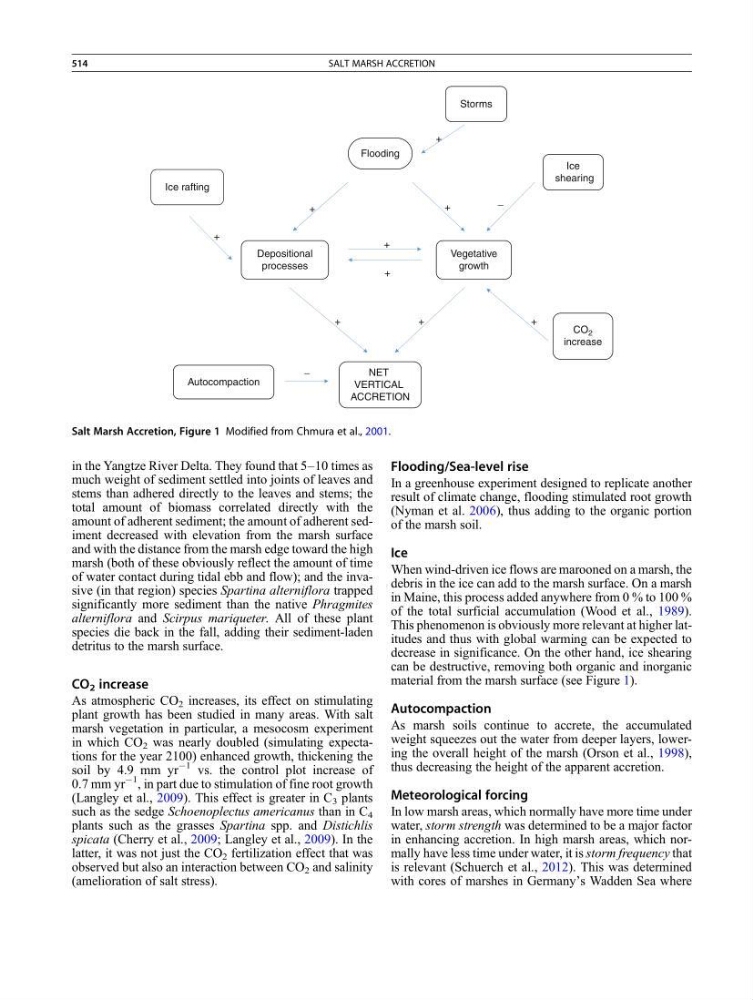
material from the marsh surface (see Figure 1).
Autocompaction
As marsh soils continue to accrete, the accumulated
weight squeezes out the water from deeper layers, lowering the overall height of the marsh (Orson et al., 1998),
thus decreasing the height of the apparent accretion.
Meteorological forcing
In low marsh areas, which normally have more time under
water, storm strength was determined to be a major factor
in enhancing accretion. In high marsh areas, which normally have less time under water, it is storm frequency that
is relevant (Schuerch et al., 2012). This was determined
with cores of marshes in Germany’s Wadden Sea where
Flooding
Depositional
processes
NET
VERTICAL
ACCRETION
CO 2
increase
Autocompaction
Ice
shearing
Vegetative
growth
Storms
Ice rafting
_
+
_
+
+
+
+
+
+
+
+
Salt Marsh Accretion, Figure 1 Modified from Chmura et al., 2001.
514
SALT MARSH ACCRETION
much weight of sediment settled into joints of leaves and
stems than adhered directly to the leaves and stems; the
total amount of biomass correlated directly with the
amount of adherent sediment; the amount of adherent sediment decreased with elevation from the marsh surface
and with the distance from the marsh edge toward the high
marsh (both of these obviously reflect the amount of time
of water contact during tidal ebb and flow); and the invasive (in that region) species Spartina alterniflora trapped
significantly more sediment than the native Phragmites
alterniflora and Scirpus mariqueter. All of these plant
species die back in the fall, adding their sediment-laden
detritus to the marsh surface.
CO 2 increase
As atmospheric CO 2 increases, its effect on stimulating
plant growth has been studied in many areas. With salt
marsh vegetation in particular, a mesocosm experiment
in which CO 2 was nearly doubled (simulating expectations for the year 2100) enhanced growth, thickening the
soil by 4.9 mm yr
À1 vs. the control plot increase of
0.7 mm yr
À1
, in part due to stimulation of fine root growth
(Langley et al., 2009). This effect is greater in C 3 plants
such as the sedge Schoenoplectus americanus than in C 4
plants such as the grasses Spartina spp. and Distichlis
spicata (Cherry et al., 2009; Langley et al., 2009). In the
latter, it was not just the CO 2 fertilization effect that was
observed but also an interaction between CO 2 and salinity
(amelioration of salt stress).
Flooding/Sea-level rise
In a greenhouse experiment designed to replicate another
result of climate change, flooding stimulated root growth
(Nyman et al. 2006), thus adding to the organic portion
of the marsh soil.
Ice
When wind-driven ice flows are marooned on a marsh, the
debris in the ice can add to the marsh surface. On a marsh
in Maine, this process added anywhere from 0 % to 100 %
of the total surficial accumulation (Wood et al., 1989).
This phenomenon is obviously more relevant at higher latitudes and thus with global warming can be expected to
decrease in significance. On the other hand, ice shearing
can be destructive, removing both organic and inorganic
material from the marsh surface (see Figure 1).
Autocompaction
As marsh soils continue to accrete, the accumulated
weight squeezes out the water from deeper layers, lowering the overall height of the marsh (Orson et al., 1998),
thus decreasing the height of the apparent accretion.
Meteorological forcing
In low marsh areas, which normally have more time under
water, storm strength was determined to be a major factor
in enhancing accretion. In high marsh areas, which normally have less time under water, it is storm frequency that
is relevant (Schuerch et al., 2012). This was determined
with cores of marshes in Germany’s Wadden Sea where
Flooding
Depositional
processes
NET
VERTICAL
ACCRETION
CO 2
increase
Autocompaction
Ice
shearing
Vegetative
growth
Storms
Ice rafting
_
+
_
+
+
+
+
+
+
+
+
Salt Marsh Accretion, Figure 1 Modified from Chmura et al., 2001.
514
SALT MARSH ACCRETION