

organisms, which generally cannot catch food any other
way: bivalve mollusks, barnacles, corals, sea squirts, and
sponges. Oysters can filter huge amounts of water and
play an important role in clarifying water. Some mobile
animals are also filter feeders, such as baleen whales and
some fish such as menhaden.
Deposit feeders eat organic material and microalgae in
sediments and include many benthic organisms such as
polychaete worms, sea cucumbers, sea urchins, many
snails, and some crabs. Their activities contribute to
decomposition and nutrient cycles and circulate the sediments by bringing deeper sediments up to the surface.
Neither of these two types of feeding represents true
predation with predatory behavior.
Predators – active predators may hunt actively for prey.
Some predators kill large prey and dismember or chew it
prior to eating it, others may eat their (smaller) prey whole,
as does a bottlenose dolphin swallowing a fish. Sea stars
have an unusual style of predation – using steady strong
pressure, they pry open the two shells of bivalve mollusks
and then consume the animal inside.
Ambush predators capture or trap prey by stealth rather
than by speed or strength. They usually hide motionless
and wait for prey to come within striking distance. They
often are camouflaged and may be solitary. Often, this
type of predator cannot move faster than its preferred prey,
so ambushing its prey is more effective than pursuit.
Angler fishes (so named because they “go fishing”) are
highly specialized ambush predators that have a “lure”
on their head that resembles a worm or a small fish that
they wave around to lure small fish into catching distance.
The lure is a long, modified dorsal fin spine sprouting
from the middle of its head that ends in a fleshy growth
that can move and wiggle to resemble another animal.
In some deep-sea anglerfish, this lure can emit light
(bioluminescence).
Predator avoidance techniques and behaviors
Predator avoidance can be divided into two aspects, the
first of which is not being noticed in the first place. This
has both behavioral and morphological components. In
order to effectively avoid and respond to a predator,
animals must first identify the presence of a potential
predator. The ability to recognize predator cues is essential
for the initiation of antipredator behavior. Prey can rely on
a variety of senses to detect predator cues, including
visual, chemical, auditory, and tactile senses. Many prey
species reduce their activity to prevent detection. This
behavior can be stimulated in response to odors of
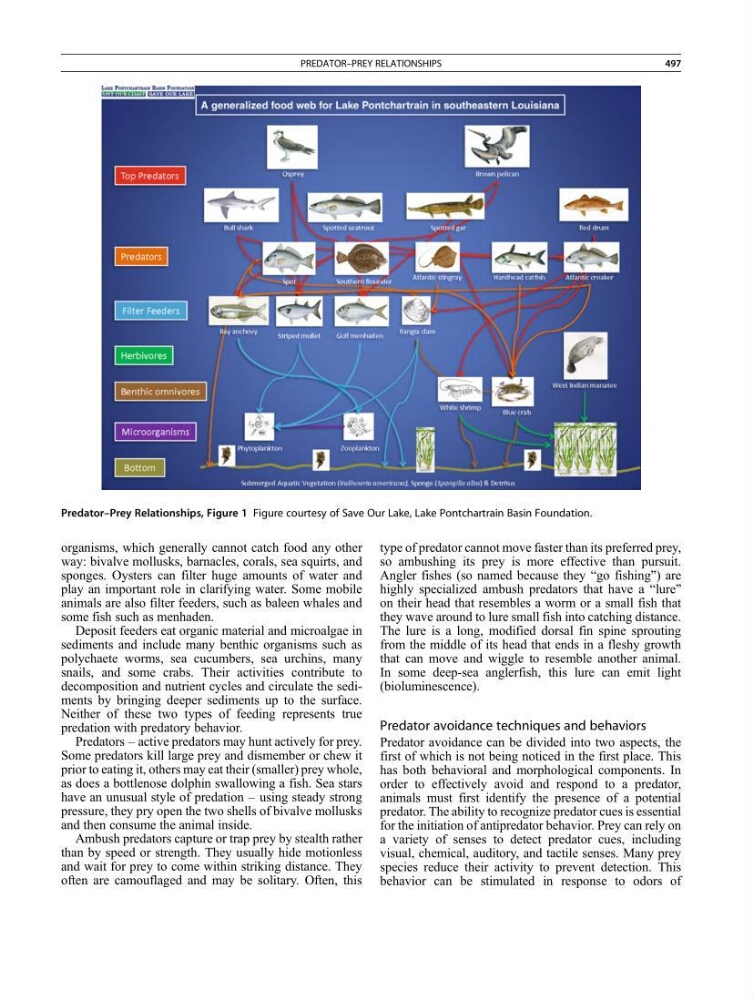
Predator–Prey Relationships, Figure 1 Figure courtesy of Save Our Lake, Lake Pontchartrain Basin Foundation.
PREDATOR–PREY RELATIONSHIPS
497
way: bivalve mollusks, barnacles, corals, sea squirts, and
sponges. Oysters can filter huge amounts of water and
play an important role in clarifying water. Some mobile
animals are also filter feeders, such as baleen whales and
some fish such as menhaden.
Deposit feeders eat organic material and microalgae in
sediments and include many benthic organisms such as
polychaete worms, sea cucumbers, sea urchins, many
snails, and some crabs. Their activities contribute to
decomposition and nutrient cycles and circulate the sediments by bringing deeper sediments up to the surface.
Neither of these two types of feeding represents true
predation with predatory behavior.
Predators – active predators may hunt actively for prey.
Some predators kill large prey and dismember or chew it
prior to eating it, others may eat their (smaller) prey whole,
as does a bottlenose dolphin swallowing a fish. Sea stars
have an unusual style of predation – using steady strong
pressure, they pry open the two shells of bivalve mollusks
and then consume the animal inside.
Ambush predators capture or trap prey by stealth rather
than by speed or strength. They usually hide motionless
and wait for prey to come within striking distance. They
often are camouflaged and may be solitary. Often, this
type of predator cannot move faster than its preferred prey,
so ambushing its prey is more effective than pursuit.
Angler fishes (so named because they “go fishing”) are
highly specialized ambush predators that have a “lure”
on their head that resembles a worm or a small fish that
they wave around to lure small fish into catching distance.
The lure is a long, modified dorsal fin spine sprouting
from the middle of its head that ends in a fleshy growth
that can move and wiggle to resemble another animal.
In some deep-sea anglerfish, this lure can emit light
(bioluminescence).
Predator avoidance techniques and behaviors
Predator avoidance can be divided into two aspects, the
first of which is not being noticed in the first place. This
has both behavioral and morphological components. In
order to effectively avoid and respond to a predator,
animals must first identify the presence of a potential
predator. The ability to recognize predator cues is essential
for the initiation of antipredator behavior. Prey can rely on
a variety of senses to detect predator cues, including
visual, chemical, auditory, and tactile senses. Many prey
species reduce their activity to prevent detection. This
behavior can be stimulated in response to odors of
Predator–Prey Relationships, Figure 1 Figure courtesy of Save Our Lake, Lake Pontchartrain Basin Foundation.
PREDATOR–PREY RELATIONSHIPS
497