

and increase rates of microbial respirations and, therefore,
oxygen consumption. For salmonid fishes, oxygen can
become limiting at relatively high values, and even air saturation can be limiting at higher temperatures (Fry, 1971).
Concentrations of dissolved oxygen below 2-3 mg O 2 /L
are a general threshold value for hypoxia for marine and
estuarine organisms and 5-6 mg O 2 /L in freshwater.
However, species and life stages differ greatly in their
basic oxygen requirements and tolerances (Vaquer-Sonyer
and Duarte, 2008).
Naturally low dissolved oxygen environments
By any definition, oceanic oxygen minimum zones
(OMZs) are the largest low dissolved oxygen areas on
earth and cover about 30 million square kilometers of
open ocean (Figure 2), much of which is not near the
continents (Paulmier and Ruiz-Pino, 2009). Globally,
where OMZs contact the bottom, about 1,148,000 km
2
of continental margin seafloor is estimated to have bottom
water oxygen concentrations <0.7 mg O 2 /L (Helly and
Levin, 2004). The principal factors that lead to the formation of OMZs are high surface productivity, old water
mass age, and limited circulation. In addition, upwelling
associated with continental margins leads to higher
productivity and greater oxygen demand and also contributes to a thicker OMZ and lower oxygen concentrations
(Helly and Levin, 2004).
Upwelling areas can also develop extensive hypoxia as
deepwater nutrients are added to surface waters increasing
production that eventually sinks and decomposes.
Hypoxia associated with upwelling is not as long-lived
and stable as that associated with OMZs but can periodically reoccur. The best known upwelling is along the coast
of Peru and Chile associated with El Niño. Hypoxia
associated with this type of coastal upwelling is not as
long-lived and stable as that associated with OMZs.
Upwelling can interact strongly with low-oxygen water
masses to produce intense shelf hypoxia; this is observed
off of Oregon, USA (Grantham et al., 2004), and Chile
(Fuenzalida et al., 2009), Africa (Monteiro et al., 2008),
and India (Naqvi et al., 2000).
Upwelling associated with both the Humboldt (Escribano
et al., 2004) and Benguela Current systems (Chapman and
Shannon, 1985; Monteiro et al., 2008) develops extensive
severe hypoxia and anoxia that adversely affect pelagic
and benthic species (Arntz et al., 2006). For example, in
1994, persistent and pronounced hypoxic conditions developed off the coast of central and northern Namibia over
much of the continental shelf. These conditions displaced
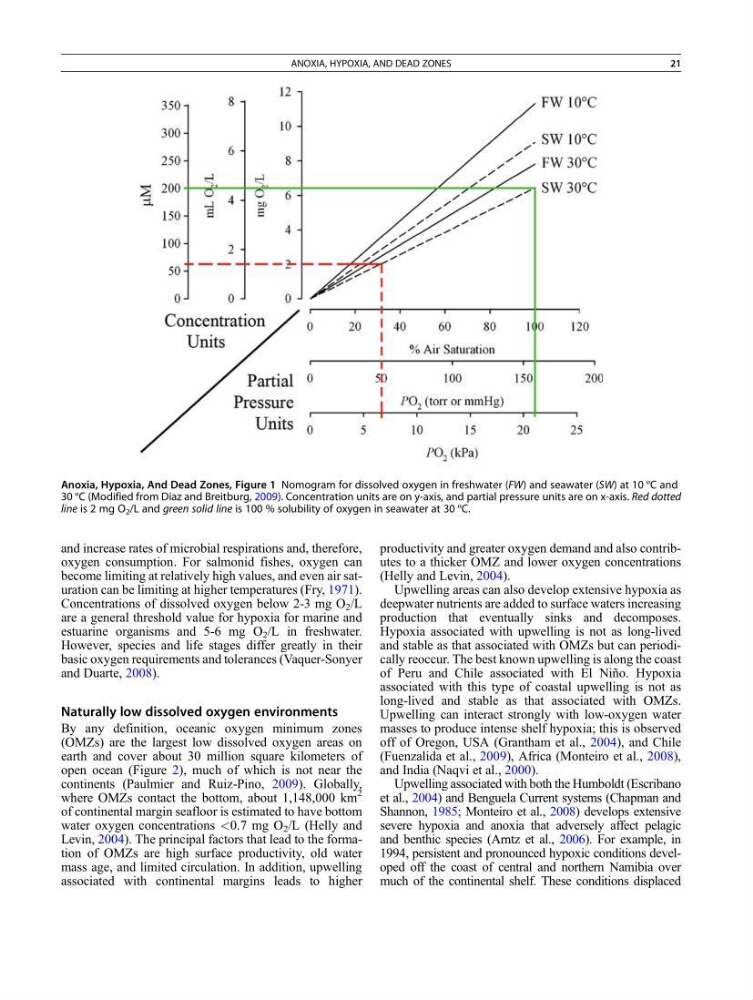
Anoxia, Hypoxia, And Dead Zones, Figure 1 Nomogram for dissolved oxygen in freshwater (FW) and seawater (SW) at 10 ºC and
30 ºC (Modified from Diaz and Breitburg, 2009). Concentration units are on y-axis, and partial pressure units are on x-axis. Red dotted
line is 2 mg O 2 /L and green solid line is 100 % solubility of oxygen in seawater at 30 ºC.
ANOXIA, HYPOXIA, AND DEAD ZONES
21
oxygen consumption. For salmonid fishes, oxygen can
become limiting at relatively high values, and even air saturation can be limiting at higher temperatures (Fry, 1971).
Concentrations of dissolved oxygen below 2-3 mg O 2 /L
are a general threshold value for hypoxia for marine and
estuarine organisms and 5-6 mg O 2 /L in freshwater.
However, species and life stages differ greatly in their
basic oxygen requirements and tolerances (Vaquer-Sonyer
and Duarte, 2008).
Naturally low dissolved oxygen environments
By any definition, oceanic oxygen minimum zones
(OMZs) are the largest low dissolved oxygen areas on
earth and cover about 30 million square kilometers of
open ocean (Figure 2), much of which is not near the
continents (Paulmier and Ruiz-Pino, 2009). Globally,
where OMZs contact the bottom, about 1,148,000 km
2
of continental margin seafloor is estimated to have bottom
water oxygen concentrations <0.7 mg O 2 /L (Helly and
Levin, 2004). The principal factors that lead to the formation of OMZs are high surface productivity, old water
mass age, and limited circulation. In addition, upwelling
associated with continental margins leads to higher
productivity and greater oxygen demand and also contributes to a thicker OMZ and lower oxygen concentrations
(Helly and Levin, 2004).
Upwelling areas can also develop extensive hypoxia as
deepwater nutrients are added to surface waters increasing
production that eventually sinks and decomposes.
Hypoxia associated with upwelling is not as long-lived
and stable as that associated with OMZs but can periodically reoccur. The best known upwelling is along the coast
of Peru and Chile associated with El Niño. Hypoxia
associated with this type of coastal upwelling is not as
long-lived and stable as that associated with OMZs.
Upwelling can interact strongly with low-oxygen water
masses to produce intense shelf hypoxia; this is observed
off of Oregon, USA (Grantham et al., 2004), and Chile
(Fuenzalida et al., 2009), Africa (Monteiro et al., 2008),
and India (Naqvi et al., 2000).
Upwelling associated with both the Humboldt (Escribano
et al., 2004) and Benguela Current systems (Chapman and
Shannon, 1985; Monteiro et al., 2008) develops extensive
severe hypoxia and anoxia that adversely affect pelagic
and benthic species (Arntz et al., 2006). For example, in
1994, persistent and pronounced hypoxic conditions developed off the coast of central and northern Namibia over
much of the continental shelf. These conditions displaced
Anoxia, Hypoxia, And Dead Zones, Figure 1 Nomogram for dissolved oxygen in freshwater (FW) and seawater (SW) at 10 ºC and
30 ºC (Modified from Diaz and Breitburg, 2009). Concentration units are on y-axis, and partial pressure units are on x-axis. Red dotted
line is 2 mg O 2 /L and green solid line is 100 % solubility of oxygen in seawater at 30 ºC.
ANOXIA, HYPOXIA, AND DEAD ZONES
21