

and regulators usually below 26 psu (Henry, 2005). Crustaceans, such as the blue crab Callinectes sapidus, could
be described as strong osmoregulators, able to maintain
high gradient of 600 mOsm internal osmotic pressure
when acclimated to freshwater in the laboratory. While
in the past, species have been classified as either weak or
strong hyperosmoregulators. Henry et al. (2012) suggest
that they should be separated into three groups based on
mechanisms of transport and based on gill epithelia which
have either low or high electrical conductance. Euryhaline
osmoconformers typically would be those with very high
conductance, no active transport of NaCl, and
hyperosmoregulators which have active NaCl uptake and
either high conductance (leaky) gills or low conductance
(tight) gills. Henry et al. (2012) provide a full description
of the mechanisms.
Tolerance to environmental extremes
Salinity, temperature, and water loss
Salinity and temperature are among the most important factors affecting the metabolic rate, heart rate, and growth of
estuarine organisms (Newell, 1979; Marsden, 2004). Many
estuarine invertebrates survive in a wide range of salinities,
and while responses are species specific, they depend on the
exposure time, salinity level, and also the exposure temperature. Some of the most tolerant species include pulmonate
snails, Amphibola crenata and Melampus bidentatus, and
high-level salt-marsh species, which are highly tolerant of
desiccation and temperature extremes (Shumway and
Marsden, 1981). Some crustaceans and mollusks acclimate
to new salinities, and survival of many estuarine invertebrates depends on both temperature and salinity (e.g., the
eastern oyster Crassostrea virginica (Heilmayer et al.,
2008), the sand shrimp Crangon crangon, and the shore
crab Carcinus maenas (Jillette et al., 2011)). In welloxygenated waters, mortality is minimal at temperatures
from < 5
C to 22
C and salinities from 15 to 30 psu.
When shrimp were exposed to poorly oxygenated water,
mortality was much higher. Shrimp survived best at lower
temperatures and salinities slightly higher than normal seawater (Haefner, 1970). The salinity tolerance will change
during development, with salinity tolerance increasing from
egg, larval stages, through later life history stages
(Charmantier et al., 2001).
Heat stress
Temperature plays a critical role in regulating the metabolic rate of organisms as well as affecting population
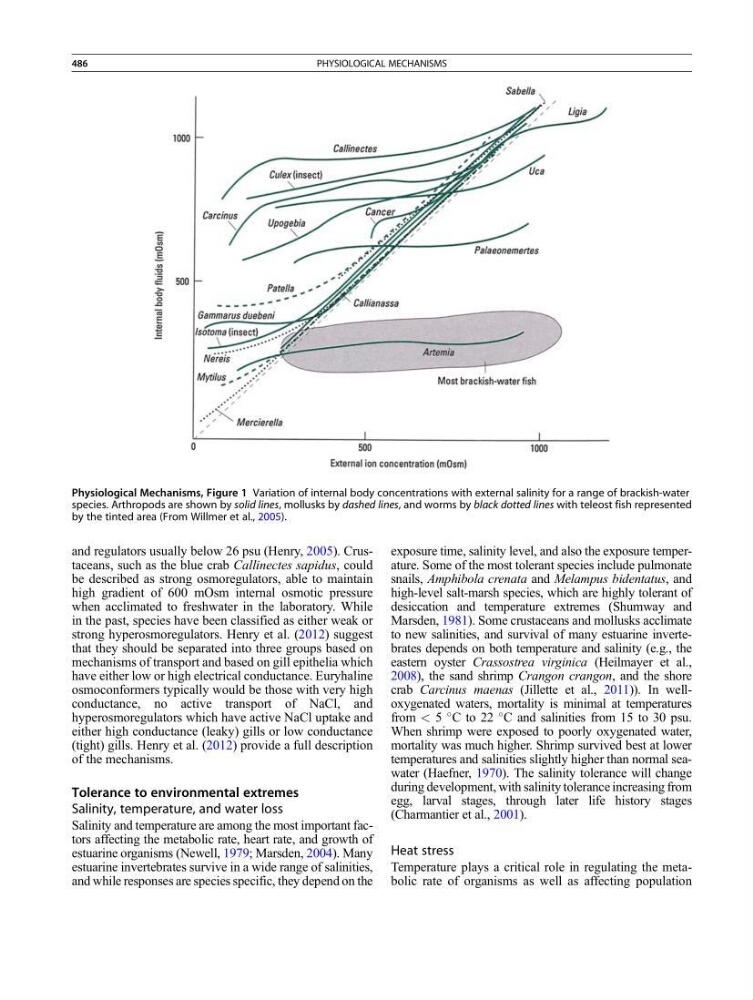
Physiological Mechanisms, Figure 1 Variation of internal body concentrations with external salinity for a range of brackish-water
species. Arthropods are shown by solid lines, mollusks by dashed lines, and worms by black dotted lines with teleost fish represented
by the tinted area (From Willmer et al., 2005).
486
PHYSIOLOGICAL MECHANISMS
be described as strong osmoregulators, able to maintain
high gradient of 600 mOsm internal osmotic pressure
when acclimated to freshwater in the laboratory. While
in the past, species have been classified as either weak or
strong hyperosmoregulators. Henry et al. (2012) suggest
that they should be separated into three groups based on
mechanisms of transport and based on gill epithelia which
have either low or high electrical conductance. Euryhaline
osmoconformers typically would be those with very high
conductance, no active transport of NaCl, and
hyperosmoregulators which have active NaCl uptake and
either high conductance (leaky) gills or low conductance
(tight) gills. Henry et al. (2012) provide a full description
of the mechanisms.
Tolerance to environmental extremes
Salinity, temperature, and water loss
Salinity and temperature are among the most important factors affecting the metabolic rate, heart rate, and growth of
estuarine organisms (Newell, 1979; Marsden, 2004). Many
estuarine invertebrates survive in a wide range of salinities,
and while responses are species specific, they depend on the
exposure time, salinity level, and also the exposure temperature. Some of the most tolerant species include pulmonate
snails, Amphibola crenata and Melampus bidentatus, and
high-level salt-marsh species, which are highly tolerant of
desiccation and temperature extremes (Shumway and
Marsden, 1981). Some crustaceans and mollusks acclimate
to new salinities, and survival of many estuarine invertebrates depends on both temperature and salinity (e.g., the
eastern oyster Crassostrea virginica (Heilmayer et al.,
2008), the sand shrimp Crangon crangon, and the shore
crab Carcinus maenas (Jillette et al., 2011)). In welloxygenated waters, mortality is minimal at temperatures
from < 5
C to 22
C and salinities from 15 to 30 psu.
When shrimp were exposed to poorly oxygenated water,
mortality was much higher. Shrimp survived best at lower
temperatures and salinities slightly higher than normal seawater (Haefner, 1970). The salinity tolerance will change
during development, with salinity tolerance increasing from
egg, larval stages, through later life history stages
(Charmantier et al., 2001).
Heat stress
Temperature plays a critical role in regulating the metabolic rate of organisms as well as affecting population
Physiological Mechanisms, Figure 1 Variation of internal body concentrations with external salinity for a range of brackish-water
species. Arthropods are shown by solid lines, mollusks by dashed lines, and worms by black dotted lines with teleost fish represented
by the tinted area (From Willmer et al., 2005).
486
PHYSIOLOGICAL MECHANISMS