

10
3.2 CFU ml
À1
. On the other hand, the number of total
populations was not affected, regardless of the varying
numbers of Vibrio sp. cells in the initial samples.
McCarthy (1996) has examined the survivability
of pathogenic V. cholerae O1 in seawater in relation to
temperature and salinity. A ballast water isolate took
240 days to obtain a one-tenth reduction in the number
of colony-forming cells in autoclaved seawater (32 ppt
salinity) at 18
C. While the isolate was suspended in
raw seawater, the survival time was reduced to
12–27 days. These results indicate that biological competition of exotic species with the native population reduces
the survivability to only a few weeks after being introduced into estuarine environments.
Summary
Nonnative and unwanted species, such as toxic
dinoflagellates and pathogenic V. cholerae, are transported
with ships’ ballast water. Some of these species have
become successfully established and are reproducing in
the new environments. Prevention of invasive exotic
marine organisms is very important for the conservation
of biodiversity as well as the reduction of economic damage to fisheries and industries.
Bibliography
Abe, A., and Mimura, H., 2013. Sterilization of ships’ ballast water
in bubble dynamics and shock waves. In Delale, C. F. (ed.),
Shock Waves. New York: Springer, Vol. 8, pp. 339–362.
Dworkin, J., and Shah, I. M., 2010. Exit from dormancy in microbial organisms. Nature Reviews Microbiology, 8, 890–896.
Hallegraeff, G. M., 1998. Transport of toxic dinoflagellates via
ships’ ballast water: bioeconomic risk assessment and efficacy
of possible ballast water management strategies. Marine Ecology
Progress Series, 168, 297–309.
International Maritime Organization, 2004. Ballast water
management.
http://www.imo.org/OurWork/Environment/
BallastWaterManagement/Pages/Default.aspx. Accessed on
April 28, 2013.
Kaper, J. B., Morris, J. G., Jr., and Levine, M. M., 1995. Cholera.
Clinical Microbiology Reviews, 8, 48–86.
Kozai, K., Ishida, H., Okamoto, K., and Fukuyo, Y., 2006. Feasibility study of ocean color remote sensing for detecting ballast
water. Advances in Space Research, 37, 787–792.
McCarthy, S. A., 1996. Effects of temperature and salinity on survival of toxigenic Vibrio cholerae Ol in seawater. Microbial
Ecology, 31, 167–175.
Mimura, H., and Miwa, T., 2013. Survival estimation of pathogenic
Vibrio cholerae after invasion from ballast water discharged into
Tokyo Bay. The Japan Institute of Marine Engineering, 48,
241–245.
Mimura, H., Katakura, R., and Ishida, H., 2005. Changes of
microbial populations in a ship’s ballast water and sediments on
a voyage from Japan to Qatar. Marine Pollution Bulletin, 50,
751–757.
Nanayakkara, K. G., Zheng, Y.-M., Alam, A. K. M. K., Zou, S., and
Chen, J. P., 2011. Electrochemical disinfection for ballast water
management: technology development and risk assessment.
Marine Pollution Bulletin, 63, 119–123.
Oshima, Y., Blackburn, S. I., and Hallegraeff, G. M., 1993. Comparative study on paralytic shellfish toxin profiles of the dinoflagellate Gymnodinium catenatum from three different countries.
Marine Biology, 116, 471–476.
Ruiz, G. M., Rawlings, T. K., Dobbs, F. C., Drake, L. A., Mullady,
T., Huq, A., and Colwell, R. R., 2000. Global spread of microorganisms by ships. Nature, 408, 49–50.
Scholin, C. A., Hallegraeff, G. M., and Anderson, D. M., 1995.
Molecular evolution of the Alexandrium tamarense ‘species
complex’ (Dinophyceae): dispersal in the North American and
West Pacific regions. Phycologia, 34, 472–485.
Tomaru, A., Kawachi, M., Demura, M., and Fukuyo, Y., 2010.
Denaturing gradient gel electrophoresis shows that bacterial
communities change with mid-ocean ballast water exchange.
Marine Pollution Bulletin, 60, 299–302.
Wright, D. A., Gensemer, R. W., Mitchelmore, C. L., Stubblefield,
W. A., van Genderen, E., Dawson, R., Orano-Dawson, C. E.,
Bearr, J. S., Mueller, R. A., and Cooper, W. J., 2010. Shipboard
trials of an ozone-based ballast water treatment system. Marine
Pollution Bulletin, 60, 1571–1583.
Cross-references
Anthropogenic Impacts
Invasive Species
Phytoplankton
0
1
2
3
4
5
6
0
1 0
2 0
3 0
Colony-forming cells (log(CFU ml −1
)
Seawater temperature (˚C)
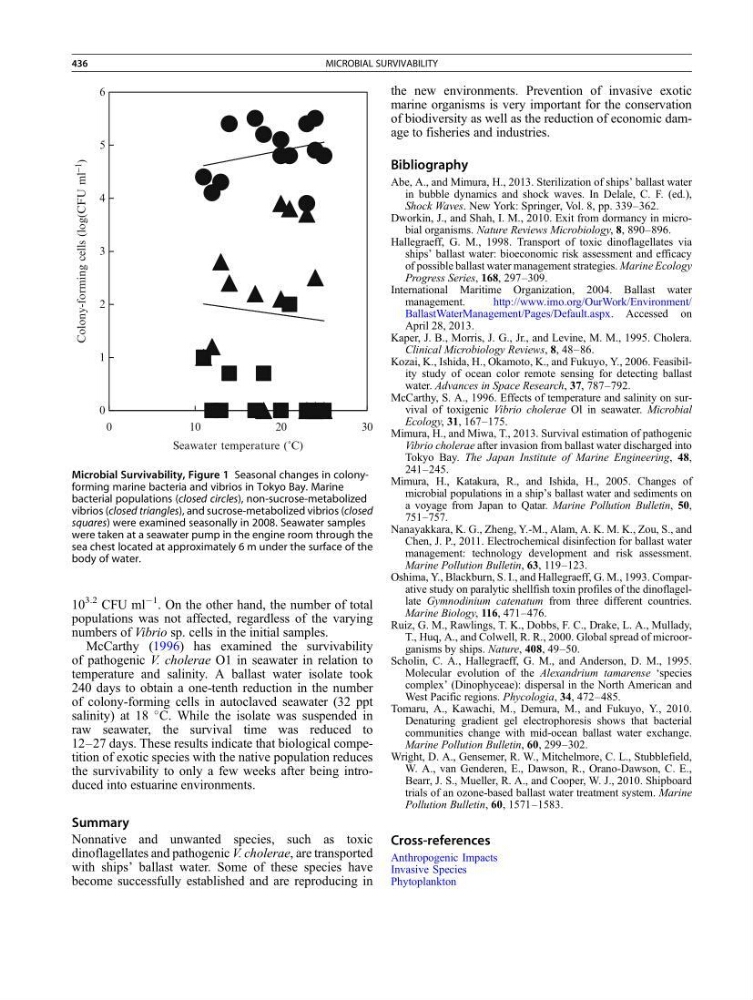
Microbial Survivability, Figure 1 Seasonal changes in colonyforming marine bacteria and vibrios in Tokyo Bay. Marine
bacterial populations (closed circles), non-sucrose-metabolized
vibrios (closed triangles), and sucrose-metabolized vibrios (closed
squares) were examined seasonally in 2008. Seawater samples
were taken at a seawater pump in the engine room through the
sea chest located at approximately 6 m under the surface of the
body of water.
436
MICROBIAL SURVIVABILITY
3.2 CFU ml
À1
. On the other hand, the number of total
populations was not affected, regardless of the varying
numbers of Vibrio sp. cells in the initial samples.
McCarthy (1996) has examined the survivability
of pathogenic V. cholerae O1 in seawater in relation to
temperature and salinity. A ballast water isolate took
240 days to obtain a one-tenth reduction in the number
of colony-forming cells in autoclaved seawater (32 ppt
salinity) at 18
C. While the isolate was suspended in
raw seawater, the survival time was reduced to
12–27 days. These results indicate that biological competition of exotic species with the native population reduces
the survivability to only a few weeks after being introduced into estuarine environments.
Summary
Nonnative and unwanted species, such as toxic
dinoflagellates and pathogenic V. cholerae, are transported
with ships’ ballast water. Some of these species have
become successfully established and are reproducing in
the new environments. Prevention of invasive exotic
marine organisms is very important for the conservation
of biodiversity as well as the reduction of economic damage to fisheries and industries.
Bibliography
Abe, A., and Mimura, H., 2013. Sterilization of ships’ ballast water
in bubble dynamics and shock waves. In Delale, C. F. (ed.),
Shock Waves. New York: Springer, Vol. 8, pp. 339–362.
Dworkin, J., and Shah, I. M., 2010. Exit from dormancy in microbial organisms. Nature Reviews Microbiology, 8, 890–896.
Hallegraeff, G. M., 1998. Transport of toxic dinoflagellates via
ships’ ballast water: bioeconomic risk assessment and efficacy
of possible ballast water management strategies. Marine Ecology
Progress Series, 168, 297–309.
International Maritime Organization, 2004. Ballast water
management.
http://www.imo.org/OurWork/Environment/
BallastWaterManagement/Pages/Default.aspx. Accessed on
April 28, 2013.
Kaper, J. B., Morris, J. G., Jr., and Levine, M. M., 1995. Cholera.
Clinical Microbiology Reviews, 8, 48–86.
Kozai, K., Ishida, H., Okamoto, K., and Fukuyo, Y., 2006. Feasibility study of ocean color remote sensing for detecting ballast
water. Advances in Space Research, 37, 787–792.
McCarthy, S. A., 1996. Effects of temperature and salinity on survival of toxigenic Vibrio cholerae Ol in seawater. Microbial
Ecology, 31, 167–175.
Mimura, H., and Miwa, T., 2013. Survival estimation of pathogenic
Vibrio cholerae after invasion from ballast water discharged into
Tokyo Bay. The Japan Institute of Marine Engineering, 48,
241–245.
Mimura, H., Katakura, R., and Ishida, H., 2005. Changes of
microbial populations in a ship’s ballast water and sediments on
a voyage from Japan to Qatar. Marine Pollution Bulletin, 50,
751–757.
Nanayakkara, K. G., Zheng, Y.-M., Alam, A. K. M. K., Zou, S., and
Chen, J. P., 2011. Electrochemical disinfection for ballast water
management: technology development and risk assessment.
Marine Pollution Bulletin, 63, 119–123.
Oshima, Y., Blackburn, S. I., and Hallegraeff, G. M., 1993. Comparative study on paralytic shellfish toxin profiles of the dinoflagellate Gymnodinium catenatum from three different countries.
Marine Biology, 116, 471–476.
Ruiz, G. M., Rawlings, T. K., Dobbs, F. C., Drake, L. A., Mullady,
T., Huq, A., and Colwell, R. R., 2000. Global spread of microorganisms by ships. Nature, 408, 49–50.
Scholin, C. A., Hallegraeff, G. M., and Anderson, D. M., 1995.
Molecular evolution of the Alexandrium tamarense ‘species
complex’ (Dinophyceae): dispersal in the North American and
West Pacific regions. Phycologia, 34, 472–485.
Tomaru, A., Kawachi, M., Demura, M., and Fukuyo, Y., 2010.
Denaturing gradient gel electrophoresis shows that bacterial
communities change with mid-ocean ballast water exchange.
Marine Pollution Bulletin, 60, 299–302.
Wright, D. A., Gensemer, R. W., Mitchelmore, C. L., Stubblefield,
W. A., van Genderen, E., Dawson, R., Orano-Dawson, C. E.,
Bearr, J. S., Mueller, R. A., and Cooper, W. J., 2010. Shipboard
trials of an ozone-based ballast water treatment system. Marine
Pollution Bulletin, 60, 1571–1583.
Cross-references
Anthropogenic Impacts
Invasive Species
Phytoplankton
0
1
2
3
4
5
6
0
1 0
2 0
3 0
Colony-forming cells (log(CFU ml −1
)
Seawater temperature (˚C)
Microbial Survivability, Figure 1 Seasonal changes in colonyforming marine bacteria and vibrios in Tokyo Bay. Marine
bacterial populations (closed circles), non-sucrose-metabolized
vibrios (closed triangles), and sucrose-metabolized vibrios (closed
squares) were examined seasonally in 2008. Seawater samples
were taken at a seawater pump in the engine room through the
sea chest located at approximately 6 m under the surface of the
body of water.
436
MICROBIAL SURVIVABILITY