

contact with underlying salt marsh peat, with relict islands
undergoing burial by marsh around their periphery.
Migrating historical inlets often show a string of progressively younger marsh islands in the direction of inlet
movement. In the event of inlet closure, these back-barrier
landforms, which are often younger than most parts of the
fronting barrier, provide important evidence of the
channel location and evolution. Although described as
fetch-limited barrier islands by some authors, most marsh
islands are more analogous to overtopping deposits.
Boat wake wash and dredge-spoil piles may have
similar morphology, but do not represent true marsh
islands. Satellite image-based analysis of active inlets in
contrasting geographic regions (Mid-Atlantic states,
western Madagascar, and northern Siberia) shows
a positive correlation between the distance from inlet
throat to the marsh islands and the high-tide inlet width.
The dimensions of the inlet channel, marsh topography,
storm wave energy, short-term sea-level changes, and
latitude-dependent factors (oyster reefs, mangrove
density, ice cover) determine the ultimate geological
context and preservation potential of the marsh islands.
If preserved in the rock record, marsh island sand bodies
will serve as localized high-permeability reservoirs within
fine-grained estuarine sequences.
Bibliography
Cleary, W. J., Hosier, P. E., and Wells, G. R., 1979. Genesis and
significance of marsh islands within southeastern North Carolina
lagoons. Journal of Sedimentary Petrology, 49, 703–709.
Cross-references
Coastal Wetlands
Saltmarshes
Wetlands
MARSH SEDIMENT TOXICITY
Judith S. Weis
Department of Biological Sciences, Rutgers University,
Newark, NJ, USA
Definition
Sediments in estuaries and salt marshes in urbanized or
agricultural areas can accumulate toxic chemicals. Sediments are a major repository (“sink”) for many persistent
contaminants, and concentrations of contaminants in sediments are often orders of magnitude greater than those in
the overlying water.
Toxicity of sediments
Toxic chemicals in sediments can be harmful to benthic
organisms. They can accumulate in sediments and are
often transferred trophically to fishes and other animals
higher in the food web. Measuring the concentrations
of individual toxic chemicals in a sample of sediment
provides useful information, but does not necessarily
indicate how toxic it is. Higher chemical concentrations
in sediments do not necessarily translate to greater toxicity because the contaminants may be so tightly bound to
the sediment particles that they are not available to the
organisms. Factors affecting the bioavailability of sediment contaminants include the pH, degree of oxidation
of the sediments, mineralogical composition, acidvolatile sulfide (AVS), and grain size. Smaller particles
have greater surface area to bind chemicals, which are
thereby less available for uptake. The amount of AVS
compared to the simultaneously extracted metals (SEM)
can be used to evaluate the availability of metals. The
SEM/AVS molar ratios are an indicator of the amount
of available metals present in the sediment pore water.
When SEM/AVS ratios are <1, the concentrations of
metals in the sediment porewater are generally below
toxic levels because of the low solubility of the metal
sulfides.
The degree of toxicity of the sediments can be evaluated biologically in standardized laboratory tests using
certain small benthic species (often amphipods) that are
exposed for certain periods of time to dilutions of the sediments and monitored for survival (acute tests), growth,
behavior, and other endpoints (chronic tests). A more ecological approach to sediment toxicity is examining the resident community in the sediments – more contaminated
sediments will tend to have reduced species richness and
reduced abundance of organisms. Highly contaminated
sediments are also likely to be dominated by tolerant
opportunistic species. Using a combination of chemical
analysis, sediment toxicity tests, and benthic community
evaluation – the “sediment quality triad” – provides the
most extensive insights into sediment toxicity.
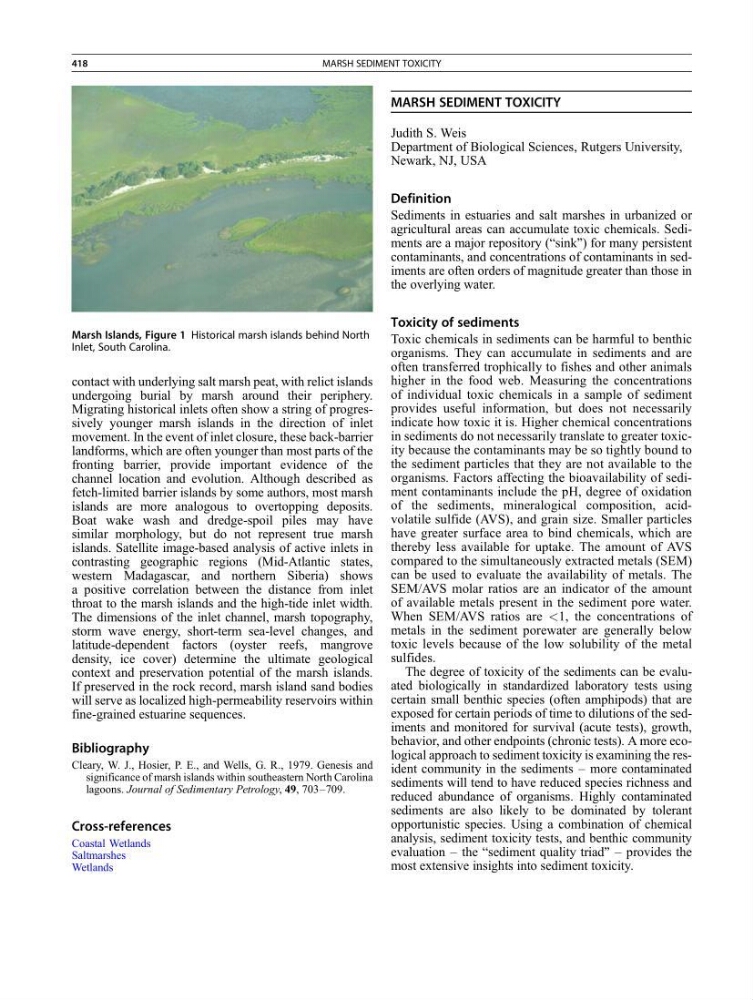
Marsh Islands, Figure 1 Historical marsh islands behind North
Inlet, South Carolina.
418
MARSH SEDIMENT TOXICITY
undergoing burial by marsh around their periphery.
Migrating historical inlets often show a string of progressively younger marsh islands in the direction of inlet
movement. In the event of inlet closure, these back-barrier
landforms, which are often younger than most parts of the
fronting barrier, provide important evidence of the
channel location and evolution. Although described as
fetch-limited barrier islands by some authors, most marsh
islands are more analogous to overtopping deposits.
Boat wake wash and dredge-spoil piles may have
similar morphology, but do not represent true marsh
islands. Satellite image-based analysis of active inlets in
contrasting geographic regions (Mid-Atlantic states,
western Madagascar, and northern Siberia) shows
a positive correlation between the distance from inlet
throat to the marsh islands and the high-tide inlet width.
The dimensions of the inlet channel, marsh topography,
storm wave energy, short-term sea-level changes, and
latitude-dependent factors (oyster reefs, mangrove
density, ice cover) determine the ultimate geological
context and preservation potential of the marsh islands.
If preserved in the rock record, marsh island sand bodies
will serve as localized high-permeability reservoirs within
fine-grained estuarine sequences.
Bibliography
Cleary, W. J., Hosier, P. E., and Wells, G. R., 1979. Genesis and
significance of marsh islands within southeastern North Carolina
lagoons. Journal of Sedimentary Petrology, 49, 703–709.
Cross-references
Coastal Wetlands
Saltmarshes
Wetlands
MARSH SEDIMENT TOXICITY
Judith S. Weis
Department of Biological Sciences, Rutgers University,
Newark, NJ, USA
Definition
Sediments in estuaries and salt marshes in urbanized or
agricultural areas can accumulate toxic chemicals. Sediments are a major repository (“sink”) for many persistent
contaminants, and concentrations of contaminants in sediments are often orders of magnitude greater than those in
the overlying water.
Toxicity of sediments
Toxic chemicals in sediments can be harmful to benthic
organisms. They can accumulate in sediments and are
often transferred trophically to fishes and other animals
higher in the food web. Measuring the concentrations
of individual toxic chemicals in a sample of sediment
provides useful information, but does not necessarily
indicate how toxic it is. Higher chemical concentrations
in sediments do not necessarily translate to greater toxicity because the contaminants may be so tightly bound to
the sediment particles that they are not available to the
organisms. Factors affecting the bioavailability of sediment contaminants include the pH, degree of oxidation
of the sediments, mineralogical composition, acidvolatile sulfide (AVS), and grain size. Smaller particles
have greater surface area to bind chemicals, which are
thereby less available for uptake. The amount of AVS
compared to the simultaneously extracted metals (SEM)
can be used to evaluate the availability of metals. The
SEM/AVS molar ratios are an indicator of the amount
of available metals present in the sediment pore water.
When SEM/AVS ratios are <1, the concentrations of
metals in the sediment porewater are generally below
toxic levels because of the low solubility of the metal
sulfides.
The degree of toxicity of the sediments can be evaluated biologically in standardized laboratory tests using
certain small benthic species (often amphipods) that are
exposed for certain periods of time to dilutions of the sediments and monitored for survival (acute tests), growth,
behavior, and other endpoints (chronic tests). A more ecological approach to sediment toxicity is examining the resident community in the sediments – more contaminated
sediments will tend to have reduced species richness and
reduced abundance of organisms. Highly contaminated
sediments are also likely to be dominated by tolerant
opportunistic species. Using a combination of chemical
analysis, sediment toxicity tests, and benthic community
evaluation – the “sediment quality triad” – provides the
most extensive insights into sediment toxicity.
Marsh Islands, Figure 1 Historical marsh islands behind North
Inlet, South Carolina.
418
MARSH SEDIMENT TOXICITY