

production (NEP). NEP varies widely among mangrove
ecosystems, but on average, mangroves produce and store
more carbon than they lose. A number of carbon mass balance estimates exist for the global expanse of mangroves
(Bouillon et al., 2007; Alongi, 2009), with the most recent
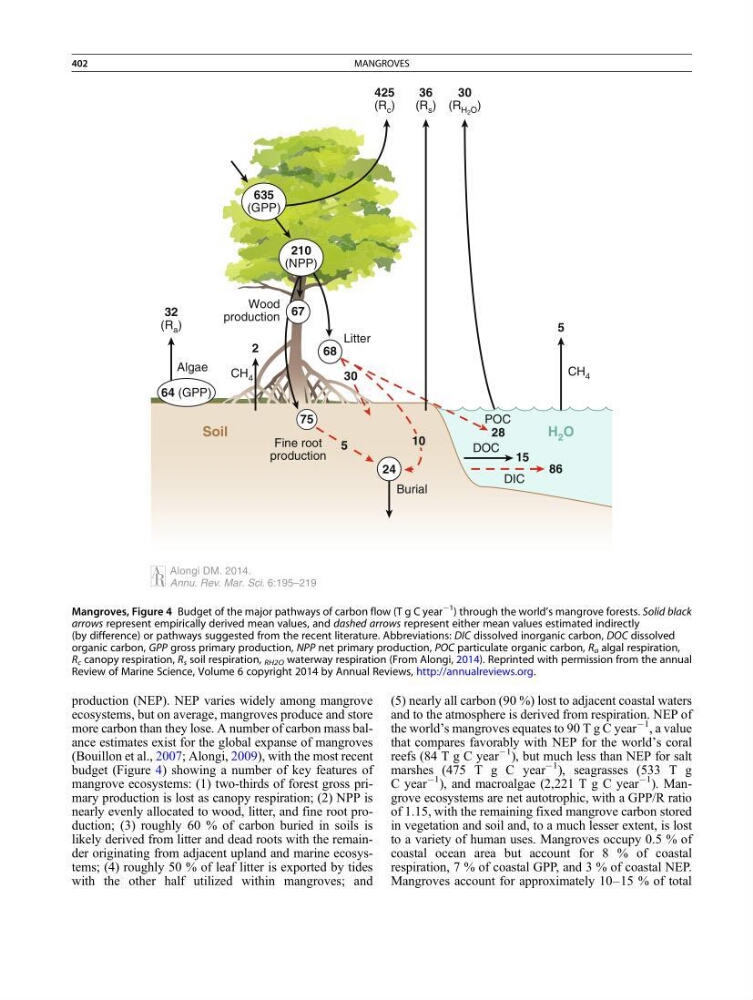
budget (Figure 4) showing a number of key features of
mangrove ecosystems: (1) two-thirds of forest gross primary production is lost as canopy respiration; (2) NPP is
nearly evenly allocated to wood, litter, and fine root production; (3) roughly 60 % of carbon buried in soils is
likely derived from litter and dead roots with the remainder originating from adjacent upland and marine ecosystems; (4) roughly 50 % of leaf litter is exported by tides
with the other half utilized within mangroves; and
(5) nearly all carbon (90 %) lost to adjacent coastal waters
and to the atmosphere is derived from respiration. NEP of
the world’s mangroves equates to 90 T g C year
À1
, a value
that compares favorably with NEP for the world’s coral
reefs (84 T g C year
À1
), but much less than NEP for salt
marshes (475 T g C year
À1 ), seagrasses (533 T g
C year
À1
), and macroalgae (2,221 T g C year
À1
). Mangrove ecosystems are net autotrophic, with a GPP/R ratio
of 1.15, with the remaining fixed mangrove carbon stored
in vegetation and soil and, to a much lesser extent, is lost
to a variety of human uses. Mangroves occupy 0.5 % of
coastal ocean area but account for 8 % of coastal
respiration, 7 % of coastal GPP, and 3 % of coastal NEP.
Mangroves account for approximately 10–15 % of total
5
Burial
H 2 O
POC
CH 4
CH 4
DOC
28
15
Soil
Fine root
production
425
(R c )
32
(R a )
36
(R s )
30
(R H 2 O )
67
Litter
30 30
10 10
5 5
86
DIC
Algae
Wood
production
68
2
64 (GPP)
210
(NPP)
635
(GPP)
24
75
Alongi DM. 2014.
Annu. Rev. Mar. Sci. 6:195–219
Mangroves, Figure 4 Budget of the major pathways of carbon flow (T g C year
À1
) through the world’s mangrove forests. Solid black
arrows represent empirically derived mean values, and dashed arrows represent either mean values estimated indirectly
(by difference) or pathways suggested from the recent literature. Abbreviations: DIC dissolved inorganic carbon, DOC dissolved
organic carbon, GPP gross primary production, NPP net primary production, POC particulate organic carbon, R a algal respiration,
R c canopy respiration, R s soil respiration, RH2O waterway respiration (From Alongi, 2014). Reprinted with permission from the annual
Review of Marine Science, Volume 6 copyright 2014 by Annual Reviews, http://annualreviews.org.
402
MANGROVES
ecosystems, but on average, mangroves produce and store
more carbon than they lose. A number of carbon mass balance estimates exist for the global expanse of mangroves
(Bouillon et al., 2007; Alongi, 2009), with the most recent
budget (Figure 4) showing a number of key features of
mangrove ecosystems: (1) two-thirds of forest gross primary production is lost as canopy respiration; (2) NPP is
nearly evenly allocated to wood, litter, and fine root production; (3) roughly 60 % of carbon buried in soils is
likely derived from litter and dead roots with the remainder originating from adjacent upland and marine ecosystems; (4) roughly 50 % of leaf litter is exported by tides
with the other half utilized within mangroves; and
(5) nearly all carbon (90 %) lost to adjacent coastal waters
and to the atmosphere is derived from respiration. NEP of
the world’s mangroves equates to 90 T g C year
À1
, a value
that compares favorably with NEP for the world’s coral
reefs (84 T g C year
À1
), but much less than NEP for salt
marshes (475 T g C year
À1 ), seagrasses (533 T g
C year
À1
), and macroalgae (2,221 T g C year
À1
). Mangrove ecosystems are net autotrophic, with a GPP/R ratio
of 1.15, with the remaining fixed mangrove carbon stored
in vegetation and soil and, to a much lesser extent, is lost
to a variety of human uses. Mangroves occupy 0.5 % of
coastal ocean area but account for 8 % of coastal
respiration, 7 % of coastal GPP, and 3 % of coastal NEP.
Mangroves account for approximately 10–15 % of total
5
Burial
H 2 O
POC
CH 4
CH 4
DOC
28
15
Soil
Fine root
production
425
(R c )
32
(R a )
36
(R s )
30
(R H 2 O )
67
Litter
30 30
10 10
5 5
86
DIC
Algae
Wood
production
68
2
64 (GPP)
210
(NPP)
635
(GPP)
24
75
Alongi DM. 2014.
Annu. Rev. Mar. Sci. 6:195–219
Mangroves, Figure 4 Budget of the major pathways of carbon flow (T g C year
À1
) through the world’s mangrove forests. Solid black
arrows represent empirically derived mean values, and dashed arrows represent either mean values estimated indirectly
(by difference) or pathways suggested from the recent literature. Abbreviations: DIC dissolved inorganic carbon, DOC dissolved
organic carbon, GPP gross primary production, NPP net primary production, POC particulate organic carbon, R a algal respiration,
R c canopy respiration, R s soil respiration, RH2O waterway respiration (From Alongi, 2014). Reprinted with permission from the annual
Review of Marine Science, Volume 6 copyright 2014 by Annual Reviews, http://annualreviews.org.
402
MANGROVES