

for shifts in composition and abundance. Mangrove
zooplankton communities consist of four components:
(1) a stenohaline marine group that penetrates into the
estuary mouth, (2) a euryhaline group that penetrates
further up estuary, (3) a true estuarine component,
and (4) a freshwater group in the upper tidal reaches
(Kathiresen and Bingham, 2001). The most conspicuous
group are members of the cyclopoid copepod family
Oithonidae that may have a selective advantage of small
size to avoid prey and a number of strategies to maximize
growth and reproduction. Larger zooplankters are an
important trophic link to fish but play an equally crucial
role as structuring agents of microzooplankton, the latter
accounting for as much as 75 % of potential phytoplankton production.
Penaeid prawns and fish have received the most attention among mangrove biota due to their role in commercial and recreational fishing. Prawn species of the
genera Penaeus, Metapenaeus, Parapeneopsis, and
Macrobrachium are the primary fishery targets, and great
effort has focused on their life history strategies, distribution, abundance, degree of habitat dependence, and catch
per unit effort (Manson et al., 2005). Shrimps function as
mid-level and top omnivores, regulating the abundance
of smaller plankton and nekton and spending their postlarval and juvenile stages in mangrove estuaries until emigrating offshore where they spawn in the wet season.
Annual shrimp production is more a reflection of catch
per unit effort than a true reflection of their productivity,
but rates (13–756 kg ha
À1 year
À1
) are well within
the range of values measured in estuaries and nearshore
habitats worldwide (Alongi, 2009).
Fish life cycles are similarly well known, with species
richness of permanent and temporary residents being
a function of salinity, microhabitat diversity, tides, water
depth and clarity, coastal water currents, and proximity
to seagrass beds and coral reefs (Faunce and Serafy,
2006). The number of species in any given mangrove
estuary can range from <10 to nearly 200, with
a tendency for more species in larger estuaries; density
and biomass estimates are similarly variable, ranging from
1 to 160 fish m
À2 and 0.4–29 g m
À2 and generally greater
than in temperate estuaries (Blaber, 2002). Mangrove fish
are grouped into five feeding guilds – herbivorous,
iliophagus, zooplanktivorous, piscivorous, and benthic
invertebrate feeders – but many species shift their dietary
preferences as they age. Wild fish production varies
greatly (17–1,000 kg ha
À1 year
À1
) worldwide (Alongi,
2009), with peak landings during the post-monsoon and
summer months.
Are mangroves major nursery grounds for fish and
shrimp? This idea was first articulated nearly fifty years
ago (Heald, 1969), but the links between mangroves and
edible items were obviously known by indigenous communities much farther back in time. Three hypotheses
have been offered to explain the connection between
coastal fisheries and mangroves: (1) the food hypothesis,
which suggests that mangroves offer an abundant variety
of foods; (2) the refugia hypothesis, which suggests that
mangroves function as a refuge from predation; and
(3) the shelter hypothesis, which suggests that mangroves
provide shelter from physical disturbances (Manson et al.,
2005). None of these hypotheses are mutually exclusive,
and perhaps all three factors may be operating at the same
time in the same place. Very little direct evidence exists to
explain the relationship between fishery catch and mangroves, but evidence exists to support the notion that coral
reef fish use mangroves and seagrasses as essential juvenile habitat (Kimirei et al., 2013). The underlying mechanisms or the cause-and-effect relationships of the
connection between fishery yields and mangroves, however, remain poorly understood.
Forest production and photosynthetic
performance
Mangroves are among the most productive plants in
the sea, as revealed by proxy measurements of leaf
and wood production (Alongi, 2009). Belowground production of roots has rarely been measured, but
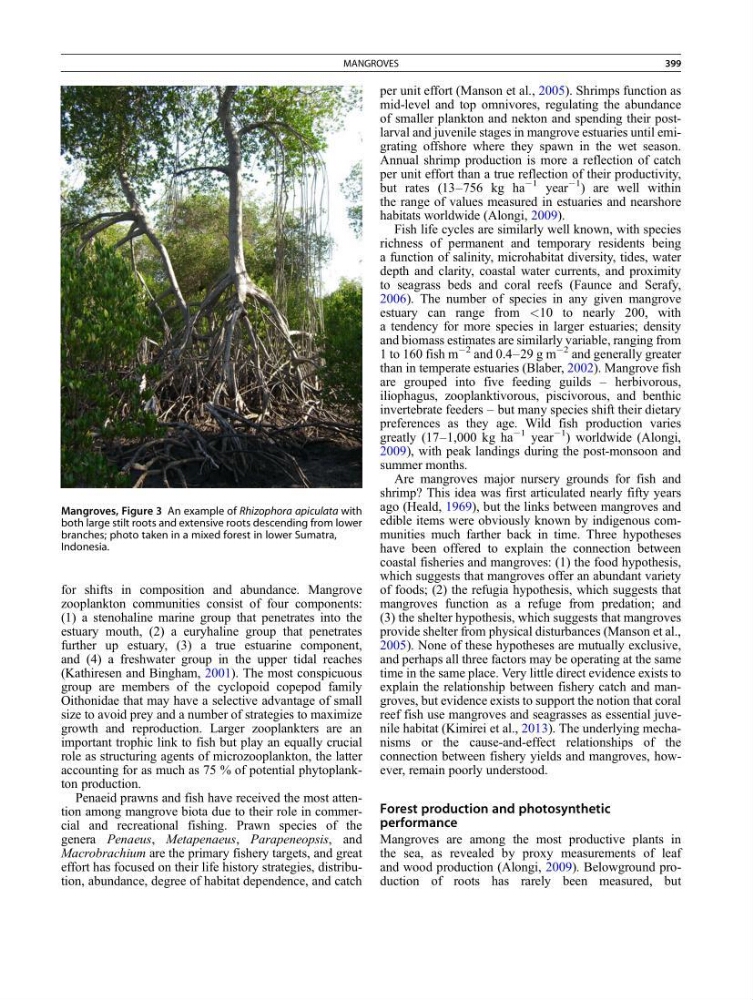
Mangroves, Figure 3 An example of Rhizophora apiculata with
both large stilt roots and extensive roots descending from lower
branches; photo taken in a mixed forest in lower Sumatra,
Indonesia.
MANGROVES
399
zooplankton communities consist of four components:
(1) a stenohaline marine group that penetrates into the
estuary mouth, (2) a euryhaline group that penetrates
further up estuary, (3) a true estuarine component,
and (4) a freshwater group in the upper tidal reaches
(Kathiresen and Bingham, 2001). The most conspicuous
group are members of the cyclopoid copepod family
Oithonidae that may have a selective advantage of small
size to avoid prey and a number of strategies to maximize
growth and reproduction. Larger zooplankters are an
important trophic link to fish but play an equally crucial
role as structuring agents of microzooplankton, the latter
accounting for as much as 75 % of potential phytoplankton production.
Penaeid prawns and fish have received the most attention among mangrove biota due to their role in commercial and recreational fishing. Prawn species of the
genera Penaeus, Metapenaeus, Parapeneopsis, and
Macrobrachium are the primary fishery targets, and great
effort has focused on their life history strategies, distribution, abundance, degree of habitat dependence, and catch
per unit effort (Manson et al., 2005). Shrimps function as
mid-level and top omnivores, regulating the abundance
of smaller plankton and nekton and spending their postlarval and juvenile stages in mangrove estuaries until emigrating offshore where they spawn in the wet season.
Annual shrimp production is more a reflection of catch
per unit effort than a true reflection of their productivity,
but rates (13–756 kg ha
À1 year
À1
) are well within
the range of values measured in estuaries and nearshore
habitats worldwide (Alongi, 2009).
Fish life cycles are similarly well known, with species
richness of permanent and temporary residents being
a function of salinity, microhabitat diversity, tides, water
depth and clarity, coastal water currents, and proximity
to seagrass beds and coral reefs (Faunce and Serafy,
2006). The number of species in any given mangrove
estuary can range from <10 to nearly 200, with
a tendency for more species in larger estuaries; density
and biomass estimates are similarly variable, ranging from
1 to 160 fish m
À2 and 0.4–29 g m
À2 and generally greater
than in temperate estuaries (Blaber, 2002). Mangrove fish
are grouped into five feeding guilds – herbivorous,
iliophagus, zooplanktivorous, piscivorous, and benthic
invertebrate feeders – but many species shift their dietary
preferences as they age. Wild fish production varies
greatly (17–1,000 kg ha
À1 year
À1
) worldwide (Alongi,
2009), with peak landings during the post-monsoon and
summer months.
Are mangroves major nursery grounds for fish and
shrimp? This idea was first articulated nearly fifty years
ago (Heald, 1969), but the links between mangroves and
edible items were obviously known by indigenous communities much farther back in time. Three hypotheses
have been offered to explain the connection between
coastal fisheries and mangroves: (1) the food hypothesis,
which suggests that mangroves offer an abundant variety
of foods; (2) the refugia hypothesis, which suggests that
mangroves function as a refuge from predation; and
(3) the shelter hypothesis, which suggests that mangroves
provide shelter from physical disturbances (Manson et al.,
2005). None of these hypotheses are mutually exclusive,
and perhaps all three factors may be operating at the same
time in the same place. Very little direct evidence exists to
explain the relationship between fishery catch and mangroves, but evidence exists to support the notion that coral
reef fish use mangroves and seagrasses as essential juvenile habitat (Kimirei et al., 2013). The underlying mechanisms or the cause-and-effect relationships of the
connection between fishery yields and mangroves, however, remain poorly understood.
Forest production and photosynthetic
performance
Mangroves are among the most productive plants in
the sea, as revealed by proxy measurements of leaf
and wood production (Alongi, 2009). Belowground production of roots has rarely been measured, but
Mangroves, Figure 3 An example of Rhizophora apiculata with
both large stilt roots and extensive roots descending from lower
branches; photo taken in a mixed forest in lower Sumatra,
Indonesia.
MANGROVES
399