

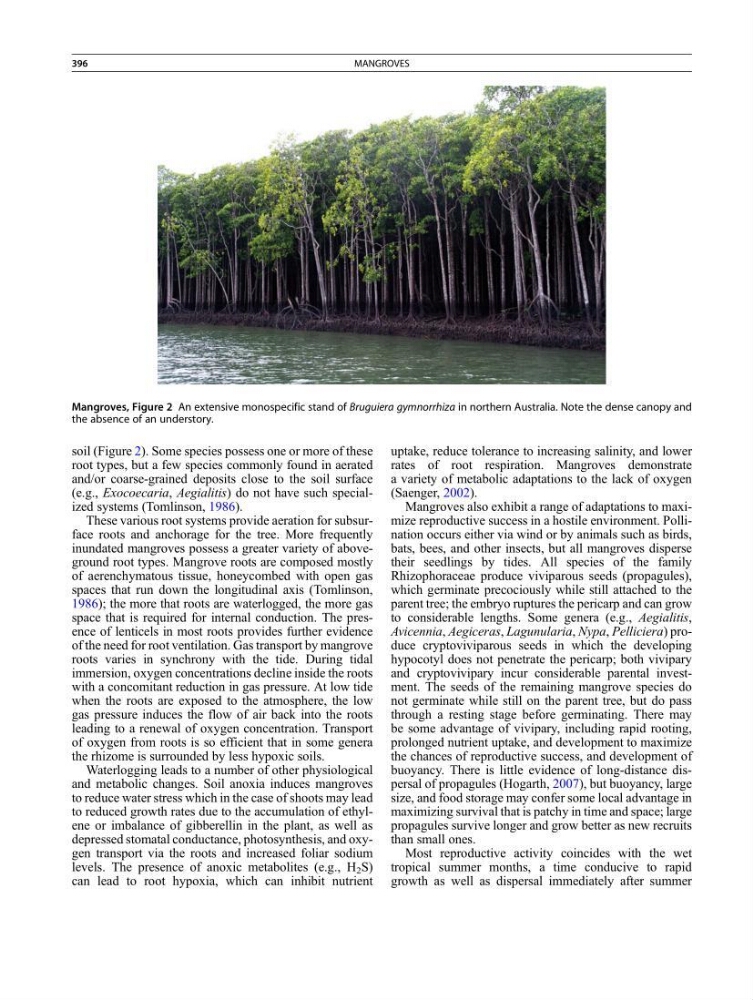
soil (Figure 2). Some species possess one or more of these
root types, but a few species commonly found in aerated
and/or coarse-grained deposits close to the soil surface
(e.g., Exocoecaria, Aegialitis) do not have such specialized systems (Tomlinson, 1986).
These various root systems provide aeration for subsurface roots and anchorage for the tree. More frequently
inundated mangroves possess a greater variety of aboveground root types. Mangrove roots are composed mostly
of aerenchymatous tissue, honeycombed with open gas
spaces that run down the longitudinal axis (Tomlinson,
1986); the more that roots are waterlogged, the more gas
space that is required for internal conduction. The presence of lenticels in most roots provides further evidence
of the need for root ventilation. Gas transport by mangrove
roots varies in synchrony with the tide. During tidal
immersion, oxygen concentrations decline inside the roots
with a concomitant reduction in gas pressure. At low tide
when the roots are exposed to the atmosphere, the low
gas pressure induces the flow of air back into the roots
leading to a renewal of oxygen concentration. Transport
of oxygen from roots is so efficient that in some genera
the rhizome is surrounded by less hypoxic soils.
Waterlogging leads to a number of other physiological
and metabolic changes. Soil anoxia induces mangroves
to reduce water stress which in the case of shoots may lead
to reduced growth rates due to the accumulation of ethylene or imbalance of gibberellin in the plant, as well as
depressed stomatal conductance, photosynthesis, and oxygen transport via the roots and increased foliar sodium
levels. The presence of anoxic metabolites (e.g., H 2 S)
can lead to root hypoxia, which can inhibit nutrient
uptake, reduce tolerance to increasing salinity, and lower
rates of root respiration. Mangroves demonstrate
a variety of metabolic adaptations to the lack of oxygen
(Saenger, 2002).
Mangroves also exhibit a range of adaptations to maximize reproductive success in a hostile environment. Pollination occurs either via wind or by animals such as birds,
bats, bees, and other insects, but all mangroves disperse
their seedlings by tides. All species of the family
Rhizophoraceae produce viviparous seeds (propagules),
which germinate precociously while still attached to the
parent tree; the embryo ruptures the pericarp and can grow
to considerable lengths. Some genera (e.g., Aegialitis,
Avicennia, Aegiceras, Lagunularia, Nypa, Pelliciera) produce cryptoviviparous seeds in which the developing
hypocotyl does not penetrate the pericarp; both vivipary
and cryptovivipary incur considerable parental investment. The seeds of the remaining mangrove species do
not germinate while still on the parent tree, but do pass
through a resting stage before germinating. There may
be some advantage of vivipary, including rapid rooting,
prolonged nutrient uptake, and development to maximize
the chances of reproductive success, and development of
buoyancy. There is little evidence of long-distance dispersal of propagules (Hogarth, 2007), but buoyancy, large
size, and food storage may confer some local advantage in
maximizing survival that is patchy in time and space; large
propagules survive longer and grow better as new recruits
than small ones.
Most reproductive activity coincides with the wet
tropical summer months, a time conducive to rapid
growth as well as dispersal immediately after summer
Mangroves, Figure 2 An extensive monospecific stand of Bruguiera gymnorrhiza in northern Australia. Note the dense canopy and
the absence of an understory.
396
MANGROVES
root types, but a few species commonly found in aerated
and/or coarse-grained deposits close to the soil surface
(e.g., Exocoecaria, Aegialitis) do not have such specialized systems (Tomlinson, 1986).
These various root systems provide aeration for subsurface roots and anchorage for the tree. More frequently
inundated mangroves possess a greater variety of aboveground root types. Mangrove roots are composed mostly
of aerenchymatous tissue, honeycombed with open gas
spaces that run down the longitudinal axis (Tomlinson,
1986); the more that roots are waterlogged, the more gas
space that is required for internal conduction. The presence of lenticels in most roots provides further evidence
of the need for root ventilation. Gas transport by mangrove
roots varies in synchrony with the tide. During tidal
immersion, oxygen concentrations decline inside the roots
with a concomitant reduction in gas pressure. At low tide
when the roots are exposed to the atmosphere, the low
gas pressure induces the flow of air back into the roots
leading to a renewal of oxygen concentration. Transport
of oxygen from roots is so efficient that in some genera
the rhizome is surrounded by less hypoxic soils.
Waterlogging leads to a number of other physiological
and metabolic changes. Soil anoxia induces mangroves
to reduce water stress which in the case of shoots may lead
to reduced growth rates due to the accumulation of ethylene or imbalance of gibberellin in the plant, as well as
depressed stomatal conductance, photosynthesis, and oxygen transport via the roots and increased foliar sodium
levels. The presence of anoxic metabolites (e.g., H 2 S)
can lead to root hypoxia, which can inhibit nutrient
uptake, reduce tolerance to increasing salinity, and lower
rates of root respiration. Mangroves demonstrate
a variety of metabolic adaptations to the lack of oxygen
(Saenger, 2002).
Mangroves also exhibit a range of adaptations to maximize reproductive success in a hostile environment. Pollination occurs either via wind or by animals such as birds,
bats, bees, and other insects, but all mangroves disperse
their seedlings by tides. All species of the family
Rhizophoraceae produce viviparous seeds (propagules),
which germinate precociously while still attached to the
parent tree; the embryo ruptures the pericarp and can grow
to considerable lengths. Some genera (e.g., Aegialitis,
Avicennia, Aegiceras, Lagunularia, Nypa, Pelliciera) produce cryptoviviparous seeds in which the developing
hypocotyl does not penetrate the pericarp; both vivipary
and cryptovivipary incur considerable parental investment. The seeds of the remaining mangrove species do
not germinate while still on the parent tree, but do pass
through a resting stage before germinating. There may
be some advantage of vivipary, including rapid rooting,
prolonged nutrient uptake, and development to maximize
the chances of reproductive success, and development of
buoyancy. There is little evidence of long-distance dispersal of propagules (Hogarth, 2007), but buoyancy, large
size, and food storage may confer some local advantage in
maximizing survival that is patchy in time and space; large
propagules survive longer and grow better as new recruits
than small ones.
Most reproductive activity coincides with the wet
tropical summer months, a time conducive to rapid
growth as well as dispersal immediately after summer
Mangroves, Figure 2 An extensive monospecific stand of Bruguiera gymnorrhiza in northern Australia. Note the dense canopy and
the absence of an understory.
396
MANGROVES