

subsidence but rising sea level; and (6) the forest floor is
set back when there is no change in sediment volume with
a rise in sea level (Woodroffe, 2003). Thus, mangroves are
not static ecosystems, but ever changing, like the interface
they occupy between land and sea, and have been traditionally classified as forests occupying overwash islands,
coastal fringes, riverine areas, and intertidal basins; scrub
forests and other unique settings do occur, especially in
relation to the dominance of carbonate (Lugo and
Snedaker, 1974).
Mangroves are of great importance economically to
coastal inhabitants and ecologically as an integral part of
the coastal zone throughout low latitudes and are a prime
source of wood for fuel and construction; chemicals for
traditional medicine; food; breeding grounds and nursery
sites for many terrestrial and marine organisms; sites of
accumulation of sediments, carbon, nutrients, and contaminants; as well as offering some protection from erosion
and from catastrophic events, such as tsunami and
cyclones (Alongi, 2008).
Global distribution, biogeography, and losses
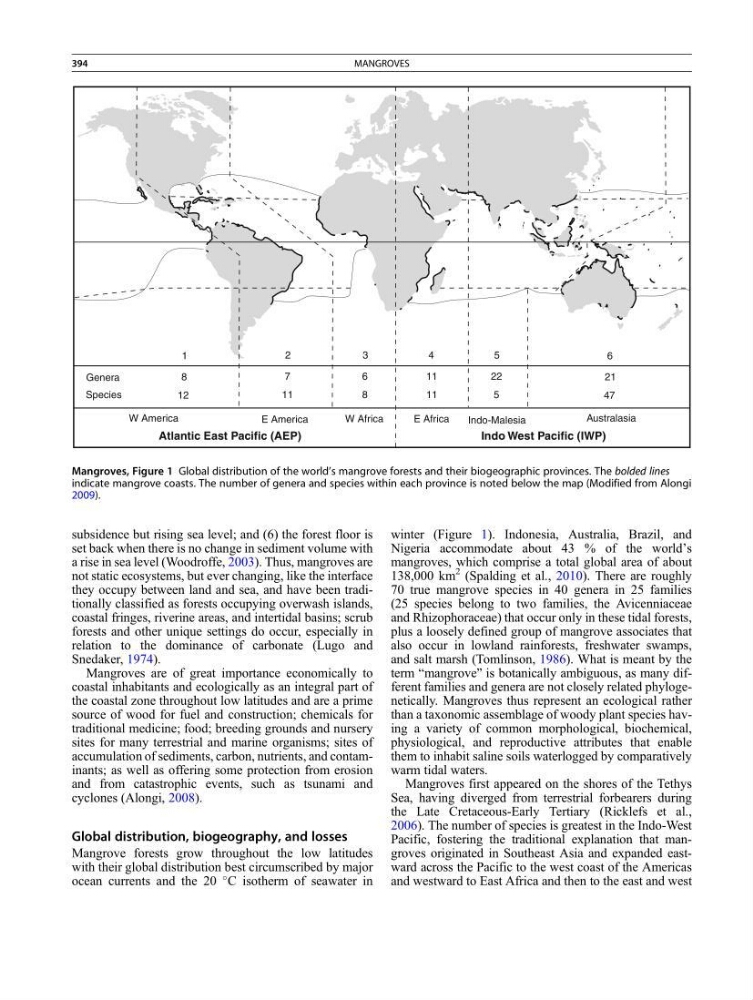
Mangrove forests grow throughout the low latitudes
with their global distribution best circumscribed by major
ocean currents and the 20
C isotherm of seawater in
winter (Figure 1). Indonesia, Australia, Brazil, and
Nigeria accommodate about 43 % of the world’s
mangroves, which comprise a total global area of about
138,000 km
2 (Spalding et al., 2010). There are roughly
70 true mangrove species in 40 genera in 25 families
(25 species belong to two families, the Avicenniaceae
and Rhizophoraceae) that occur only in these tidal forests,
plus a loosely defined group of mangrove associates that
also occur in lowland rainforests, freshwater swamps,
and salt marsh (Tomlinson, 1986). What is meant by the
term “mangrove” is botanically ambiguous, as many different families and genera are not closely related phylogenetically. Mangroves thus represent an ecological rather
than a taxonomic assemblage of woody plant species having a variety of common morphological, biochemical,
physiological, and reproductive attributes that enable
them to inhabit saline soils waterlogged by comparatively
warm tidal waters.
Mangroves first appeared on the shores of the Tethys
Sea, having diverged from terrestrial forbearers during
the Late Cretaceous-Early Tertiary (Ricklefs et al.,
2006). The number of species is greatest in the Indo-West
Pacific, fostering the traditional explanation that mangroves originated in Southeast Asia and expanded eastward across the Pacific to the west coast of the Americas
and westward to East Africa and then to the east and west
Species
Genera
1
2
3
4
5
6
8
7
6
1 1
22
21
12
11
8
11
5
47
W America
E America
W Africa
E Africa
Indo-Malesia
Australasia
Atlantic East Pacific (AEP)
Indo West Pacific (IWP)
Mangroves, Figure 1 Global distribution of the world’s mangrove forests and their biogeographic provinces. The bolded lines
indicate mangrove coasts. The number of genera and species within each province is noted below the map (Modified from Alongi
2009).
394
MANGROVES
set back when there is no change in sediment volume with
a rise in sea level (Woodroffe, 2003). Thus, mangroves are
not static ecosystems, but ever changing, like the interface
they occupy between land and sea, and have been traditionally classified as forests occupying overwash islands,
coastal fringes, riverine areas, and intertidal basins; scrub
forests and other unique settings do occur, especially in
relation to the dominance of carbonate (Lugo and
Snedaker, 1974).
Mangroves are of great importance economically to
coastal inhabitants and ecologically as an integral part of
the coastal zone throughout low latitudes and are a prime
source of wood for fuel and construction; chemicals for
traditional medicine; food; breeding grounds and nursery
sites for many terrestrial and marine organisms; sites of
accumulation of sediments, carbon, nutrients, and contaminants; as well as offering some protection from erosion
and from catastrophic events, such as tsunami and
cyclones (Alongi, 2008).
Global distribution, biogeography, and losses
Mangrove forests grow throughout the low latitudes
with their global distribution best circumscribed by major
ocean currents and the 20
C isotherm of seawater in
winter (Figure 1). Indonesia, Australia, Brazil, and
Nigeria accommodate about 43 % of the world’s
mangroves, which comprise a total global area of about
138,000 km
2 (Spalding et al., 2010). There are roughly
70 true mangrove species in 40 genera in 25 families
(25 species belong to two families, the Avicenniaceae
and Rhizophoraceae) that occur only in these tidal forests,
plus a loosely defined group of mangrove associates that
also occur in lowland rainforests, freshwater swamps,
and salt marsh (Tomlinson, 1986). What is meant by the
term “mangrove” is botanically ambiguous, as many different families and genera are not closely related phylogenetically. Mangroves thus represent an ecological rather
than a taxonomic assemblage of woody plant species having a variety of common morphological, biochemical,
physiological, and reproductive attributes that enable
them to inhabit saline soils waterlogged by comparatively
warm tidal waters.
Mangroves first appeared on the shores of the Tethys
Sea, having diverged from terrestrial forbearers during
the Late Cretaceous-Early Tertiary (Ricklefs et al.,
2006). The number of species is greatest in the Indo-West
Pacific, fostering the traditional explanation that mangroves originated in Southeast Asia and expanded eastward across the Pacific to the west coast of the Americas
and westward to East Africa and then to the east and west
Species
Genera
1
2
3
4
5
6
8
7
6
1 1
22
21
12
11
8
11
5
47
W America
E America
W Africa
E Africa
Indo-Malesia
Australasia
Atlantic East Pacific (AEP)
Indo West Pacific (IWP)
Mangroves, Figure 1 Global distribution of the world’s mangrove forests and their biogeographic provinces. The bolded lines
indicate mangrove coasts. The number of genera and species within each province is noted below the map (Modified from Alongi
2009).
394
MANGROVES