

Cross-references
Algal Blooms
Bioavailability
Ecological Stoichiometry
Nitrogen
Nutrient Limitation
Phosphorus
MANAGED REALIGNMENT
Luciana S. Esteves
Faculty of Science and Technology, Talbot Campus,
Bournemouth University, Poole, Dorset, UK
Synonyms
De-embankment; Managed retreat; Setback
Definition
Managed realignment most often involves the planned
breaching or removal of coastal defenses to create
new intertidal habitats aiming to improve flood risk
management with added environmental value. Managed
realignment is usually implemented in low-lying estuarine
or open coast sites, and may require the construction of
a new line of defenses to control flood risk. Hence,
the expression “managed realignment” may refer to the
relocation of both the coastline and the flood
defense line. An overview of the different definitions used
in the literature is provided in Esteves (2014).
A shift from the traditional ‘hold-the-line’
approach of coastal protection
Managed realignment is one of the soft engineering
approaches to coastal protection. By working with coastal
processes, managed realignment aims to increase the sustainability of coastal protection while at the same time
reducing adverse environmental impacts normally associated with hard engineering (French, 1997). For centuries,
hard engineering structures have been built to protect
assets at the coast from erosion and flooding events. These
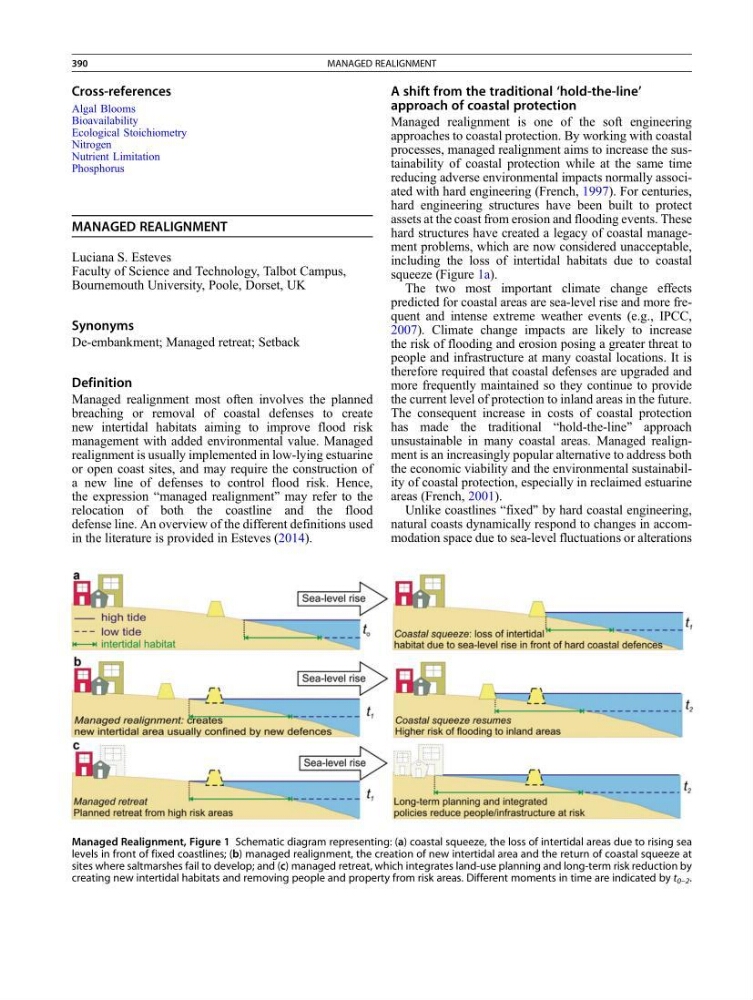
hard structures have created a legacy of coastal management problems, which are now considered unacceptable,
including the loss of intertidal habitats due to coastal
squeeze (Figure 1a).
The two most important climate change effects
predicted for coastal areas are sea-level rise and more frequent and intense extreme weather events (e.g., IPCC,
2007). Climate change impacts are likely to increase
the risk of flooding and erosion posing a greater threat to
people and infrastructure at many coastal locations. It is
therefore required that coastal defenses are upgraded and
more frequently maintained so they continue to provide
the current level of protection to inland areas in the future.
The consequent increase in costs of coastal protection
has made the traditional “hold-the-line” approach
unsustainable in many coastal areas. Managed realignment is an increasingly popular alternative to address both
the economic viability and the environmental sustainability of coastal protection, especially in reclaimed estuarine
areas (French, 2001).
Unlike coastlines “fixed” by hard coastal engineering,
natural coasts dynamically respond to changes in accommodation space due to sea-level fluctuations or alterations
Managed Realignment, Figure 1 Schematic diagram representing: (a) coastal squeeze, the loss of intertidal areas due to rising sea
levels in front of fixed coastlines; (b) managed realignment, the creation of new intertidal area and the return of coastal squeeze at
sites where saltmarshes fail to develop; and (c) managed retreat, which integrates land-use planning and long-term risk reduction by
creating new intertidal habitats and removing people and property from risk areas. Different moments in time are indicated by t 0–2 .
390
MANAGED REALIGNMENT
Algal Blooms
Bioavailability
Ecological Stoichiometry
Nitrogen
Nutrient Limitation
Phosphorus
MANAGED REALIGNMENT
Luciana S. Esteves
Faculty of Science and Technology, Talbot Campus,
Bournemouth University, Poole, Dorset, UK
Synonyms
De-embankment; Managed retreat; Setback
Definition
Managed realignment most often involves the planned
breaching or removal of coastal defenses to create
new intertidal habitats aiming to improve flood risk
management with added environmental value. Managed
realignment is usually implemented in low-lying estuarine
or open coast sites, and may require the construction of
a new line of defenses to control flood risk. Hence,
the expression “managed realignment” may refer to the
relocation of both the coastline and the flood
defense line. An overview of the different definitions used
in the literature is provided in Esteves (2014).
A shift from the traditional ‘hold-the-line’
approach of coastal protection
Managed realignment is one of the soft engineering
approaches to coastal protection. By working with coastal
processes, managed realignment aims to increase the sustainability of coastal protection while at the same time
reducing adverse environmental impacts normally associated with hard engineering (French, 1997). For centuries,
hard engineering structures have been built to protect
assets at the coast from erosion and flooding events. These
hard structures have created a legacy of coastal management problems, which are now considered unacceptable,
including the loss of intertidal habitats due to coastal
squeeze (Figure 1a).
The two most important climate change effects
predicted for coastal areas are sea-level rise and more frequent and intense extreme weather events (e.g., IPCC,
2007). Climate change impacts are likely to increase
the risk of flooding and erosion posing a greater threat to
people and infrastructure at many coastal locations. It is
therefore required that coastal defenses are upgraded and
more frequently maintained so they continue to provide
the current level of protection to inland areas in the future.
The consequent increase in costs of coastal protection
has made the traditional “hold-the-line” approach
unsustainable in many coastal areas. Managed realignment is an increasingly popular alternative to address both
the economic viability and the environmental sustainability of coastal protection, especially in reclaimed estuarine
areas (French, 2001).
Unlike coastlines “fixed” by hard coastal engineering,
natural coasts dynamically respond to changes in accommodation space due to sea-level fluctuations or alterations
Managed Realignment, Figure 1 Schematic diagram representing: (a) coastal squeeze, the loss of intertidal areas due to rising sea
levels in front of fixed coastlines; (b) managed realignment, the creation of new intertidal area and the return of coastal squeeze at
sites where saltmarshes fail to develop; and (c) managed retreat, which integrates land-use planning and long-term risk reduction by
creating new intertidal habitats and removing people and property from risk areas. Different moments in time are indicated by t 0–2 .
390
MANAGED REALIGNMENT