

Links to eutrophication and altered nutrient
stoichiometry
Overenrichment of coastal waters by nutrients is considered
a major pollution problem worldwide (Howarth, 2008) and
one of the most important factors contributing to global
HAB increases (Anderson et al., 2002; Glibert et al.,
2005b; Glibert and Burkholder, 2006; Heisler et al.,
2008). Nutrient pollution is on the rise because of dramatic
increases in human populations in many regions and concomitant increasing demands for energy, increases in nitrogen (N) and phosphorus (P) fertilizer use for agriculture,
changes in diet that are leading to more meat production
and animal waste, and expanding aquaculture industries
(e.g., Howarth, 2008; Glibert et al., 2010; Bouwman et al.,
2011; Bouwman et al., 2013). These industries have altered
ecosystems through input of feed and feces, only a small
percentage of which is incorporated in food biomass.
Increases in total nutrient load can support higher HAB
biomass, and alterations in nutrient form can lead to
a nutrient regime favoring HAB growth relative to other
algal species. At the simplest level, harmful phytoplankton may increase in abundance due to nutrient enrichment,
but remain in the same relative fraction of the total
phytoplankton biomass. Even though non-HAB species
are stimulated proportionately, a modest increase in the
abundance of a HAB species can promote noticeable
differences in the ecosystem because of its harmful or
toxic effects. More frequently, a species or group of species dominates in response to nutrient enrichment or
a change in the ratios of nutrient enrichment (Anderson
et al., 2002).
The number of examples of algal blooms linked to
eutrophication globally is long, and only a few are
highlighted here. A species now well documented to be
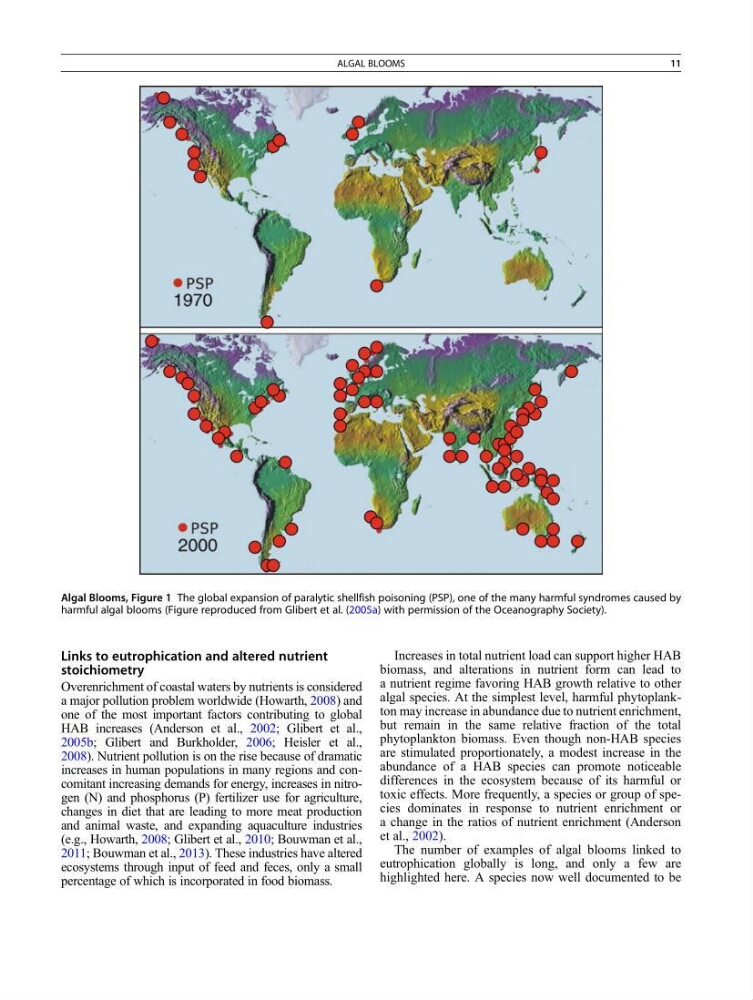
Algal Blooms, Figure 1 The global expansion of paralytic shellfish poisoning (PSP), one of the many harmful syndromes caused by
harmful algal blooms (Figure reproduced from Glibert et al. (2005a) with permission of the Oceanography Society).
ALGAL BLOOMS
11
stoichiometry
Overenrichment of coastal waters by nutrients is considered
a major pollution problem worldwide (Howarth, 2008) and
one of the most important factors contributing to global
HAB increases (Anderson et al., 2002; Glibert et al.,
2005b; Glibert and Burkholder, 2006; Heisler et al.,
2008). Nutrient pollution is on the rise because of dramatic
increases in human populations in many regions and concomitant increasing demands for energy, increases in nitrogen (N) and phosphorus (P) fertilizer use for agriculture,
changes in diet that are leading to more meat production
and animal waste, and expanding aquaculture industries
(e.g., Howarth, 2008; Glibert et al., 2010; Bouwman et al.,
2011; Bouwman et al., 2013). These industries have altered
ecosystems through input of feed and feces, only a small
percentage of which is incorporated in food biomass.
Increases in total nutrient load can support higher HAB
biomass, and alterations in nutrient form can lead to
a nutrient regime favoring HAB growth relative to other
algal species. At the simplest level, harmful phytoplankton may increase in abundance due to nutrient enrichment,
but remain in the same relative fraction of the total
phytoplankton biomass. Even though non-HAB species
are stimulated proportionately, a modest increase in the
abundance of a HAB species can promote noticeable
differences in the ecosystem because of its harmful or
toxic effects. More frequently, a species or group of species dominates in response to nutrient enrichment or
a change in the ratios of nutrient enrichment (Anderson
et al., 2002).
The number of examples of algal blooms linked to
eutrophication globally is long, and only a few are
highlighted here. A species now well documented to be
Algal Blooms, Figure 1 The global expansion of paralytic shellfish poisoning (PSP), one of the many harmful syndromes caused by
harmful algal blooms (Figure reproduced from Glibert et al. (2005a) with permission of the Oceanography Society).
ALGAL BLOOMS
11