

region (e.g., the ground and land cover). These data
are often used to derive digital elevation models (DEM)
or digital surface models (DSM) of the imaged terrain.
Bibliography
Shan, J., and Toth, C., 2009. Topographic Laser Ranging and
Scanning, Principles and Processes. Boca Raton: CRC Press.
Cross-references
Airborne Laser Terrain Mapping (ALTM)
LITTORAL CORDON
J. Javier Diez
1 and Efren M. Veiga
2
1
Research Group on Marine, Coastal and Port
Environment and Other Sensitive Areas, Department of
Land and Urban Planning and Environment, Universidad
Politécnica de Madrid, Madrid, Spain
2
Civil Engineering: Land & Urban Management and
Environment, Universidad Politécnica de Madrid, Escuela
de Caminos, Canales y Puertos, Madrid, Spain
Synonyms
Sandbar
Definition
Littoral cordon (cord, belt) is a Spanish term from the
genetic classification of simple coastal forms (Bores,
1978) which together with littoral flecha (arrow) is
a term used to describe the shaping of most barrier islands
(Finkl, 2004).
Genesis
Barrier islands can be formed in a number of ways (King,
1972; Williams, 1982), with wave and sediment processes
playing significant roles. The linear momentum of the
transversal (orthogonal) wave generates a bar in the
breaker zone that results in a radical modification of
hydrodynamic conditions. The bar may become a littoral
cordon if the alongshore (parallel) linear momentum is relatively minor. If, in contrast, this longitudinal component
is significant, the bar tends to advance in the direction of
littoral transport giving rise to a spit. Both cordons and
spits may become barrier islands.
Climatic conditions can cause short-term increases in
sea level via (1) low-pressure suction (storm surge),
(2) wind setup, and (3) wind-wave setup. The last two
processes are always interrelated and increase together,
though with a delay. Further, both are coupled to the first
process, though not jointly. Maxima of the first or third
processes are not concurrent with maxima of the second,
though they are additive in a maximum storm, which is
precisely when storm bars are created. Storm bars are
deeper than bars formed during more quiescent conditions. Storm bars may also attain higher elevations. At
times, when storm waters recede, storm bars may remain
above sea level.
A bar with insufficient thickness, elevation, or sedimentary consistency is often temporary. This can happen when
sea level is not extraordinarily high. However, if sea level is
high enough and the nature of the sedimentary system supports it, a sandbar can survive the annual cycle and become
a permanent formation once it is colonized by biota.
There are broad morphological and genetic analogies
between littoral cordons and spits, such as the wave action
under which the features evolve. There are also radical differences between the features. One pronounced difference
is the relative importance of parallel littoral transport.
Littoral cordons and spits facilitate the subsequent
infilling of an intracoastal channel or bay. This leads to
the eventual extension of the littoral plain and the creation
of residual littoral lagoons that have some degree of permanence. Up to three successive barrier islands that have
been added to the mainland on the Guadiana River delta
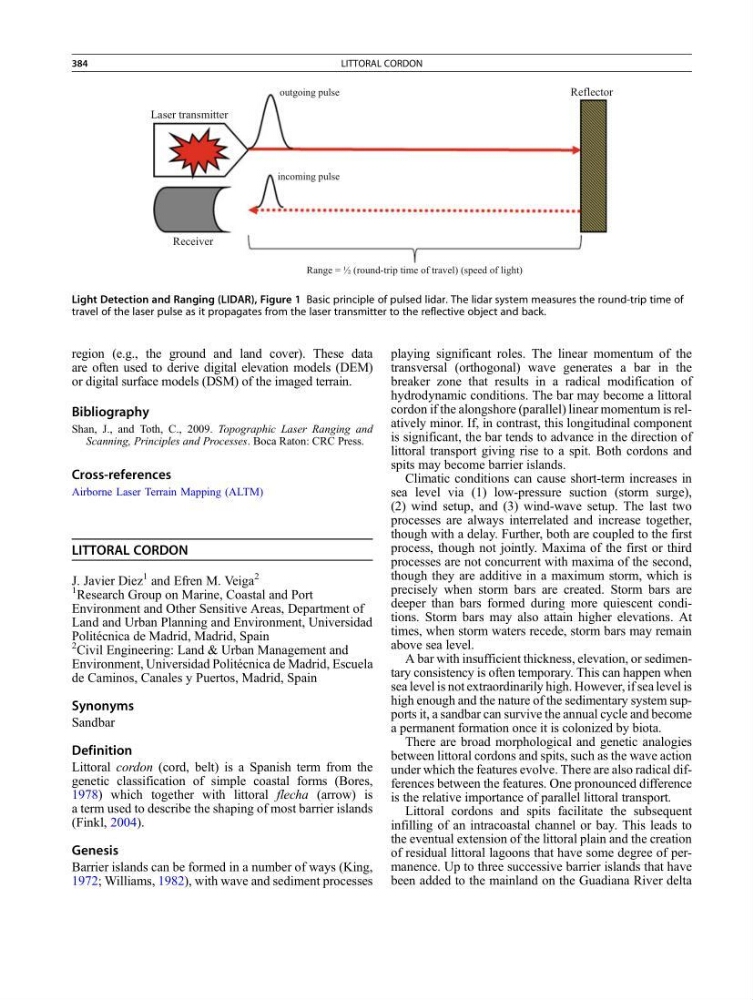
outgoing pulse
incoming pulse
Range = ½ (round-trip time of travel) (speed of light)
Receiver
Laser transmitter
Reflector
Light Detection and Ranging (LIDAR), Figure 1 Basic principle of pulsed lidar. The lidar system measures the round-trip time of
travel of the laser pulse as it propagates from the laser transmitter to the reflective object and back.
384
LITTORAL CORDON
are often used to derive digital elevation models (DEM)
or digital surface models (DSM) of the imaged terrain.
Bibliography
Shan, J., and Toth, C., 2009. Topographic Laser Ranging and
Scanning, Principles and Processes. Boca Raton: CRC Press.
Cross-references
Airborne Laser Terrain Mapping (ALTM)
LITTORAL CORDON
J. Javier Diez
1 and Efren M. Veiga
2
1
Research Group on Marine, Coastal and Port
Environment and Other Sensitive Areas, Department of
Land and Urban Planning and Environment, Universidad
Politécnica de Madrid, Madrid, Spain
2
Civil Engineering: Land & Urban Management and
Environment, Universidad Politécnica de Madrid, Escuela
de Caminos, Canales y Puertos, Madrid, Spain
Synonyms
Sandbar
Definition
Littoral cordon (cord, belt) is a Spanish term from the
genetic classification of simple coastal forms (Bores,
1978) which together with littoral flecha (arrow) is
a term used to describe the shaping of most barrier islands
(Finkl, 2004).
Genesis
Barrier islands can be formed in a number of ways (King,
1972; Williams, 1982), with wave and sediment processes
playing significant roles. The linear momentum of the
transversal (orthogonal) wave generates a bar in the
breaker zone that results in a radical modification of
hydrodynamic conditions. The bar may become a littoral
cordon if the alongshore (parallel) linear momentum is relatively minor. If, in contrast, this longitudinal component
is significant, the bar tends to advance in the direction of
littoral transport giving rise to a spit. Both cordons and
spits may become barrier islands.
Climatic conditions can cause short-term increases in
sea level via (1) low-pressure suction (storm surge),
(2) wind setup, and (3) wind-wave setup. The last two
processes are always interrelated and increase together,
though with a delay. Further, both are coupled to the first
process, though not jointly. Maxima of the first or third
processes are not concurrent with maxima of the second,
though they are additive in a maximum storm, which is
precisely when storm bars are created. Storm bars are
deeper than bars formed during more quiescent conditions. Storm bars may also attain higher elevations. At
times, when storm waters recede, storm bars may remain
above sea level.
A bar with insufficient thickness, elevation, or sedimentary consistency is often temporary. This can happen when
sea level is not extraordinarily high. However, if sea level is
high enough and the nature of the sedimentary system supports it, a sandbar can survive the annual cycle and become
a permanent formation once it is colonized by biota.
There are broad morphological and genetic analogies
between littoral cordons and spits, such as the wave action
under which the features evolve. There are also radical differences between the features. One pronounced difference
is the relative importance of parallel littoral transport.
Littoral cordons and spits facilitate the subsequent
infilling of an intracoastal channel or bay. This leads to
the eventual extension of the littoral plain and the creation
of residual littoral lagoons that have some degree of permanence. Up to three successive barrier islands that have
been added to the mainland on the Guadiana River delta
outgoing pulse
incoming pulse
Range = ½ (round-trip time of travel) (speed of light)
Receiver
Laser transmitter
Reflector
Light Detection and Ranging (LIDAR), Figure 1 Basic principle of pulsed lidar. The lidar system measures the round-trip time of
travel of the laser pulse as it propagates from the laser transmitter to the reflective object and back.
384
LITTORAL CORDON