

plants, creating a single ecological zone that eliminates the
transitional areas native species need. It reduces the species richness of benthic organisms and modifies benthic
communities (Neira et al., 2005). It has displaced native
flora, changed sedimentation, decreased invertebrate and
algal populations, and eliminated foraging sites used by
marsh birds and shorebirds. Levin et al. (2006) concluded
there had been a “trophic shift” in the ecosystem in
response to the Spartina invasion, involving loss of key
trophic support for fishes and migratory birds by shifting
dominance to species not widely consumed by species at
higher trophic levels.
It is suspected that S. alterniflora was introduced into
Willapa Bay in the late 1800s or early 1900s as packing
material for oyster shipments from the East Coast. From
the middle of the twentieth century, the plant spread rapidly throughout Willapa Bay. In the 1970s, the US Army
Corps of Engineers deliberately introduced it to stabilize
flood control levees on Alameda Island in San Francisco
Bay because it grows much faster than the native cordgrass (S. foliosa). Unfortunately, S. alterniflora both outcompetes it and hybridizes with S. foliosa (Daehler and
Strong, 1997) and the hybrid is particularly invasive,
choking off small creeks in the marshes that are used by
the endangered California clapper rails and covering mudflats that provide food for the rails and other shorebirds.
Authorities are concerned that cordgrass is likely to choke
tidal creeks, dominate newly restored marshes, impair
thousands of acres of shorebird habitat, and eventually
cause extinction of the native Pacific cordgrass. By
2005, about 10 % of the acres of tidal flats in the San
Francisco Bay estuary had been invaded by the hybrid.
In Washington State, the loss of mudflat habitat harms
marine species such as the juvenile chum salmon,
Dungeness crab, and English sole that rely on these habitats as food sources. About one quarter of the total foraging habitat of the Dungeness crabs has been lost because
the rigid structure of the shoots seems to reduce the ability
of the crabs to access their prey (Feist and Simenstad,
2000). The sediments around the Spartina hybrid have
also reduced communities of invertebrates, and commercial oyster production has been threatened because culture
beds are being invaded. At the Willapa National Wildlife
Refuge in Washington, Spartina has displaced habitat for
wintering and breeding migratory aquatic birds.
Costly efforts to spray and excavate are underway in
San Francisco Bay and Puget Sound. Workers are
spraying many acres with the herbicide Habitat® which
kills the grass with minimal effects on animals because it
works by selectively interfering with plant biochemistry.
Biological control is being investigated using the plant
hopper Prokelisia marginata (Grevstad et al., 2003).
Researchers in China are concerned about how the
invasive Spartina alterniflora is threatening their valuable
Phragmites australis marshes. It is highly invasive on
the Chinese coast and is causing concern due to its rapid
expansion and damage to native ecosystems. Both tall
and dwarf forms of the species are in China, and the
tall form with its strongly invasive ability has expanded
widely and is replacing native Phragmites in some sites.
Several methods for Spartina control in China, such as
harvesting, herbicide application, and freshwater irrigation, have been developed, but more research is needed
to verify their effectiveness (An et al., 2007).
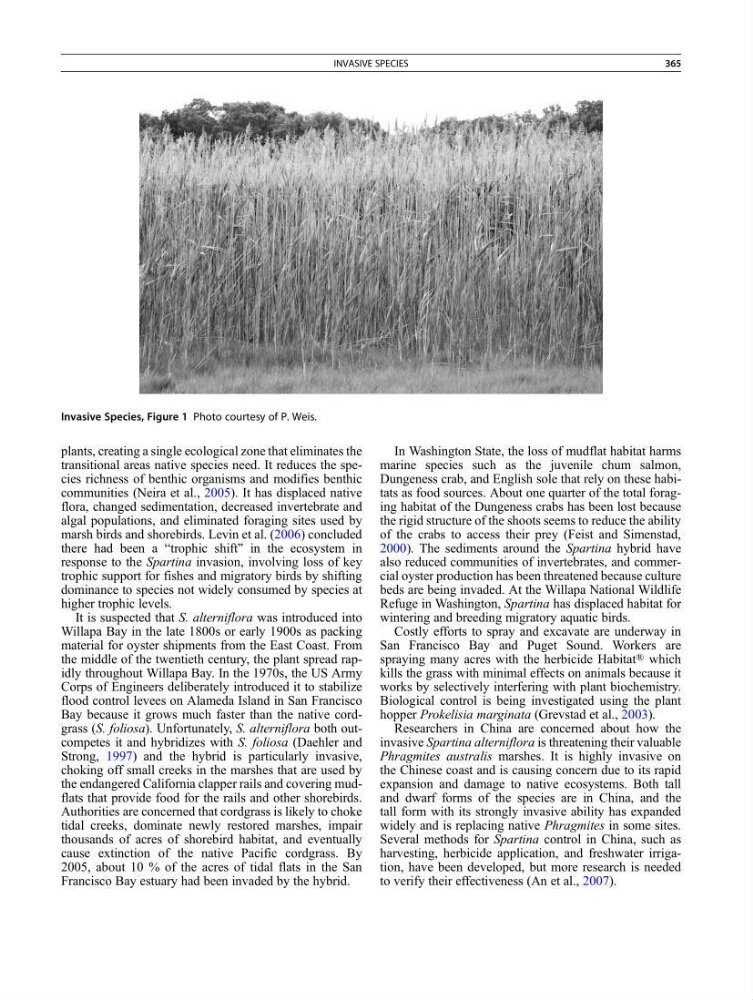
Invasive Species, Figure 1 Photo courtesy of P. Weis.
INVASIVE SPECIES
365
transitional areas native species need. It reduces the species richness of benthic organisms and modifies benthic
communities (Neira et al., 2005). It has displaced native
flora, changed sedimentation, decreased invertebrate and
algal populations, and eliminated foraging sites used by
marsh birds and shorebirds. Levin et al. (2006) concluded
there had been a “trophic shift” in the ecosystem in
response to the Spartina invasion, involving loss of key
trophic support for fishes and migratory birds by shifting
dominance to species not widely consumed by species at
higher trophic levels.
It is suspected that S. alterniflora was introduced into
Willapa Bay in the late 1800s or early 1900s as packing
material for oyster shipments from the East Coast. From
the middle of the twentieth century, the plant spread rapidly throughout Willapa Bay. In the 1970s, the US Army
Corps of Engineers deliberately introduced it to stabilize
flood control levees on Alameda Island in San Francisco
Bay because it grows much faster than the native cordgrass (S. foliosa). Unfortunately, S. alterniflora both outcompetes it and hybridizes with S. foliosa (Daehler and
Strong, 1997) and the hybrid is particularly invasive,
choking off small creeks in the marshes that are used by
the endangered California clapper rails and covering mudflats that provide food for the rails and other shorebirds.
Authorities are concerned that cordgrass is likely to choke
tidal creeks, dominate newly restored marshes, impair
thousands of acres of shorebird habitat, and eventually
cause extinction of the native Pacific cordgrass. By
2005, about 10 % of the acres of tidal flats in the San
Francisco Bay estuary had been invaded by the hybrid.
In Washington State, the loss of mudflat habitat harms
marine species such as the juvenile chum salmon,
Dungeness crab, and English sole that rely on these habitats as food sources. About one quarter of the total foraging habitat of the Dungeness crabs has been lost because
the rigid structure of the shoots seems to reduce the ability
of the crabs to access their prey (Feist and Simenstad,
2000). The sediments around the Spartina hybrid have
also reduced communities of invertebrates, and commercial oyster production has been threatened because culture
beds are being invaded. At the Willapa National Wildlife
Refuge in Washington, Spartina has displaced habitat for
wintering and breeding migratory aquatic birds.
Costly efforts to spray and excavate are underway in
San Francisco Bay and Puget Sound. Workers are
spraying many acres with the herbicide Habitat® which
kills the grass with minimal effects on animals because it
works by selectively interfering with plant biochemistry.
Biological control is being investigated using the plant
hopper Prokelisia marginata (Grevstad et al., 2003).
Researchers in China are concerned about how the
invasive Spartina alterniflora is threatening their valuable
Phragmites australis marshes. It is highly invasive on
the Chinese coast and is causing concern due to its rapid
expansion and damage to native ecosystems. Both tall
and dwarf forms of the species are in China, and the
tall form with its strongly invasive ability has expanded
widely and is replacing native Phragmites in some sites.
Several methods for Spartina control in China, such as
harvesting, herbicide application, and freshwater irrigation, have been developed, but more research is needed
to verify their effectiveness (An et al., 2007).
Invasive Species, Figure 1 Photo courtesy of P. Weis.
INVASIVE SPECIES
365