

INTERTIDAL ZONATION
Brian Helmuth
Marine Science Center, Northeastern University,
Nahant, MA, USA
Definition
Intertidal zonation refers to the frequently observed pattern by which species replace one another along
a gradient from the low to high tide lines along many of
the world’s coastlines.
Causes of zonation
Intertidal zones are the regions between the lowest and
highest tides on a shoreline which serves as an interface
between the terrestrial and marine environments. As such,
organisms living in these often physically harsh habitats
must survive both submersion (at high tide) and aerial
exposure (at low tide) (Fig. 1). The resulting gradient
whereby organisms closer to the ocean (in the low intertidal zone) are generally exposed to air for short periods
and those higher on the shore can spend more time in air
than in water has resulted in intertidal zone emergence as
natural laboratories for examining how the physical and
biotic environments affect the distribution of organisms
in nature (Paine, 1994).
Early studies of zonation in the late nineteenth century
focused on documenting patterns, but later work shifted
to a focus on the underlying causes of zonation (Benson,
2002). Seminal work by Connell (1961) and Paine
(reviewed in Paine, 1994) has led to the general paradigm
that the lower (oceanward) edge of zones are set by biotic
factors such as competition and predation, while the upper
(shoreward) edges are driven by tolerance to environmental stress and emersion time. Because of the sensitivity of
intertidal organisms to environmental stress, the study of
the causes of intertidal zonation has renewed significance
in the context of climate change impacts.
While several schemata for defining zonation have
been articulated (e.g., Doty, 1946), zones are typically
defined either by their height above the low tide line
(low, middle, upper, and splash zones) or by the organisms
that dominate the zone (e.g., the “mussel zone” in many
mid-intertidal regions).
Bibliography
Benson, K. R., 2002. The study of vertical zonation on rocky intertidal shores – a historical perspective. Integrative and Comparative Biology, 42, 776–779.
Connell, J. H., 1961. The influence of interspecific competition and
other factors on the distribution of the barnacle Chthamalus
stellatus. Ecology, 42, 710–723.
Doty, M. S., 1946. Critical tide factors that are correlated with the
vertical distribution of marine algae and other organisms along
the Pacific Coast. Ecology, 27, 315–328.
Paine, R. T., 1994. Marine Rocky Shores and Community Ecology:
An Experimentalist’s Perspective. Oldendorf/Luhe, Germany:
Ecology Institute.
Cross-references
Coastal Wetlands
Littoral Zone
Tidal Flat
INTRODUCED SPECIES
Francisco Barros
Laboratório de Ecologia Bentônica, Instituto de
Biologia, Universidade Federal da Bahia, Salvador,
Bahia, Brazil
Synonyms
Alien species; Exotic species; Non-native species
Definition
An introduced species is one that arrives in an ecosystem,
where it did not occur naturally, with intentional or
accidental human assistance.
Biological introductions and invasions
Introductions of non-native, or exotic, species to estuaries or other new ecosystems are the direct or indirect
results of human activities. These introductions do
not necessarily cause economic or environmental harm,
and social and economic factors are often as critical as
biological factors in the introduction process (Sakai
et al., 2001). However, when a species is proposed for
introduction, or a recent introduction is detected, invasion science suggests cause for concern (Simberloff
et al., 2013).
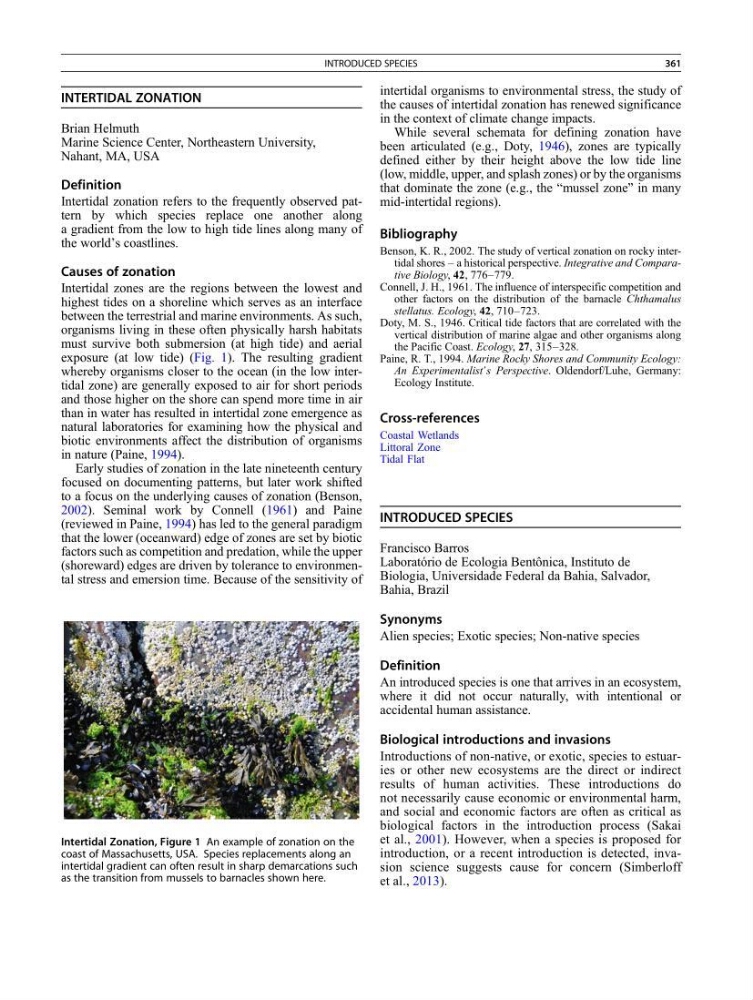
Intertidal Zonation, Figure 1 An example of zonation on the
coast of Massachusetts, USA. Species replacements along an
intertidal gradient can often result in sharp demarcations such
as the transition from mussels to barnacles shown here.
INTRODUCED SPECIES
361
Brian Helmuth
Marine Science Center, Northeastern University,
Nahant, MA, USA
Definition
Intertidal zonation refers to the frequently observed pattern by which species replace one another along
a gradient from the low to high tide lines along many of
the world’s coastlines.
Causes of zonation
Intertidal zones are the regions between the lowest and
highest tides on a shoreline which serves as an interface
between the terrestrial and marine environments. As such,
organisms living in these often physically harsh habitats
must survive both submersion (at high tide) and aerial
exposure (at low tide) (Fig. 1). The resulting gradient
whereby organisms closer to the ocean (in the low intertidal zone) are generally exposed to air for short periods
and those higher on the shore can spend more time in air
than in water has resulted in intertidal zone emergence as
natural laboratories for examining how the physical and
biotic environments affect the distribution of organisms
in nature (Paine, 1994).
Early studies of zonation in the late nineteenth century
focused on documenting patterns, but later work shifted
to a focus on the underlying causes of zonation (Benson,
2002). Seminal work by Connell (1961) and Paine
(reviewed in Paine, 1994) has led to the general paradigm
that the lower (oceanward) edge of zones are set by biotic
factors such as competition and predation, while the upper
(shoreward) edges are driven by tolerance to environmental stress and emersion time. Because of the sensitivity of
intertidal organisms to environmental stress, the study of
the causes of intertidal zonation has renewed significance
in the context of climate change impacts.
While several schemata for defining zonation have
been articulated (e.g., Doty, 1946), zones are typically
defined either by their height above the low tide line
(low, middle, upper, and splash zones) or by the organisms
that dominate the zone (e.g., the “mussel zone” in many
mid-intertidal regions).
Bibliography
Benson, K. R., 2002. The study of vertical zonation on rocky intertidal shores – a historical perspective. Integrative and Comparative Biology, 42, 776–779.
Connell, J. H., 1961. The influence of interspecific competition and
other factors on the distribution of the barnacle Chthamalus
stellatus. Ecology, 42, 710–723.
Doty, M. S., 1946. Critical tide factors that are correlated with the
vertical distribution of marine algae and other organisms along
the Pacific Coast. Ecology, 27, 315–328.
Paine, R. T., 1994. Marine Rocky Shores and Community Ecology:
An Experimentalist’s Perspective. Oldendorf/Luhe, Germany:
Ecology Institute.
Cross-references
Coastal Wetlands
Littoral Zone
Tidal Flat
INTRODUCED SPECIES
Francisco Barros
Laboratório de Ecologia Bentônica, Instituto de
Biologia, Universidade Federal da Bahia, Salvador,
Bahia, Brazil
Synonyms
Alien species; Exotic species; Non-native species
Definition
An introduced species is one that arrives in an ecosystem,
where it did not occur naturally, with intentional or
accidental human assistance.
Biological introductions and invasions
Introductions of non-native, or exotic, species to estuaries or other new ecosystems are the direct or indirect
results of human activities. These introductions do
not necessarily cause economic or environmental harm,
and social and economic factors are often as critical as
biological factors in the introduction process (Sakai
et al., 2001). However, when a species is proposed for
introduction, or a recent introduction is detected, invasion science suggests cause for concern (Simberloff
et al., 2013).
Intertidal Zonation, Figure 1 An example of zonation on the
coast of Massachusetts, USA. Species replacements along an
intertidal gradient can often result in sharp demarcations such
as the transition from mussels to barnacles shown here.
INTRODUCED SPECIES
361