

F
FIDDLER CRABS
Judith S. Weis
Department of Biological Sciences, Rutgers University,
Newark, NJ, USA
Definition
Fiddler crabs are small (up to $5 cm across) ocypodid
crabs found worldwide in temperate and tropical estuaries.
They live along bay beaches and brackish intertidal salt
marshes, mangroves, mud flats, lagoons and swamps.
Description
There are about 100 named species of fiddlers, all in the
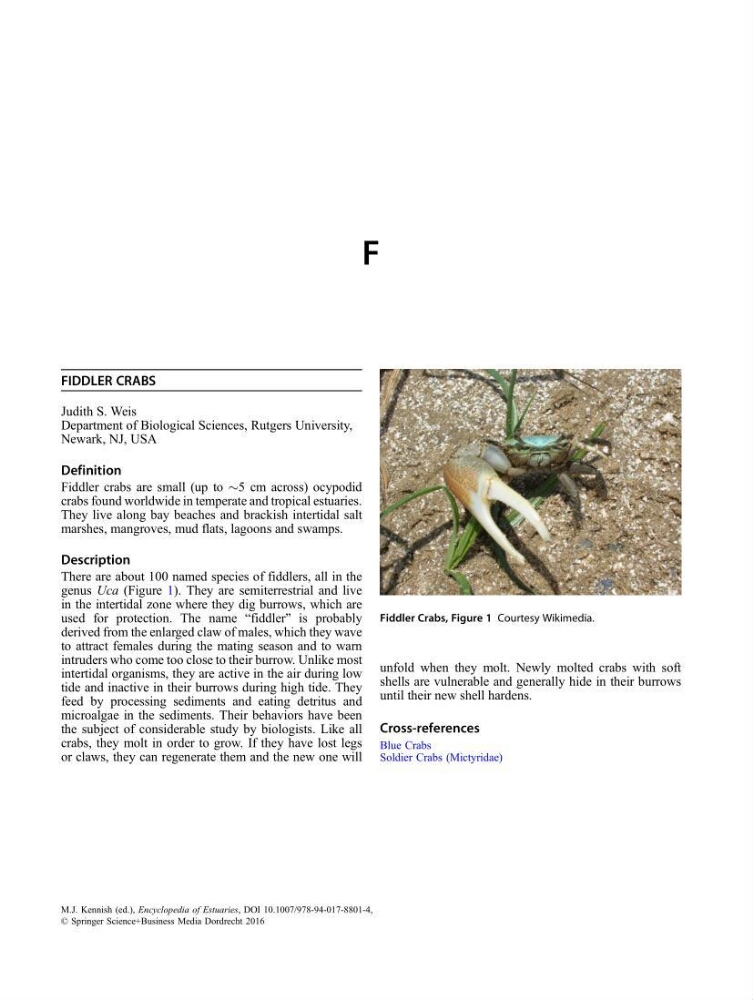
genus Uca (Figure 1). They are semiterrestrial and live
in the intertidal zone where they dig burrows, which are
used for protection. The name “fiddler” is probably
derived from the enlarged claw of males, which they wave
to attract females during the mating season and to warn
intruders who come too close to their burrow. Unlike most
intertidal organisms, they are active in the air during low
tide and inactive in their burrows during high tide. They
feed by processing sediments and eating detritus and
microalgae in the sediments. Their behaviors have been
the subject of considerable study by biologists. Like all
crabs, they molt in order to grow. If they have lost legs
or claws, they can regenerate them and the new one will
unfold when they molt. Newly molted crabs with soft
shells are vulnerable and generally hide in their burrows
until their new shell hardens.
Cross-references
Blue Crabs
Soldier Crabs (Mictyridae)
Fiddler Crabs, Figure 1 Courtesy Wikimedia.
M.J. Kennish (ed.), Encyclopedia of Estuaries, DOI 10.1007/978-94-017-8801-4,
© Springer Science+Business Media Dordrecht 2016
FIDDLER CRABS
Judith S. Weis
Department of Biological Sciences, Rutgers University,
Newark, NJ, USA
Definition
Fiddler crabs are small (up to $5 cm across) ocypodid
crabs found worldwide in temperate and tropical estuaries.
They live along bay beaches and brackish intertidal salt
marshes, mangroves, mud flats, lagoons and swamps.
Description
There are about 100 named species of fiddlers, all in the
genus Uca (Figure 1). They are semiterrestrial and live
in the intertidal zone where they dig burrows, which are
used for protection. The name “fiddler” is probably
derived from the enlarged claw of males, which they wave
to attract females during the mating season and to warn
intruders who come too close to their burrow. Unlike most
intertidal organisms, they are active in the air during low
tide and inactive in their burrows during high tide. They
feed by processing sediments and eating detritus and
microalgae in the sediments. Their behaviors have been
the subject of considerable study by biologists. Like all
crabs, they molt in order to grow. If they have lost legs
or claws, they can regenerate them and the new one will
unfold when they molt. Newly molted crabs with soft
shells are vulnerable and generally hide in their burrows
until their new shell hardens.
Cross-references
Blue Crabs
Soldier Crabs (Mictyridae)
Fiddler Crabs, Figure 1 Courtesy Wikimedia.
M.J. Kennish (ed.), Encyclopedia of Estuaries, DOI 10.1007/978-94-017-8801-4,
© Springer Science+Business Media Dordrecht 2016