

sediments supplied by the alluvial systems. The
Changjiang and the Mississippi are two very clear examples of delta front estuaries (Zhao et al., 2012).
Sediment composition in rias
There is some debate as to whether rias are estuaries or
incised valleys, because only a small part of the ria is
influenced by estuarine processes (Evans and Prego,
2003). However, the term ria is useful to define an incised
valley, whether it is predominantly estuarine or marine.
Rias may be found in rocky or cliffy shores that were not
modified by alpine glaciation, but by subaerial erosion
(Castaing and Guilcher, 1995). Apart from some exceptions, rias are found in the north of Spain, Brittany in
France, South Devon and Cornwall in Great Britain, in
southern Ireland, in Korea, in parts of China and Argentina, in the Red Sea, and the Mediterranean. The sediments
in the rias in northern Spain and Galicia come from different sources. The sand is considered to derive from the erosion of rocks outcropping behind the coastal limestones
and is maintained within the ria by the powerful Bay of
Biscay surf. These sediments contain marine shells, which
comprise 25–35 % of the sediments. Mud replaces sand in
the inner reaches of the rias, with the usual presence of
vegetated high marshes and bare low marshes. The rias
in Brittany, France, may be categorized into four different
sedimentological types: (1) pelitic rias (with sediments
with median diameter of <50 mm); (2) sandy rias, or rias
with large sand fractions coming from the sea; (3) widely
open, or bay-like rias, with even larger sea influences; and
(4) some microperiglacial, dwarflike rias (located in
southwestern Brittany), with lengths of less than 2 km.
In the southwest of England, the geological evolution is
similar to the geological evolution of Brittany, and so
Devon and Cornwall are girdled by a number of drowned
valleys. Examples include the Exe, the Teign, the Dart, the
Tamar and its tributaries, the Fal and the Carrick Roads,
the Camel, and the Taw. The rias in Devon and Cornwall
follow, as a whole, a pattern of sandy sediments near their
mouths, and mudflats and high marshes in the inner
reaches. Sand features are commonly found: Barnstaple
Bay is fronted by the largest sand dunes in Devon and
Cornwall, while the mouths of the Teign and the Exe are
populated by complicated patterns of sandbars and spits
(Steers, 1964). As for the Korean rias, the usual high
marshes are rare or absent, due to land reclamations for
rice cultivation. However, Korean rias present extensive
areas of mud flats, sometimes several kilometers wide at
low spring tide. Finally, little is known about the Argentinean rias, including the Deseado, San Julian, Santa Cruz,
and Gallegos rias, all in Patagonia. The Deseado, Santa
Cruz, and Gallegos have similar features. The last 18 km
of the Deseado ria are covered by islands, tidal sandbanks,
and small bays. Flood and ebb currents are turbulent
enough to induce high turbidity of the water, loaded with
volcanic clays. High tidal ranges cause large tidal flats,
with outcrops and pebbly beaches along the rias margins.
In contrast, the Santa Cruz ria is an ebb delta, with two ebb
tidal channels.
TIDAL
PROCESSES
MARINE
SEDIMENT
SOURCE
SALINITY = 32
WAVE
PROCESSES
RIVER
PROCESSES
RIVER
ESTUARY (Dalrymple et at., 1992)
MARINE
SALINITY = 0.1
LIMIT OF
TIDAL INFLUENCE
FLUVIAL
SEDIMENT
SOURCE
FACIES BOUNDARY BETWEEN
MARINE (TIDALLY-) INFLUENCED
AND FLUVIAL SEDIMENTS
FACIES BOUNDARY BETWEEN
ESTUARINE SAND BODY AND
NORMAL MARINE SEDIMENTS
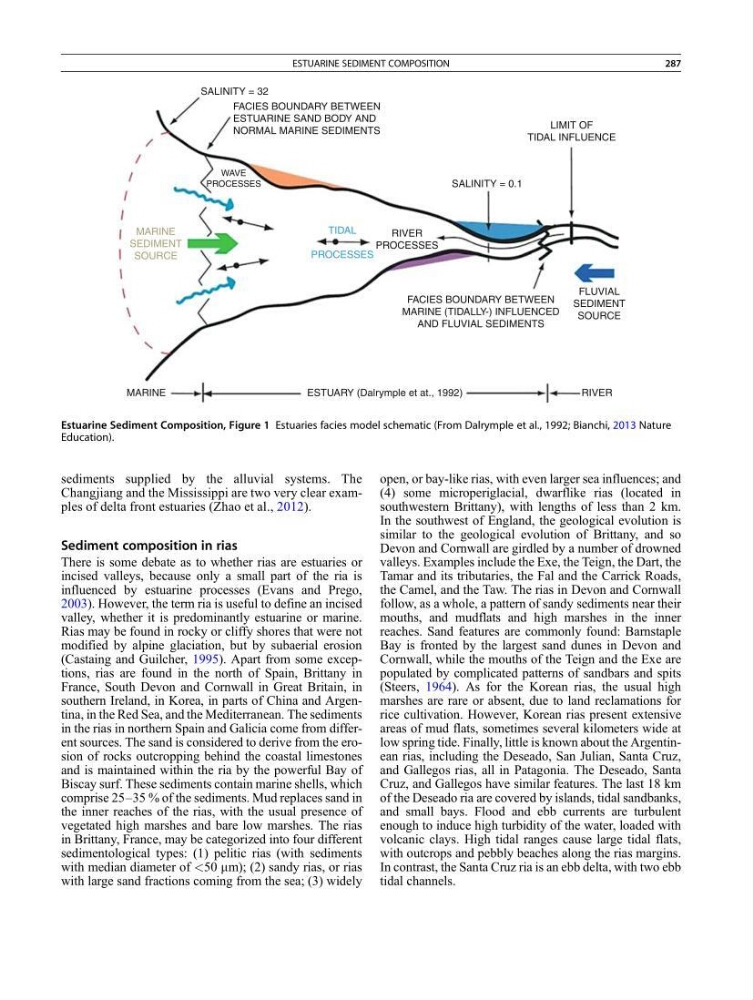
Estuarine Sediment Composition, Figure 1 Estuaries facies model schematic (From Dalrymple et al., 1992; Bianchi, 2013 Nature
Education).
ESTUARINE SEDIMENT COMPOSITION
287
Changjiang and the Mississippi are two very clear examples of delta front estuaries (Zhao et al., 2012).
Sediment composition in rias
There is some debate as to whether rias are estuaries or
incised valleys, because only a small part of the ria is
influenced by estuarine processes (Evans and Prego,
2003). However, the term ria is useful to define an incised
valley, whether it is predominantly estuarine or marine.
Rias may be found in rocky or cliffy shores that were not
modified by alpine glaciation, but by subaerial erosion
(Castaing and Guilcher, 1995). Apart from some exceptions, rias are found in the north of Spain, Brittany in
France, South Devon and Cornwall in Great Britain, in
southern Ireland, in Korea, in parts of China and Argentina, in the Red Sea, and the Mediterranean. The sediments
in the rias in northern Spain and Galicia come from different sources. The sand is considered to derive from the erosion of rocks outcropping behind the coastal limestones
and is maintained within the ria by the powerful Bay of
Biscay surf. These sediments contain marine shells, which
comprise 25–35 % of the sediments. Mud replaces sand in
the inner reaches of the rias, with the usual presence of
vegetated high marshes and bare low marshes. The rias
in Brittany, France, may be categorized into four different
sedimentological types: (1) pelitic rias (with sediments
with median diameter of <50 mm); (2) sandy rias, or rias
with large sand fractions coming from the sea; (3) widely
open, or bay-like rias, with even larger sea influences; and
(4) some microperiglacial, dwarflike rias (located in
southwestern Brittany), with lengths of less than 2 km.
In the southwest of England, the geological evolution is
similar to the geological evolution of Brittany, and so
Devon and Cornwall are girdled by a number of drowned
valleys. Examples include the Exe, the Teign, the Dart, the
Tamar and its tributaries, the Fal and the Carrick Roads,
the Camel, and the Taw. The rias in Devon and Cornwall
follow, as a whole, a pattern of sandy sediments near their
mouths, and mudflats and high marshes in the inner
reaches. Sand features are commonly found: Barnstaple
Bay is fronted by the largest sand dunes in Devon and
Cornwall, while the mouths of the Teign and the Exe are
populated by complicated patterns of sandbars and spits
(Steers, 1964). As for the Korean rias, the usual high
marshes are rare or absent, due to land reclamations for
rice cultivation. However, Korean rias present extensive
areas of mud flats, sometimes several kilometers wide at
low spring tide. Finally, little is known about the Argentinean rias, including the Deseado, San Julian, Santa Cruz,
and Gallegos rias, all in Patagonia. The Deseado, Santa
Cruz, and Gallegos have similar features. The last 18 km
of the Deseado ria are covered by islands, tidal sandbanks,
and small bays. Flood and ebb currents are turbulent
enough to induce high turbidity of the water, loaded with
volcanic clays. High tidal ranges cause large tidal flats,
with outcrops and pebbly beaches along the rias margins.
In contrast, the Santa Cruz ria is an ebb delta, with two ebb
tidal channels.
TIDAL
PROCESSES
MARINE
SEDIMENT
SOURCE
SALINITY = 32
WAVE
PROCESSES
RIVER
PROCESSES
RIVER
ESTUARY (Dalrymple et at., 1992)
MARINE
SALINITY = 0.1
LIMIT OF
TIDAL INFLUENCE
FLUVIAL
SEDIMENT
SOURCE
FACIES BOUNDARY BETWEEN
MARINE (TIDALLY-) INFLUENCED
AND FLUVIAL SEDIMENTS
FACIES BOUNDARY BETWEEN
ESTUARINE SAND BODY AND
NORMAL MARINE SEDIMENTS
Estuarine Sediment Composition, Figure 1 Estuaries facies model schematic (From Dalrymple et al., 1992; Bianchi, 2013 Nature
Education).
ESTUARINE SEDIMENT COMPOSITION
287