

The NRC (1992, pp. 347–348) concluded that
“Wherever
possible. . .restoration
of
aquatic
resources. . .should not be made on a small-scale, shortterm, site-by-site basis, but should instead be made to promote the long-term sustainability of all aquatic resources
in the landscape.” Successful restoration of selfmaintaining habitat is more likely when the restoration
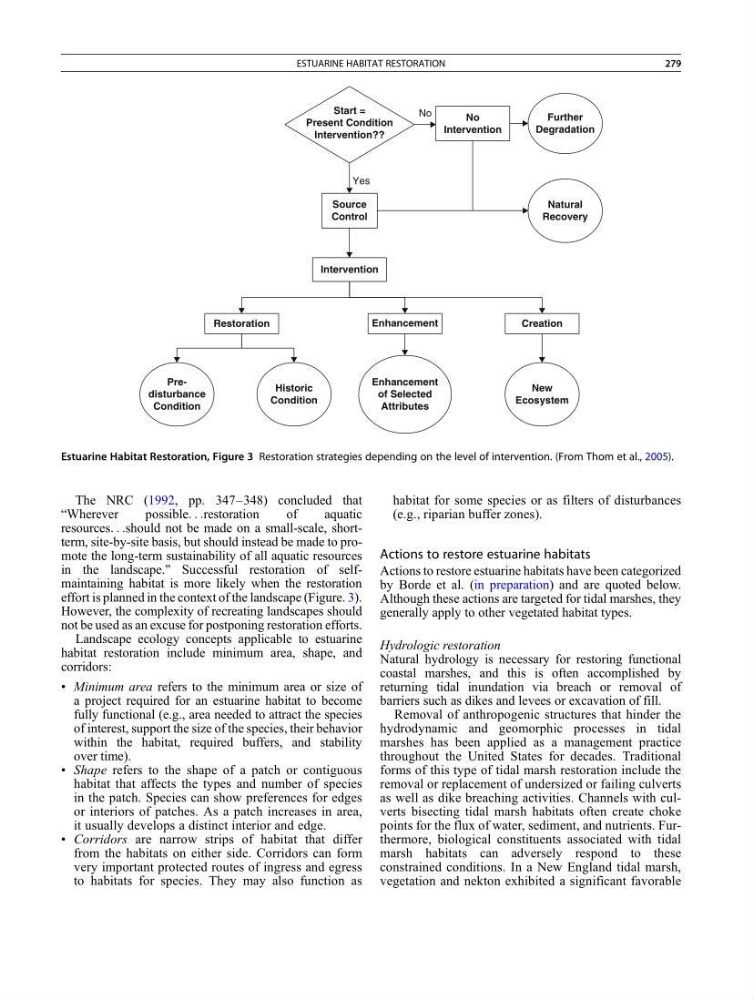
effort is planned in the context of the landscape (Figure. 3).
However, the complexity of recreating landscapes should
not be used as an excuse for postponing restoration efforts.
Landscape ecology concepts applicable to estuarine
habitat restoration include minimum area, shape, and
corridors:
• Minimum area refers to the minimum area or size of
a project required for an estuarine habitat to become
fully functional (e.g., area needed to attract the species
of interest, support the size of the species, their behavior
within the habitat, required buffers, and stability
over time).
• Shape refers to the shape of a patch or contiguous
habitat that affects the types and number of species
in the patch. Species can show preferences for edges
or interiors of patches. As a patch increases in area,
it usually develops a distinct interior and edge.
• Corridors are narrow strips of habitat that differ
from the habitats on either side. Corridors can form
very important protected routes of ingress and egress
to habitats for species. They may also function as
habitat for some species or as filters of disturbances
(e.g., riparian buffer zones).
Actions to restore estuarine habitats
Actions to restore estuarine habitats have been categorized
by Borde et al. (in preparation) and are quoted below.
Although these actions are targeted for tidal marshes, they
generally apply to other vegetated habitat types.
Hydrologic restoration
Natural hydrology is necessary for restoring functional
coastal marshes, and this is often accomplished by
returning tidal inundation via breach or removal of
barriers such as dikes and levees or excavation of fill.
Removal of anthropogenic structures that hinder the
hydrodynamic and geomorphic processes in tidal
marshes has been applied as a management practice
throughout the United States for decades. Traditional
forms of this type of tidal marsh restoration include the
removal or replacement of undersized or failing culverts
as well as dike breaching activities. Channels with culverts bisecting tidal marsh habitats often create choke
points for the flux of water, sediment, and nutrients. Furthermore, biological constituents associated with tidal
marsh habitats can adversely respond to these
constrained conditions. In a New England tidal marsh,
vegetation and nekton exhibited a significant favorable
Source
Control
No
Intervention
Further
Degradation
Natural
Recovery
Intervention
Restoration
Enhancement
Creation
Predisturbance
Condition
Historic
Condition
Enhancement
of Selected
Attributes
New
Ecosystem
Start =
Present Condition
Intervention??
No
Yes
Estuarine Habitat Restoration, Figure 3 Restoration strategies depending on the level of intervention. (From Thom et al., 2005).
ESTUARINE HABITAT RESTORATION
279
“Wherever
possible. . .restoration
of
aquatic
resources. . .should not be made on a small-scale, shortterm, site-by-site basis, but should instead be made to promote the long-term sustainability of all aquatic resources
in the landscape.” Successful restoration of selfmaintaining habitat is more likely when the restoration
effort is planned in the context of the landscape (Figure. 3).
However, the complexity of recreating landscapes should
not be used as an excuse for postponing restoration efforts.
Landscape ecology concepts applicable to estuarine
habitat restoration include minimum area, shape, and
corridors:
• Minimum area refers to the minimum area or size of
a project required for an estuarine habitat to become
fully functional (e.g., area needed to attract the species
of interest, support the size of the species, their behavior
within the habitat, required buffers, and stability
over time).
• Shape refers to the shape of a patch or contiguous
habitat that affects the types and number of species
in the patch. Species can show preferences for edges
or interiors of patches. As a patch increases in area,
it usually develops a distinct interior and edge.
• Corridors are narrow strips of habitat that differ
from the habitats on either side. Corridors can form
very important protected routes of ingress and egress
to habitats for species. They may also function as
habitat for some species or as filters of disturbances
(e.g., riparian buffer zones).
Actions to restore estuarine habitats
Actions to restore estuarine habitats have been categorized
by Borde et al. (in preparation) and are quoted below.
Although these actions are targeted for tidal marshes, they
generally apply to other vegetated habitat types.
Hydrologic restoration
Natural hydrology is necessary for restoring functional
coastal marshes, and this is often accomplished by
returning tidal inundation via breach or removal of
barriers such as dikes and levees or excavation of fill.
Removal of anthropogenic structures that hinder the
hydrodynamic and geomorphic processes in tidal
marshes has been applied as a management practice
throughout the United States for decades. Traditional
forms of this type of tidal marsh restoration include the
removal or replacement of undersized or failing culverts
as well as dike breaching activities. Channels with culverts bisecting tidal marsh habitats often create choke
points for the flux of water, sediment, and nutrients. Furthermore, biological constituents associated with tidal
marsh habitats can adversely respond to these
constrained conditions. In a New England tidal marsh,
vegetation and nekton exhibited a significant favorable
Source
Control
No
Intervention
Further
Degradation
Natural
Recovery
Intervention
Restoration
Enhancement
Creation
Predisturbance
Condition
Historic
Condition
Enhancement
of Selected
Attributes
New
Ecosystem
Start =
Present Condition
Intervention??
No
Yes
Estuarine Habitat Restoration, Figure 3 Restoration strategies depending on the level of intervention. (From Thom et al., 2005).
ESTUARINE HABITAT RESTORATION
279