

Valle-Levinson, A., 2008. Density-driven exchange flow in terms of
the Kelvin and Ekman numbers. Journal of Geophysical
Research, 113, C04001, doi:10.1029/2007JC004144.
Villwock, J. A., 1972. Contribuição à Geologia do Holoceno da
Provı ´ncia Costeira do Rio Grande do Sul. Dissertação de
Mestrado, Porto Alegre, Universidade Federal do Rio Grande
do Sul, 133 p.
von Arx, W. S., 1962. An Introduction to Physical Oceanography.
Massachusetts: Addison-Wesley, p. 422.
Walstra, D. J. R., van Rijn, L. C., Blogg, H., and van Ormondt, M.,
2001. Evaluation of a Hydrodynamic Area Model based on the
Coast3D Data at Teignmouth 1999. WLjDelft Hydraulics, Paper
D4, pp. 1–4
Warner, J. C., Geyer, W. R., and Lerczak, J. A., 2005. Numerical
modeling of an estuary: a comprehensive skill assessment.
Journal of Geophysical Research, 110(CO5001), 1–13.
Wilmott, C. J., 1981. On the validation models. Physical Geography, 2(2), 184–194.
ESTUARINE CONNECTIVITY
Pat Dale
1 and Marcus Sheaves
2
1
Environmental Futures Research Institute, Griffith
School of Environment, Griffith University, Brisbane,
QLD, Australia
2
Estuary and Tidal Wetland Ecosystems Research Group,
School of Marine and Tropical Biology, James Cook
University, Townsville, QLD, Australia
Definition
Connectivity is defined as the state of being connected
or interconnected (Oxford Dictionary). From an ecological perspective, it is better described as an empowering
mechanism that facilitates the movement of materials
or effects between spatiotemporal units and enables
events in one spatiotemporal unit to influence events in
another unit.
Estuarine connectivity is a facilitator of the movement
of materials or effects in an estuarine context. It occurs at
multiple scales: within the estuary, between the estuary
and other contiguous marine and terrestrial systems, and
between habitats within the estuary.
Introduction
Estuaries are dynamic ecosystems that interact with both
the ocean downstream and freshwater from rivers
upstream. The pattern of dilution varies between different
estuaries and depends on the volume of freshwater, the
tidal range, and the extent of evaporation of the water in
the estuary (McLusky and Elliott, 2004). It is connectivity
that allows the interactions to occur. Connectivity occurs
at all scales: between estuaries and other ecosystems but
also among different habitats within estuaries, for example, among seagrass, mangrove, and saltmarsh systems.
Connectivity is a facilitator of the complex interaction
between biogeographic and physical variables (tides,
salinity, DO, pH), ecological processes (larval supply,
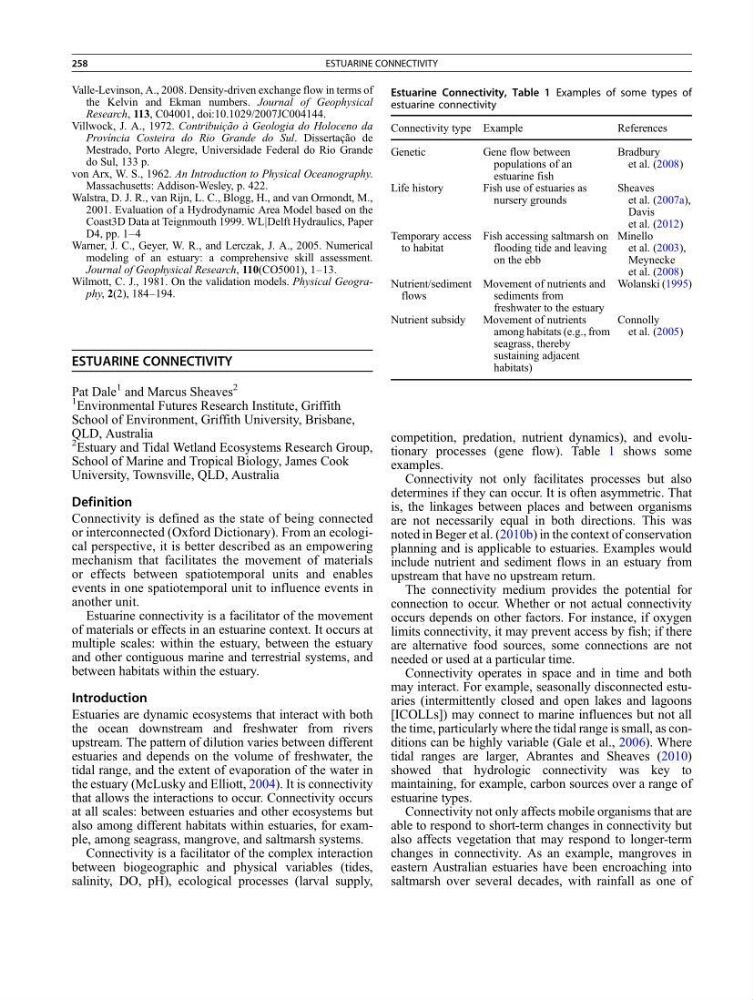
competition, predation, nutrient dynamics), and evolutionary processes (gene flow). Table 1 shows some
examples.
Connectivity not only facilitates processes but also
determines if they can occur. It is often asymmetric. That
is, the linkages between places and between organisms
are not necessarily equal in both directions. This was
noted in Beger et al. (2010b) in the context of conservation
planning and is applicable to estuaries. Examples would
include nutrient and sediment flows in an estuary from
upstream that have no upstream return.
The connectivity medium provides the potential for
connection to occur. Whether or not actual connectivity
occurs depends on other factors. For instance, if oxygen
limits connectivity, it may prevent access by fish; if there
are alternative food sources, some connections are not
needed or used at a particular time.
Connectivity operates in space and in time and both
may interact. For example, seasonally disconnected estuaries (intermittently closed and open lakes and lagoons
[ICOLLs]) may connect to marine influences but not all
the time, particularly where the tidal range is small, as conditions can be highly variable (Gale et al., 2006). Where
tidal ranges are larger, Abrantes and Sheaves (2010)
showed that hydrologic connectivity was key to
maintaining, for example, carbon sources over a range of
estuarine types.
Connectivity not only affects mobile organisms that are
able to respond to short-term changes in connectivity but
also affects vegetation that may respond to longer-term
changes in connectivity. As an example, mangroves in
eastern Australian estuaries have been encroaching into
saltmarsh over several decades, with rainfall as one of
Estuarine Connectivity, Table 1 Examples of some types of
estuarine connectivity
Connectivity type Example
References
Genetic
Gene flow between
populations of an
estuarine fish
Bradbury
et al. (2008)
Life history
Fish use of estuaries as
nursery grounds
Sheaves
et al. (2007a),
Davis
et al. (2012)
Temporary access
to habitat
Fish accessing saltmarsh on
flooding tide and leaving
on the ebb
Minello
et al. (2003),
Meynecke
et al. (2008)
Nutrient/sediment
flows
Movement of nutrients and
sediments from
freshwater to the estuary
Wolanski (1995)
Nutrient subsidy
Movement of nutrients
among habitats (e.g., from
seagrass, thereby
sustaining adjacent
habitats)
Connolly
et al. (2005)
258
ESTUARINE CONNECTIVITY
the Kelvin and Ekman numbers. Journal of Geophysical
Research, 113, C04001, doi:10.1029/2007JC004144.
Villwock, J. A., 1972. Contribuição à Geologia do Holoceno da
Provı ´ncia Costeira do Rio Grande do Sul. Dissertação de
Mestrado, Porto Alegre, Universidade Federal do Rio Grande
do Sul, 133 p.
von Arx, W. S., 1962. An Introduction to Physical Oceanography.
Massachusetts: Addison-Wesley, p. 422.
Walstra, D. J. R., van Rijn, L. C., Blogg, H., and van Ormondt, M.,
2001. Evaluation of a Hydrodynamic Area Model based on the
Coast3D Data at Teignmouth 1999. WLjDelft Hydraulics, Paper
D4, pp. 1–4
Warner, J. C., Geyer, W. R., and Lerczak, J. A., 2005. Numerical
modeling of an estuary: a comprehensive skill assessment.
Journal of Geophysical Research, 110(CO5001), 1–13.
Wilmott, C. J., 1981. On the validation models. Physical Geography, 2(2), 184–194.
ESTUARINE CONNECTIVITY
Pat Dale
1 and Marcus Sheaves
2
1
Environmental Futures Research Institute, Griffith
School of Environment, Griffith University, Brisbane,
QLD, Australia
2
Estuary and Tidal Wetland Ecosystems Research Group,
School of Marine and Tropical Biology, James Cook
University, Townsville, QLD, Australia
Definition
Connectivity is defined as the state of being connected
or interconnected (Oxford Dictionary). From an ecological perspective, it is better described as an empowering
mechanism that facilitates the movement of materials
or effects between spatiotemporal units and enables
events in one spatiotemporal unit to influence events in
another unit.
Estuarine connectivity is a facilitator of the movement
of materials or effects in an estuarine context. It occurs at
multiple scales: within the estuary, between the estuary
and other contiguous marine and terrestrial systems, and
between habitats within the estuary.
Introduction
Estuaries are dynamic ecosystems that interact with both
the ocean downstream and freshwater from rivers
upstream. The pattern of dilution varies between different
estuaries and depends on the volume of freshwater, the
tidal range, and the extent of evaporation of the water in
the estuary (McLusky and Elliott, 2004). It is connectivity
that allows the interactions to occur. Connectivity occurs
at all scales: between estuaries and other ecosystems but
also among different habitats within estuaries, for example, among seagrass, mangrove, and saltmarsh systems.
Connectivity is a facilitator of the complex interaction
between biogeographic and physical variables (tides,
salinity, DO, pH), ecological processes (larval supply,
competition, predation, nutrient dynamics), and evolutionary processes (gene flow). Table 1 shows some
examples.
Connectivity not only facilitates processes but also
determines if they can occur. It is often asymmetric. That
is, the linkages between places and between organisms
are not necessarily equal in both directions. This was
noted in Beger et al. (2010b) in the context of conservation
planning and is applicable to estuaries. Examples would
include nutrient and sediment flows in an estuary from
upstream that have no upstream return.
The connectivity medium provides the potential for
connection to occur. Whether or not actual connectivity
occurs depends on other factors. For instance, if oxygen
limits connectivity, it may prevent access by fish; if there
are alternative food sources, some connections are not
needed or used at a particular time.
Connectivity operates in space and in time and both
may interact. For example, seasonally disconnected estuaries (intermittently closed and open lakes and lagoons
[ICOLLs]) may connect to marine influences but not all
the time, particularly where the tidal range is small, as conditions can be highly variable (Gale et al., 2006). Where
tidal ranges are larger, Abrantes and Sheaves (2010)
showed that hydrologic connectivity was key to
maintaining, for example, carbon sources over a range of
estuarine types.
Connectivity not only affects mobile organisms that are
able to respond to short-term changes in connectivity but
also affects vegetation that may respond to longer-term
changes in connectivity. As an example, mangroves in
eastern Australian estuaries have been encroaching into
saltmarsh over several decades, with rainfall as one of
Estuarine Connectivity, Table 1 Examples of some types of
estuarine connectivity
Connectivity type Example
References
Genetic
Gene flow between
populations of an
estuarine fish
Bradbury
et al. (2008)
Life history
Fish use of estuaries as
nursery grounds
Sheaves
et al. (2007a),
Davis
et al. (2012)
Temporary access
to habitat
Fish accessing saltmarsh on
flooding tide and leaving
on the ebb
Minello
et al. (2003),
Meynecke
et al. (2008)
Nutrient/sediment
flows
Movement of nutrients and
sediments from
freshwater to the estuary
Wolanski (1995)
Nutrient subsidy
Movement of nutrients
among habitats (e.g., from
seagrass, thereby
sustaining adjacent
habitats)
Connolly
et al. (2005)
258
ESTUARINE CONNECTIVITY