

last several decades. They serve as important tools for synthesizing current understanding and available data, understanding how estuaries function, testing our assumptions,
and identifying gaps in our knowledge. They provide us
a means of conducting whole-system experiments to identify how estuaries respond to change, and this predictive
capability has made them essential tools for informing
estuarine management. A wide variety of modeling
approaches exist from conceptual to mathematical, individual to compartmental, and population to ecosystem.
Models will continue to play a critical role in both research
and management in estuarine systems and can be continually updated as our empirical understanding of ecosystem
processes improves. In addition to their ongoing role in
predicting estuarine response to changes in nutrient loading, fishing pressure, and restoration, models will become
increasingly important in the coming years in predicting
responses to climate change, individually and in combination with other stressors.
Box 1: Modeling definitions
Analytical model–A model with equation(s) that can
be mathematically solved to produce an exact
solution or prediction at any time.
Boundary conditions–The values of state variables
imposed at the boundary of the model domain; these
are required when water mixes into the model
domain from outside the system.
Calibration–The process by which parameter values
are modified within reasonable ranges by the user, or
with an optimization routine, to obtain the best
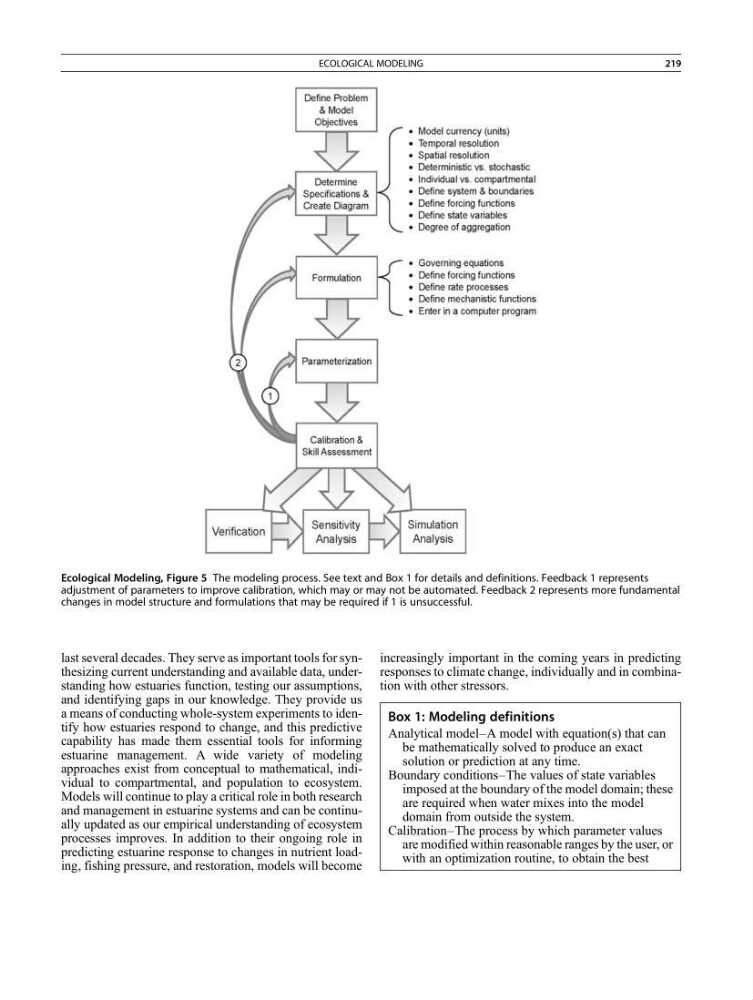
Ecological Modeling, Figure 5 The modeling process. See text and Box 1 for details and definitions. Feedback 1 represents
adjustment of parameters to improve calibration, which may or may not be automated. Feedback 2 represents more fundamental
changes in model structure and formulations that may be required if 1 is unsuccessful.
ECOLOGICAL MODELING
219
and identifying gaps in our knowledge. They provide us
a means of conducting whole-system experiments to identify how estuaries respond to change, and this predictive
capability has made them essential tools for informing
estuarine management. A wide variety of modeling
approaches exist from conceptual to mathematical, individual to compartmental, and population to ecosystem.
Models will continue to play a critical role in both research
and management in estuarine systems and can be continually updated as our empirical understanding of ecosystem
processes improves. In addition to their ongoing role in
predicting estuarine response to changes in nutrient loading, fishing pressure, and restoration, models will become
increasingly important in the coming years in predicting
responses to climate change, individually and in combination with other stressors.
Box 1: Modeling definitions
Analytical model–A model with equation(s) that can
be mathematically solved to produce an exact
solution or prediction at any time.
Boundary conditions–The values of state variables
imposed at the boundary of the model domain; these
are required when water mixes into the model
domain from outside the system.
Calibration–The process by which parameter values
are modified within reasonable ranges by the user, or
with an optimization routine, to obtain the best
Ecological Modeling, Figure 5 The modeling process. See text and Box 1 for details and definitions. Feedback 1 represents
adjustment of parameters to improve calibration, which may or may not be automated. Feedback 2 represents more fundamental
changes in model structure and formulations that may be required if 1 is unsuccessful.
ECOLOGICAL MODELING
219