

Types of deltas within estuaries
Given that a delta is a sedimentary deposit formed where
a river enters an ocean, a semi-enclosed sea, an estuary,
a lake or lagoon, the hydrodynamic forces operating on
these sediments to distribute, rework, and shape them into
various types of deltaic bodies are river flow (fluvial
hydrodynamics), waves, and tides. If any of these
hydrodynamic forces are dominant, the resulting delta will
be fluvial dominated, wave dominated, or tide dominated
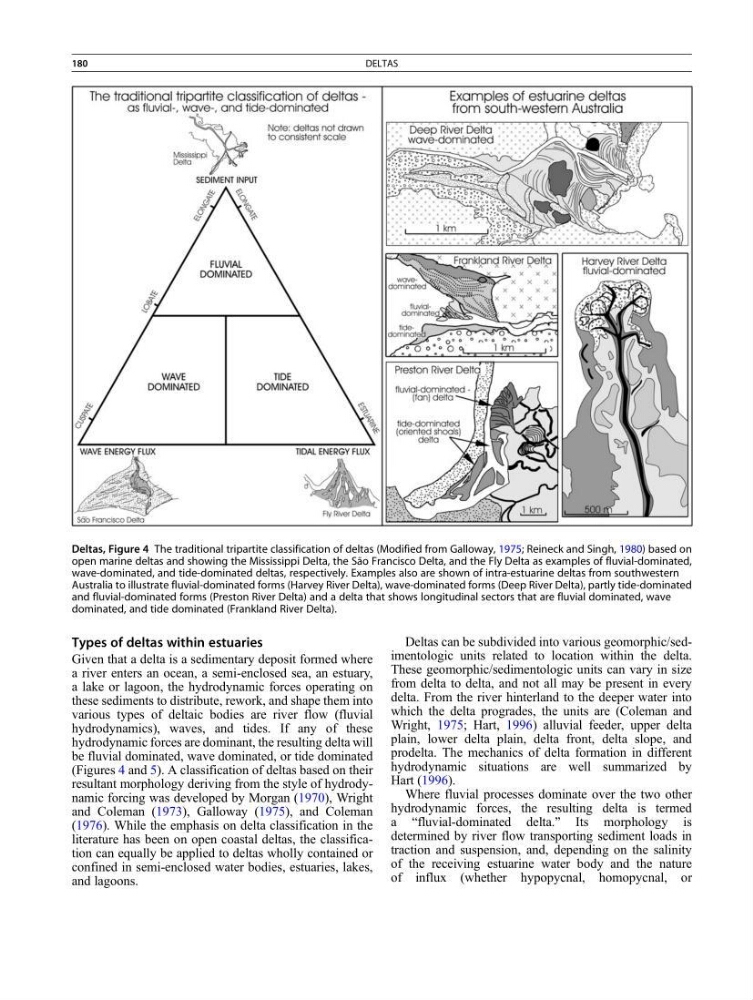
(Figures 4 and 5). A classification of deltas based on their
resultant morphology deriving from the style of hydrodynamic forcing was developed by Morgan (1970), Wright
and Coleman (1973), Galloway (1975), and Coleman
(1976). While the emphasis on delta classification in the
literature has been on open coastal deltas, the classification can equally be applied to deltas wholly contained or
confined in semi-enclosed water bodies, estuaries, lakes,
and lagoons.
Deltas can be subdivided into various geomorphic/sedimentologic units related to location within the delta.
These geomorphic/sedimentologic units can vary in size
from delta to delta, and not all may be present in every
delta. From the river hinterland to the deeper water into
which the delta progrades, the units are (Coleman and
Wright, 1975; Hart, 1996) alluvial feeder, upper delta
plain, lower delta plain, delta front, delta slope, and
prodelta. The mechanics of delta formation in different
hydrodynamic situations are well summarized by
Hart (1996).
Where fluvial processes dominate over the two other
hydrodynamic forces, the resulting delta is termed
a “fluvial-dominated delta.” Its morphology is
determined by river flow transporting sediment loads in
traction and suspension, and, depending on the salinity
of the receiving estuarine water body and the nature
of influx (whether hypopycnal, homopycnal, or
Deltas, Figure 4 The traditional tripartite classification of deltas (Modified from Galloway, 1975; Reineck and Singh, 1980) based on
open marine deltas and showing the Mississippi Delta, the Sa ˜o Francisco Delta, and the Fly Delta as examples of fluvial-dominated,
wave-dominated, and tide-dominated deltas, respectively. Examples also are shown of intra-estuarine deltas from southwestern
Australia to illustrate fluvial-dominated forms (Harvey River Delta), wave-dominated forms (Deep River Delta), partly tide-dominated
and fluvial-dominated forms (Preston River Delta) and a delta that shows longitudinal sectors that are fluvial dominated, wave
dominated, and tide dominated (Frankland River Delta).
180
DELTAS
Given that a delta is a sedimentary deposit formed where
a river enters an ocean, a semi-enclosed sea, an estuary,
a lake or lagoon, the hydrodynamic forces operating on
these sediments to distribute, rework, and shape them into
various types of deltaic bodies are river flow (fluvial
hydrodynamics), waves, and tides. If any of these
hydrodynamic forces are dominant, the resulting delta will
be fluvial dominated, wave dominated, or tide dominated
(Figures 4 and 5). A classification of deltas based on their
resultant morphology deriving from the style of hydrodynamic forcing was developed by Morgan (1970), Wright
and Coleman (1973), Galloway (1975), and Coleman
(1976). While the emphasis on delta classification in the
literature has been on open coastal deltas, the classification can equally be applied to deltas wholly contained or
confined in semi-enclosed water bodies, estuaries, lakes,
and lagoons.
Deltas can be subdivided into various geomorphic/sedimentologic units related to location within the delta.
These geomorphic/sedimentologic units can vary in size
from delta to delta, and not all may be present in every
delta. From the river hinterland to the deeper water into
which the delta progrades, the units are (Coleman and
Wright, 1975; Hart, 1996) alluvial feeder, upper delta
plain, lower delta plain, delta front, delta slope, and
prodelta. The mechanics of delta formation in different
hydrodynamic situations are well summarized by
Hart (1996).
Where fluvial processes dominate over the two other
hydrodynamic forces, the resulting delta is termed
a “fluvial-dominated delta.” Its morphology is
determined by river flow transporting sediment loads in
traction and suspension, and, depending on the salinity
of the receiving estuarine water body and the nature
of influx (whether hypopycnal, homopycnal, or
Deltas, Figure 4 The traditional tripartite classification of deltas (Modified from Galloway, 1975; Reineck and Singh, 1980) based on
open marine deltas and showing the Mississippi Delta, the Sa ˜o Francisco Delta, and the Fly Delta as examples of fluvial-dominated,
wave-dominated, and tide-dominated deltas, respectively. Examples also are shown of intra-estuarine deltas from southwestern
Australia to illustrate fluvial-dominated forms (Harvey River Delta), wave-dominated forms (Deep River Delta), partly tide-dominated
and fluvial-dominated forms (Preston River Delta) and a delta that shows longitudinal sectors that are fluvial dominated, wave
dominated, and tide dominated (Frankland River Delta).
180
DELTAS