

DELTAS
Vic Semeniuk and Christine Semeniuk
V & C Semeniuk Research Group, Warwick, WA, Australia
Definition
A delta is a discrete shoreline sedimentary protuberance
formed where a river enters an ocean, a semi-enclosed
sea, an estuary, a lake, or lagoon and supplies sediment
more rapidly than it can be redistributed by basinal processes (modified after Elliott, 1986).
Deltas in an estuarine environment
A delta is often closely associated in time and space with an
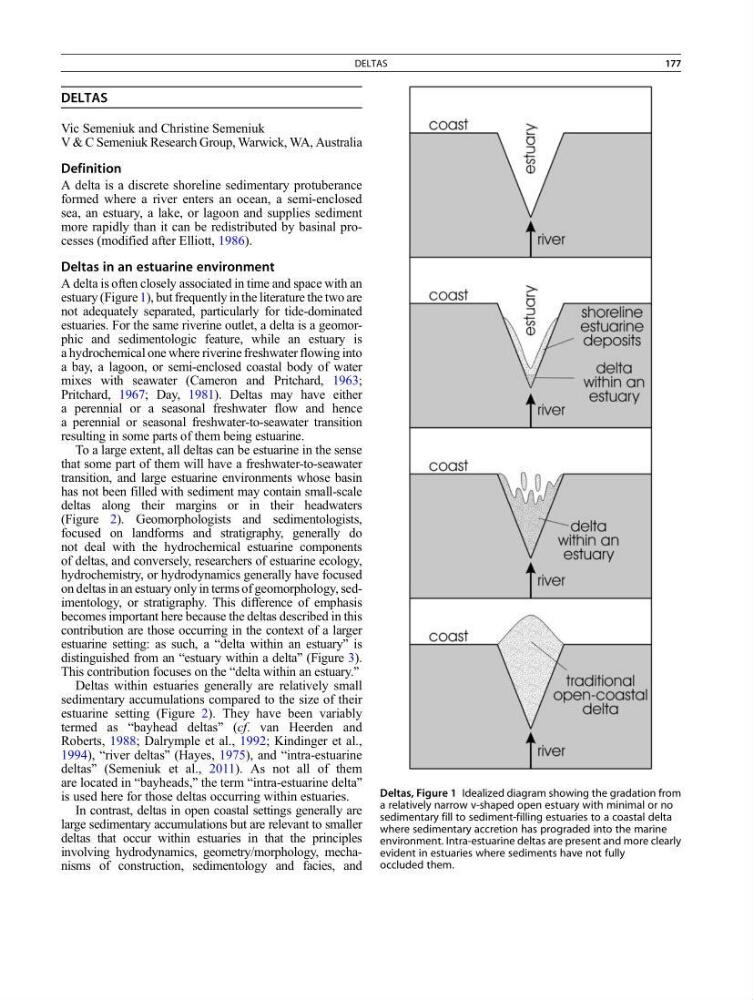
estuary (Figure 1), but frequently in the literature the two are
not adequately separated, particularly for tide-dominated
estuaries. For the same riverine outlet, a delta is a geomorphic and sedimentologic feature, while an estuary is
a hydrochemical one where riverine freshwater flowing into
a bay, a lagoon, or semi-enclosed coastal body of water
mixes with seawater (Cameron and Pritchard, 1963;
Pritchard, 1967; Day, 1981). Deltas may have either
a perennial or a seasonal freshwater flow and hence
a perennial or seasonal freshwater-to-seawater transition
resulting in some parts of them being estuarine.
To a large extent, all deltas can be estuarine in the sense
that some part of them will have a freshwater-to-seawater
transition, and large estuarine environments whose basin
has not been filled with sediment may contain small-scale
deltas along their margins or in their headwaters
(Figure 2). Geomorphologists and sedimentologists,
focused on landforms and stratigraphy, generally do
not deal with the hydrochemical estuarine components
of deltas, and conversely, researchers of estuarine ecology,
hydrochemistry, or hydrodynamics generally have focused
on deltas in an estuary only in terms of geomorphology, sedimentology, or stratigraphy. This difference of emphasis
becomes important here because the deltas described in this
contribution are those occurring in the context of a larger
estuarine setting: as such, a “delta within an estuary” is
distinguished from an “estuary within a delta” (Figure 3).
This contribution focuses on the “delta within an estuary.”
Deltas within estuaries generally are relatively small
sedimentary accumulations compared to the size of their
estuarine setting (Figure 2). They have been variably
termed as “bayhead deltas” (cf. van Heerden and
Roberts, 1988; Dalrymple et al., 1992; Kindinger et al.,
1994), “river deltas” (Hayes, 1975), and “intra-estuarine
deltas” (Semeniuk et al., 2011). As not all of them
are located in “bayheads,” the term “intra-estuarine delta”
is used here for those deltas occurring within estuaries.
In contrast, deltas in open coastal settings generally are
large sedimentary accumulations but are relevant to smaller
deltas that occur within estuaries in that the principles
involving hydrodynamics, geometry/morphology, mechanisms of construction, sedimentology and facies, and
Deltas, Figure 1 Idealized diagram showing the gradation from
a relatively narrow v-shaped open estuary with minimal or no
sedimentary fill to sediment-filling estuaries to a coastal delta
where sedimentary accretion has prograded into the marine
environment. Intra-estuarine deltas are present and more clearly
evident in estuaries where sediments have not fully
occluded them.
DELTAS
177
Vic Semeniuk and Christine Semeniuk
V & C Semeniuk Research Group, Warwick, WA, Australia
Definition
A delta is a discrete shoreline sedimentary protuberance
formed where a river enters an ocean, a semi-enclosed
sea, an estuary, a lake, or lagoon and supplies sediment
more rapidly than it can be redistributed by basinal processes (modified after Elliott, 1986).
Deltas in an estuarine environment
A delta is often closely associated in time and space with an
estuary (Figure 1), but frequently in the literature the two are
not adequately separated, particularly for tide-dominated
estuaries. For the same riverine outlet, a delta is a geomorphic and sedimentologic feature, while an estuary is
a hydrochemical one where riverine freshwater flowing into
a bay, a lagoon, or semi-enclosed coastal body of water
mixes with seawater (Cameron and Pritchard, 1963;
Pritchard, 1967; Day, 1981). Deltas may have either
a perennial or a seasonal freshwater flow and hence
a perennial or seasonal freshwater-to-seawater transition
resulting in some parts of them being estuarine.
To a large extent, all deltas can be estuarine in the sense
that some part of them will have a freshwater-to-seawater
transition, and large estuarine environments whose basin
has not been filled with sediment may contain small-scale
deltas along their margins or in their headwaters
(Figure 2). Geomorphologists and sedimentologists,
focused on landforms and stratigraphy, generally do
not deal with the hydrochemical estuarine components
of deltas, and conversely, researchers of estuarine ecology,
hydrochemistry, or hydrodynamics generally have focused
on deltas in an estuary only in terms of geomorphology, sedimentology, or stratigraphy. This difference of emphasis
becomes important here because the deltas described in this
contribution are those occurring in the context of a larger
estuarine setting: as such, a “delta within an estuary” is
distinguished from an “estuary within a delta” (Figure 3).
This contribution focuses on the “delta within an estuary.”
Deltas within estuaries generally are relatively small
sedimentary accumulations compared to the size of their
estuarine setting (Figure 2). They have been variably
termed as “bayhead deltas” (cf. van Heerden and
Roberts, 1988; Dalrymple et al., 1992; Kindinger et al.,
1994), “river deltas” (Hayes, 1975), and “intra-estuarine
deltas” (Semeniuk et al., 2011). As not all of them
are located in “bayheads,” the term “intra-estuarine delta”
is used here for those deltas occurring within estuaries.
In contrast, deltas in open coastal settings generally are
large sedimentary accumulations but are relevant to smaller
deltas that occur within estuaries in that the principles
involving hydrodynamics, geometry/morphology, mechanisms of construction, sedimentology and facies, and
Deltas, Figure 1 Idealized diagram showing the gradation from
a relatively narrow v-shaped open estuary with minimal or no
sedimentary fill to sediment-filling estuaries to a coastal delta
where sedimentary accretion has prograded into the marine
environment. Intra-estuarine deltas are present and more clearly
evident in estuaries where sediments have not fully
occluded them.
DELTAS
177