

effects of waves from the northeast played a significant
role (Martin and Suguio, 1992). It is clear that these plains
were related to deltas forming within large coastal lagoons
until the delta exceeded the body of these bays (Figure 4).
Two generations of beach ridges were linked to fluctuations of sea level in a generalized trend of sea-level fall
(Martin and Suguio, 1992). Some of these plains were
originally prograding cuspate headlands (esporoes or
pontales, as they are called in Brazil) which evolved later
into regressive spits.
In recent years, different riprap structures have been
constructed in order to control the river floods of the Magdalena River (Colombia). The modifications of the discharge channel between 1925 and 1935 produced
significant morphological changes (Martínez et al., 1995).
The east coast prograded 3.5 km in $50 years
(1943–1990). The two jetties constructed at the outlet
(Bocas de Ceniza, 1946–1954) reduced the outlet width
to 705 m (Correa et al., 2005; Alvarado Ortega, 2010).
On the western coast, the man-made obstruction of
longshore drift caused the disappearance of the Sabanilla,
Verde, del Medio, and Arena Islands (Martínez et al., 1995).
Processes and mechanisms
Within large estuaries and open coasts, sediment can be
distributed by different processes and mechanisms. As
a result, several major bedforms occur in these environments that can be distinguished: (1) cuspate spits,
(2) regressive spits, (3) cheniers, and (4) washovers.
Cuspate spits are common along elongated coastal
lagoons where either wind or tidal currents cause
resonance effects, resulting in nodal points where currents
counteract and sediment is deposited. This process leads
to the septation of coastal lagoons as described by
Zenkovitch (1959). It should be stressed that the septation
or segmentation is due to estuarine processes (Bird, 2002).
The septation of coastal lagoons explains why some cuspate spits are small points, while others are very long
and always perpendicular to the main flow (Figure 4).
Some of these cuspate spits can increase in size at a fast
rate: the Pontal das Desertas (Lagoa dos Patos, Brazil)
prograded about 3,400 m in 57 years toward the southeast
(Toldo, 1991). At the region of Laguna (Santa Catarina,
Brazil), two beach-ridge plains were compared in their
development. The Rio do Meio and Campos Verdes plains
(Laguna, Santa Catarina, Brazil) evolved from cuspate
spits that divided the mid-Holocene coastal lagoon in the
last 5,000 years (Fornari, 2010; Tanaka, 2010). The sediment delivered to this mid-Holocene coastal lagoon by
the Tubarão River initially divided the northern lagoons
(Santo Antonio and Santa Marta) and afterward the
Camacho and Santa Marta lagoons (Nascimento, 2010;
Figure 4).
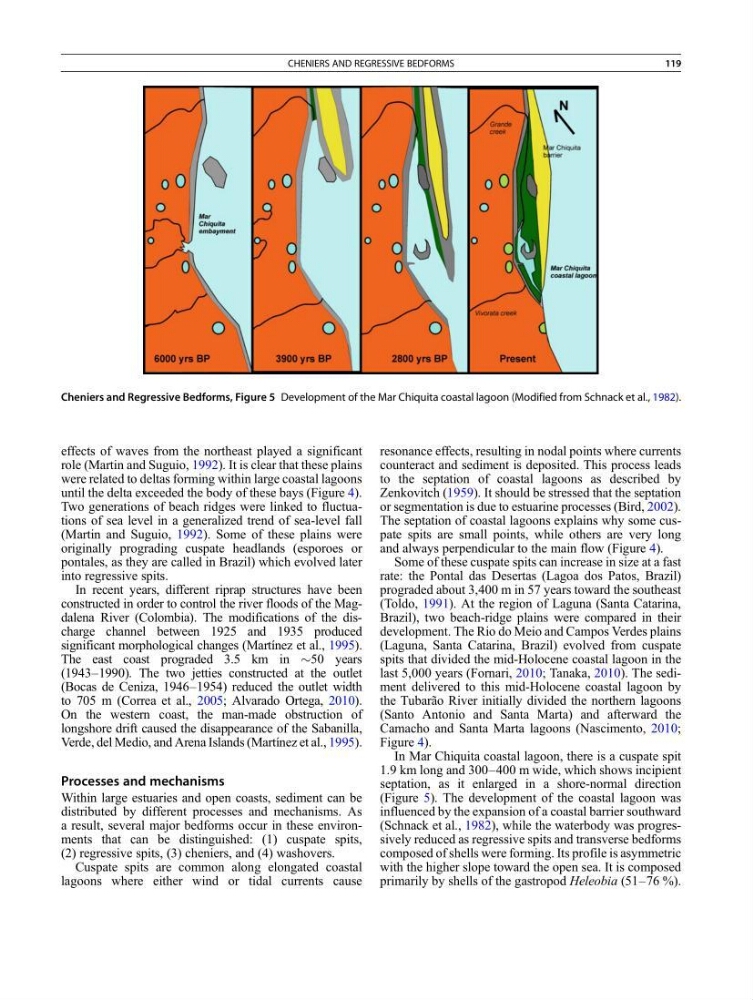
In Mar Chiquita coastal lagoon, there is a cuspate spit
1.9 km long and 300–400 m wide, which shows incipient
septation, as it enlarged in a shore-normal direction
(Figure 5). The development of the coastal lagoon was
influenced by the expansion of a coastal barrier southward
(Schnack et al., 1982), while the waterbody was progressively reduced as regressive spits and transverse bedforms
composed of shells were forming. Its profile is asymmetric
with the higher slope toward the open sea. It is composed
primarily by shells of the gastropod Heleobia (51–76 %).
Cheniers and Regressive Bedforms, Figure 5 Development of the Mar Chiquita coastal lagoon (Modified from Schnack et al., 1982).
CHENIERS AND REGRESSIVE BEDFORMS
119
role (Martin and Suguio, 1992). It is clear that these plains
were related to deltas forming within large coastal lagoons
until the delta exceeded the body of these bays (Figure 4).
Two generations of beach ridges were linked to fluctuations of sea level in a generalized trend of sea-level fall
(Martin and Suguio, 1992). Some of these plains were
originally prograding cuspate headlands (esporoes or
pontales, as they are called in Brazil) which evolved later
into regressive spits.
In recent years, different riprap structures have been
constructed in order to control the river floods of the Magdalena River (Colombia). The modifications of the discharge channel between 1925 and 1935 produced
significant morphological changes (Martínez et al., 1995).
The east coast prograded 3.5 km in $50 years
(1943–1990). The two jetties constructed at the outlet
(Bocas de Ceniza, 1946–1954) reduced the outlet width
to 705 m (Correa et al., 2005; Alvarado Ortega, 2010).
On the western coast, the man-made obstruction of
longshore drift caused the disappearance of the Sabanilla,
Verde, del Medio, and Arena Islands (Martínez et al., 1995).
Processes and mechanisms
Within large estuaries and open coasts, sediment can be
distributed by different processes and mechanisms. As
a result, several major bedforms occur in these environments that can be distinguished: (1) cuspate spits,
(2) regressive spits, (3) cheniers, and (4) washovers.
Cuspate spits are common along elongated coastal
lagoons where either wind or tidal currents cause
resonance effects, resulting in nodal points where currents
counteract and sediment is deposited. This process leads
to the septation of coastal lagoons as described by
Zenkovitch (1959). It should be stressed that the septation
or segmentation is due to estuarine processes (Bird, 2002).
The septation of coastal lagoons explains why some cuspate spits are small points, while others are very long
and always perpendicular to the main flow (Figure 4).
Some of these cuspate spits can increase in size at a fast
rate: the Pontal das Desertas (Lagoa dos Patos, Brazil)
prograded about 3,400 m in 57 years toward the southeast
(Toldo, 1991). At the region of Laguna (Santa Catarina,
Brazil), two beach-ridge plains were compared in their
development. The Rio do Meio and Campos Verdes plains
(Laguna, Santa Catarina, Brazil) evolved from cuspate
spits that divided the mid-Holocene coastal lagoon in the
last 5,000 years (Fornari, 2010; Tanaka, 2010). The sediment delivered to this mid-Holocene coastal lagoon by
the Tubarão River initially divided the northern lagoons
(Santo Antonio and Santa Marta) and afterward the
Camacho and Santa Marta lagoons (Nascimento, 2010;
Figure 4).
In Mar Chiquita coastal lagoon, there is a cuspate spit
1.9 km long and 300–400 m wide, which shows incipient
septation, as it enlarged in a shore-normal direction
(Figure 5). The development of the coastal lagoon was
influenced by the expansion of a coastal barrier southward
(Schnack et al., 1982), while the waterbody was progressively reduced as regressive spits and transverse bedforms
composed of shells were forming. Its profile is asymmetric
with the higher slope toward the open sea. It is composed
primarily by shells of the gastropod Heleobia (51–76 %).
Cheniers and Regressive Bedforms, Figure 5 Development of the Mar Chiquita coastal lagoon (Modified from Schnack et al., 1982).
CHENIERS AND REGRESSIVE BEDFORMS
119