

the activities of opportunistic communities that developed
understressed conditions (brackish waters) in transgressive sediments overlying coplanar surfaces. The outer
zone of the estuary displays fully or almost fully marine
conditions, and the possible trace assemblages reflect the
activities of organisms that include deposit feeders, predators, and suspension feeders in intertidal to subtidal
settings. However, high-energy and rapidly migrating
bedforms generally preclude the establishment of
a mobile epifaunal and/or shallow infaunal biota
(Buatois and Mangano, 2003).
Summary
Trace fossils can be retained as both paleontological and
sedimentological entities because they represent not only
the morphology and ethology of the tracemakers but also
the physical characteristics of the substrate on which the
tracemakers lived. In this sense, biogenic sedimentary
structures can make meaningful contributions to numerous research fields in the earth sciences, with an integrated
approach that articulates ichnological information with
other sources of data. This is a good approach to reconstruct ancient depositional settings, which notably takes
advantage of the integration of both sedimentological/
stratigraphic and ichnological data. In marginal-marine
environments (including estuaries), trace fossil assemblages play a major role in distinguishing open-marine,
brackish-water, and freshwater/terrestrial deposits.
Bibliography
Bromley, R. G., 1996. Trace Fossils. London: Unwin Hyman.
Bromley, R. G., and Fürsich, F. T., 1980. Comments on the proposed amendments to the international code of zoological
nomenclature regarding ichnotaxa Z.N. (S.) 1973. Bulletin of
Zoological Nomenclature, 37, 6–10.
Buatois, L. A., and Mangano, M. G., 2003. Sedimentary facies and
depositional evolution of the Upper Cambrian to Lower Ordovician Santa Rosita Formation in northwest Argentina. Journal of
South American Earth Sciences, 16, 343–363.
Buatois, L. A., and Mangano, M. G., 2011. Ichnology. Cambridge:
Cambridge University Press.
Dalrymple, R. W., 1992. Tidal depositional system. In Walker, R. G.,
and James, N. P. (eds.), Facies Models and Sea Level Changes.
St. John’s: Geological Association of Canada, pp. 195–218.
Dalrymple, R. W., Zaitlin, B. A., and Boyd, R., 1992. Estuarine
facies models: conceptual basis and stratigraphic implications.
Journal of Sedimentary Petrology, 62, 1130–1146.
De Glbert, J. M., Domenech, R., and Martimell J., 2004. An ethological framework for animal bioerosion trace fossils upon mineral substrates with proposal of a new class, fixinia. Lethaia, 37,
429–437.
Ekdale, A. A., 1985. Paleoecology of the marine endobenthos.
Palaeogeography Palaeoclimatology Palaeoecology, 50, 63–81.
Ekdale, A. A., Bromley, R. G., and Pemberton, S. G., 1984.
Ichnology, Trace Fossils in Sedimentology and Stratigraphy.
Society of Economic Paleontologists and Mineralogists: Tulsa.
SEPM Short Course, Vol. 15.
Frey, R. W., 1971. Ichnology: the study of fossil and recent
lebensspuren. In Perkins, B. F. (ed.), Trace Fossils, A Field
Guide to Selected Localities in Pennsylvanian, Permian, Cretaceous and Tertiary Rocks of Texas, and Related Papers. Baton
Rouge: Lousiana, USA. Louisiana State University School of
Geoscience, Miscellaneous Publication, Vol. 71, pp. 91–125.
Frey, R. W., 1973. Concepts in the study of biogenic sedimentary
structures. Journal of Sedimentary Petrology, 43, 6–19.
Frey, R. W., and Pemberton, S. G., 1984. Trace fossils facies
models. In Walker, R. G. (ed.), Facies Models. Toronto: Geological Association of Canada Publications. Geoscience Canada
Reprint Series, pp. 189–207.
Frey, R. W., and Pemberton, S. G., 1985. Biogenic structures in outcrops and cores. I. Approaches to ichnology. Bulletin of Canadian Petroleum Geology, 33, 72–115.
ICZN, 1999. International code of zoological nomenclature,
adopted by the international union of biological sciences, 4th
edition. International Trust for Zoological nomenclature,
London.
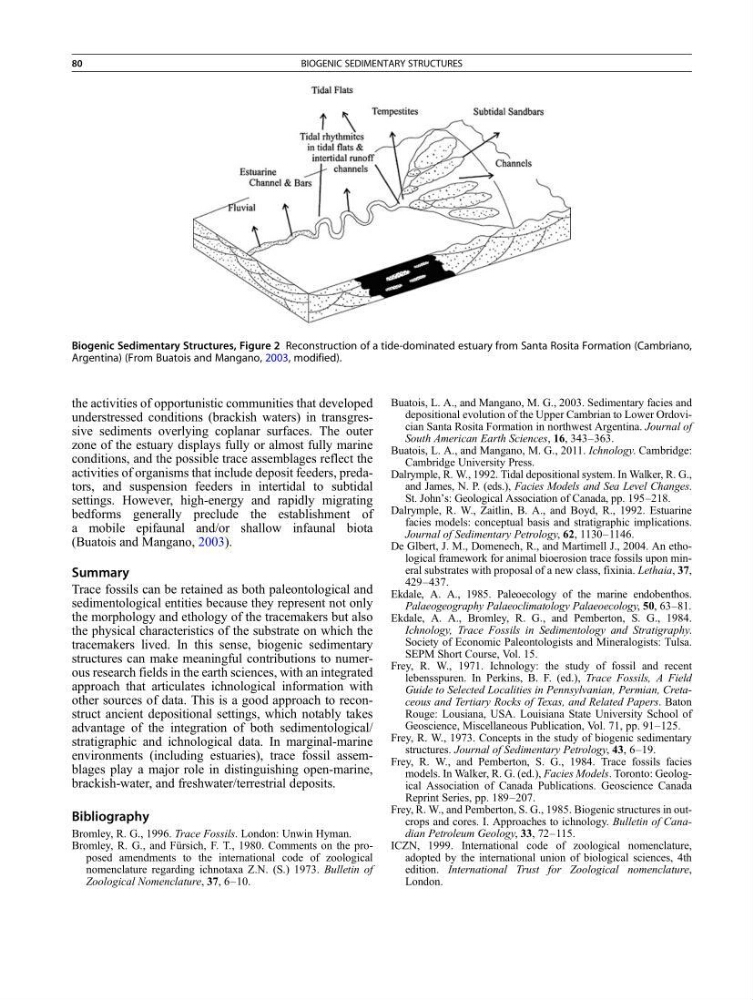
Biogenic Sedimentary Structures, Figure 2 Reconstruction of a tide-dominated estuary from Santa Rosita Formation (Cambriano,
Argentina) (From Buatois and Mangano, 2003, modified).
80
BIOGENIC SEDIMENTARY STRUCTURES
understressed conditions (brackish waters) in transgressive sediments overlying coplanar surfaces. The outer
zone of the estuary displays fully or almost fully marine
conditions, and the possible trace assemblages reflect the
activities of organisms that include deposit feeders, predators, and suspension feeders in intertidal to subtidal
settings. However, high-energy and rapidly migrating
bedforms generally preclude the establishment of
a mobile epifaunal and/or shallow infaunal biota
(Buatois and Mangano, 2003).
Summary
Trace fossils can be retained as both paleontological and
sedimentological entities because they represent not only
the morphology and ethology of the tracemakers but also
the physical characteristics of the substrate on which the
tracemakers lived. In this sense, biogenic sedimentary
structures can make meaningful contributions to numerous research fields in the earth sciences, with an integrated
approach that articulates ichnological information with
other sources of data. This is a good approach to reconstruct ancient depositional settings, which notably takes
advantage of the integration of both sedimentological/
stratigraphic and ichnological data. In marginal-marine
environments (including estuaries), trace fossil assemblages play a major role in distinguishing open-marine,
brackish-water, and freshwater/terrestrial deposits.
Bibliography
Bromley, R. G., 1996. Trace Fossils. London: Unwin Hyman.
Bromley, R. G., and Fürsich, F. T., 1980. Comments on the proposed amendments to the international code of zoological
nomenclature regarding ichnotaxa Z.N. (S.) 1973. Bulletin of
Zoological Nomenclature, 37, 6–10.
Buatois, L. A., and Mangano, M. G., 2003. Sedimentary facies and
depositional evolution of the Upper Cambrian to Lower Ordovician Santa Rosita Formation in northwest Argentina. Journal of
South American Earth Sciences, 16, 343–363.
Buatois, L. A., and Mangano, M. G., 2011. Ichnology. Cambridge:
Cambridge University Press.
Dalrymple, R. W., 1992. Tidal depositional system. In Walker, R. G.,
and James, N. P. (eds.), Facies Models and Sea Level Changes.
St. John’s: Geological Association of Canada, pp. 195–218.
Dalrymple, R. W., Zaitlin, B. A., and Boyd, R., 1992. Estuarine
facies models: conceptual basis and stratigraphic implications.
Journal of Sedimentary Petrology, 62, 1130–1146.
De Glbert, J. M., Domenech, R., and Martimell J., 2004. An ethological framework for animal bioerosion trace fossils upon mineral substrates with proposal of a new class, fixinia. Lethaia, 37,
429–437.
Ekdale, A. A., 1985. Paleoecology of the marine endobenthos.
Palaeogeography Palaeoclimatology Palaeoecology, 50, 63–81.
Ekdale, A. A., Bromley, R. G., and Pemberton, S. G., 1984.
Ichnology, Trace Fossils in Sedimentology and Stratigraphy.
Society of Economic Paleontologists and Mineralogists: Tulsa.
SEPM Short Course, Vol. 15.
Frey, R. W., 1971. Ichnology: the study of fossil and recent
lebensspuren. In Perkins, B. F. (ed.), Trace Fossils, A Field
Guide to Selected Localities in Pennsylvanian, Permian, Cretaceous and Tertiary Rocks of Texas, and Related Papers. Baton
Rouge: Lousiana, USA. Louisiana State University School of
Geoscience, Miscellaneous Publication, Vol. 71, pp. 91–125.
Frey, R. W., 1973. Concepts in the study of biogenic sedimentary
structures. Journal of Sedimentary Petrology, 43, 6–19.
Frey, R. W., and Pemberton, S. G., 1984. Trace fossils facies
models. In Walker, R. G. (ed.), Facies Models. Toronto: Geological Association of Canada Publications. Geoscience Canada
Reprint Series, pp. 189–207.
Frey, R. W., and Pemberton, S. G., 1985. Biogenic structures in outcrops and cores. I. Approaches to ichnology. Bulletin of Canadian Petroleum Geology, 33, 72–115.
ICZN, 1999. International code of zoological nomenclature,
adopted by the international union of biological sciences, 4th
edition. International Trust for Zoological nomenclature,
London.
Biogenic Sedimentary Structures, Figure 2 Reconstruction of a tide-dominated estuary from Santa Rosita Formation (Cambriano,
Argentina) (From Buatois and Mangano, 2003, modified).
80
BIOGENIC SEDIMENTARY STRUCTURES