

important classifications include preservational, phylogenetic, and behavioral schemes, although virtually all
classifications are to some extent genetic because they presuppose that the structures were produced biogenically.
The preservational aspect takes into account two main
facets: (1) the physiochemical processes of preservation
and alteration and (2) the toponomy (or stratinomy). The
former facet falls within the realm of diagenesis, which
is of paramount importance in trace fossil preservation;
nevertheless, no classification based on diagenetic features is yet available. The latter focuses on the description
and classification of biogenic structures in terms of
their mode of preservation and occurrence. Toponomic
schemes have been devised by various authors
(e.g., Simpson, 1957; Seilacher, 1964; Martinsson,
1970), and most of these relate to the position of a trace
fossil to the main casting medium. The schemes of
Martinsson (1970) and Seilacher (1964) have a lot in common and have gained the greatest acceptance.
Phylogenetic classification attempts to establish
a correspondence between a trace fossil and the potential
producer, a fascinating target but very difficult to reach.
This is because ichnofossils usually reflect animal behavior and reflect their anatomy or morphology to a much
smaller extent. As stated in the previous section, a single
taxon may construct different biogenic structures, and
conversely, identical (or very similar) structures may be
made by different taxa. It is sometimes possible to match
tracemaker and trace fossil, but this problem must be
approached with caution, bearing in mind that generalizations should be avoided and each occurrence of a given
ichnofossil must be treated on an individual basis.
Above all, trace fossils are good indicators of the
behavior of animals, and it is therefore not surprising that
ethological classification has been extremely successful.
The original scheme proposed by Seilacher (1953), based
on five categories, has been progressively modified and
enlarged by various authors; among them are Frey
(1973), Ekdale et al. (1984), Ekdale (1985), and Bromley
(1996). Frey and Pemberton (1985) suggested that categories be restricted in number and that new proposals are
only justified if they are well founded on new behaviors.
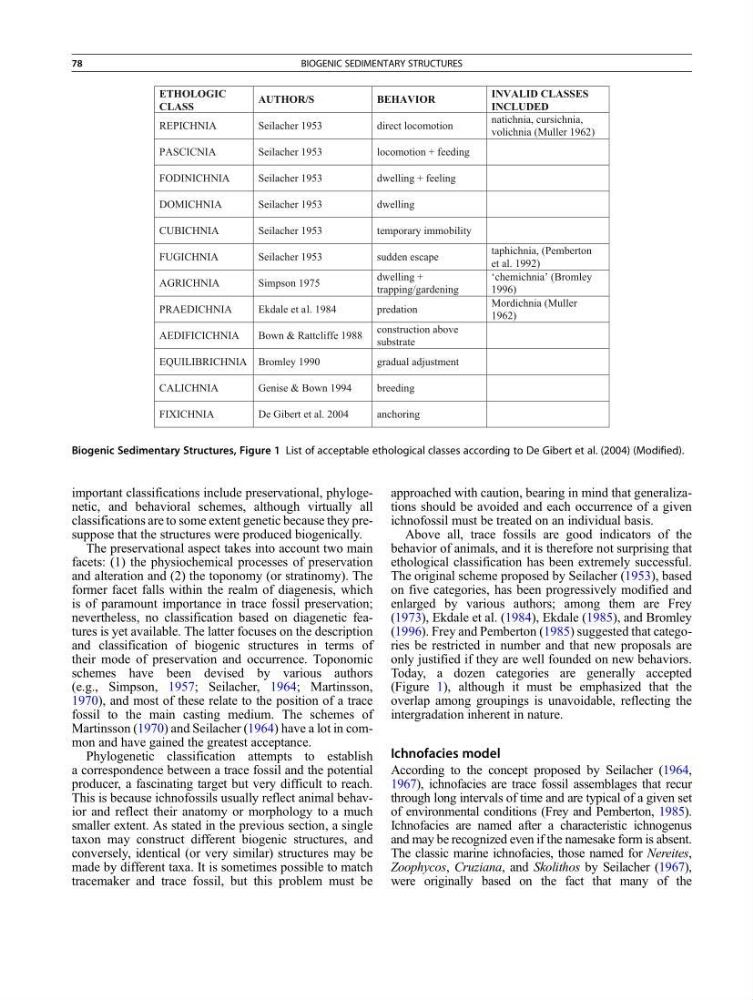
Today, a dozen categories are generally accepted
(Figure 1), although it must be emphasized that the
overlap among groupings is unavoidable, reflecting the
intergradation inherent in nature.
Ichnofacies model
According to the concept proposed by Seilacher (1964,
1967), ichnofacies are trace fossil assemblages that recur
through long intervals of time and are typical of a given set
of environmental conditions (Frey and Pemberton, 1985).
Ichnofacies are named after a characteristic ichnogenus
and may be recognized even if the namesake form is absent.
The classic marine ichnofacies, those named for Nereites,
Zoophycos, Cruziana, and Skolithos by Seilacher (1967),
were originally based on the fact that many of the
ETHOLOGIC
CLASS
AUTHOR/S
BEHAVIOR
INVALID CLASSES
INCLUDED
REPICHNIA
Seilacher 1953
direct locomotion
natichnia, cursichnia,
volichnia (Muller 1962)
PASCICNIA
Seilacher 1953
locomotion + feeding
FODINICHNIA
Seilacher 1953
dwelling + feeling
DOMICHNIA
Seilacher 1953
dwelling
CUBICHNIA
Seilacher 1953
temporary immobility
FUGICHNIA
Seilacher 1953
sudden escape
taphichnia, (Pemberton
et al. 1992)
AGRICHNIA
Simpson 1975
dwelling +
trapping/gardening
‘chemichnia’ (Bromley
1996)
PRAEDICHNIA
Ekdale et al. 1984
predation
Mordichnia (Muller
1962)
AEDIFICICHNIA
Bown & Rattcliffe 1988
construction above
substrate
EQUILIBRICHNIA Bromley 1990
gradual adjustment
CALICHNIA
Genise & Bown 1994
breeding
FIXICHNIA
De Gibert et al. 2004
anchoring
Biogenic Sedimentary Structures, Figure 1 List of acceptable ethological classes according to De Gibert et al. (2004) (Modified).
78
BIOGENIC SEDIMENTARY STRUCTURES
classifications are to some extent genetic because they presuppose that the structures were produced biogenically.
The preservational aspect takes into account two main
facets: (1) the physiochemical processes of preservation
and alteration and (2) the toponomy (or stratinomy). The
former facet falls within the realm of diagenesis, which
is of paramount importance in trace fossil preservation;
nevertheless, no classification based on diagenetic features is yet available. The latter focuses on the description
and classification of biogenic structures in terms of
their mode of preservation and occurrence. Toponomic
schemes have been devised by various authors
(e.g., Simpson, 1957; Seilacher, 1964; Martinsson,
1970), and most of these relate to the position of a trace
fossil to the main casting medium. The schemes of
Martinsson (1970) and Seilacher (1964) have a lot in common and have gained the greatest acceptance.
Phylogenetic classification attempts to establish
a correspondence between a trace fossil and the potential
producer, a fascinating target but very difficult to reach.
This is because ichnofossils usually reflect animal behavior and reflect their anatomy or morphology to a much
smaller extent. As stated in the previous section, a single
taxon may construct different biogenic structures, and
conversely, identical (or very similar) structures may be
made by different taxa. It is sometimes possible to match
tracemaker and trace fossil, but this problem must be
approached with caution, bearing in mind that generalizations should be avoided and each occurrence of a given
ichnofossil must be treated on an individual basis.
Above all, trace fossils are good indicators of the
behavior of animals, and it is therefore not surprising that
ethological classification has been extremely successful.
The original scheme proposed by Seilacher (1953), based
on five categories, has been progressively modified and
enlarged by various authors; among them are Frey
(1973), Ekdale et al. (1984), Ekdale (1985), and Bromley
(1996). Frey and Pemberton (1985) suggested that categories be restricted in number and that new proposals are
only justified if they are well founded on new behaviors.
Today, a dozen categories are generally accepted
(Figure 1), although it must be emphasized that the
overlap among groupings is unavoidable, reflecting the
intergradation inherent in nature.
Ichnofacies model
According to the concept proposed by Seilacher (1964,
1967), ichnofacies are trace fossil assemblages that recur
through long intervals of time and are typical of a given set
of environmental conditions (Frey and Pemberton, 1985).
Ichnofacies are named after a characteristic ichnogenus
and may be recognized even if the namesake form is absent.
The classic marine ichnofacies, those named for Nereites,
Zoophycos, Cruziana, and Skolithos by Seilacher (1967),
were originally based on the fact that many of the
ETHOLOGIC
CLASS
AUTHOR/S
BEHAVIOR
INVALID CLASSES
INCLUDED
REPICHNIA
Seilacher 1953
direct locomotion
natichnia, cursichnia,
volichnia (Muller 1962)
PASCICNIA
Seilacher 1953
locomotion + feeding
FODINICHNIA
Seilacher 1953
dwelling + feeling
DOMICHNIA
Seilacher 1953
dwelling
CUBICHNIA
Seilacher 1953
temporary immobility
FUGICHNIA
Seilacher 1953
sudden escape
taphichnia, (Pemberton
et al. 1992)
AGRICHNIA
Simpson 1975
dwelling +
trapping/gardening
‘chemichnia’ (Bromley
1996)
PRAEDICHNIA
Ekdale et al. 1984
predation
Mordichnia (Muller
1962)
AEDIFICICHNIA
Bown & Rattcliffe 1988
construction above
substrate
EQUILIBRICHNIA Bromley 1990
gradual adjustment
CALICHNIA
Genise & Bown 1994
breeding
FIXICHNIA
De Gibert et al. 2004
anchoring
Biogenic Sedimentary Structures, Figure 1 List of acceptable ethological classes according to De Gibert et al. (2004) (Modified).
78
BIOGENIC SEDIMENTARY STRUCTURES